

Your psychiatrist visit cost in Ohio depends on the appointment type, the provider’s billing arrangements, and how your insurance plan applies its benefits; there is no single statewide amount that tells you what you will owe. Medication, testing, and other separately billed services can add to your expenses, so confirm both the appointment charge and your expected share before booking.
At a glance
- Request an estimate for your appointment and payment arrangement; a statewide figure cannot tell you what you will owe.
- Compare an initial psychiatric evaluation with medication management follow-ups; they are different appointments.
- Insurance coverage does not mean your visit has no out-of-pocket expense.
- SOS Wellness provides outpatient psychiatry and medication management for children and adults in Ohio.
How much does a psychiatrist visit cost in Ohio?
The useful number is your expected out-of-pocket amount for the specific appointment you need. An office’s billed charge, an insurer’s allowed amount, and the amount you owe are different figures. Ask which figure an estimate represents before using it to plan your care.
An initial psychiatric evaluation and an established-patient follow-up are different services. A visit that includes psychotherapy can also involve different billing from a medication-focused appointment. Describe what you are booking rather than asking only for the cost of seeing a psychiatrist.
Sos-wellness provides psychiatry, therapy, medication management, addiction treatment, and telehealth mental health services in Ohio. Confirm the appointment type and billing arrangements directly before scheduling; a service description alone does not establish your insurance benefits.
| Payment arrangement | Potential fit | What to confirm | Main limitation |
|---|---|---|---|
| In-network insurance | Using a participating provider under your plan | Network status, deductible, copay, and coinsurance | Covered care can still leave you with a bill |
| Out-of-network insurance | Seeing a clinician outside your plan’s network | Whether benefits apply and how reimbursement works | Your plan might not reimburse the visit |
| Self-pay | Paying directly without submitting the visit through insurance | Written estimate and what the appointment includes | Do not assume the payment counts toward your deductible |
These are payment arrangements, not rankings of care quality. Choose appropriate clinical care, then verify how you will pay for it.
Why this matters
An unclear estimate makes it harder to start care and keep attending appointments. Understanding the bill helps you plan without treating an advertised visit charge as the full cost of treatment.
Check benefits for your appointment date rather than relying on an earlier explanation of coverage. Network participation, your remaining deductible, and the service being billed all matter to your personal estimate.
You do not need to understand medical billing terminology before asking for help. Start with a plain question: what would I be responsible for paying for this appointment, and what could be billed separately?
Initial psychiatric evaluation: ask what the estimate includes
An initial psychiatric evaluation reviews your symptoms, health history, current medications, and treatment needs. The clinician uses that assessment to discuss a treatment plan; the appointment does not automatically mean you will receive a prescription.
When requesting an estimate, identify whether you are booking for yourself or a child and whether you are a new patient. Ask whether the estimate covers the evaluation alone or any additional service delivered during the appointment.
Use these questions:
- Is this appointment a psychiatric evaluation or another type of assessment?
- Does the estimate apply to the clinician I will actually see?
- Can another service be billed during the same visit?
- Are testing or laboratory services included or billed separately?
- What payment is expected when I arrive?
An evaluation estimate should describe the service, not just an amount. If the office recommends a different appointment after reviewing your needs, request an updated estimate before proceeding with nonurgent care.
Medication management follow-ups: plan beyond the first visit
Medication management appointments review symptoms, treatment response, side effects, and medication-related questions. Their purpose differs from the broader assessment at an initial evaluation, so request a separate follow-up estimate.
Do not assume that every return appointment will be billed identically. The services provided during a visit affect billing, and psychotherapy delivered alongside medication management can involve an additional charge.
Ask how the clinician determines follow-up frequency and what happens when your needs change. Your treatment schedule should reflect clinical needs, not an assumption that every patient follows the same timetable.
A practical budget includes more than the next appointment. Discuss prescription expenses and any recommended monitoring, while keeping medication decisions with your prescribing clinician. Do not stop or change psychiatric medication solely because a bill is unclear; contact the prescriber to discuss the problem.
Telehealth psychiatry: verify benefits for the actual service
A video appointment changes how you attend care, but it does not by itself establish what you will owe. Confirm telehealth benefits with your insurer and billing details with the office.
For a telehealth psychiatry appointment, give the insurer the clinician’s name and explain that the visit will happen by video. Ask whether the plan applies different requirements to virtual and office-based appointments. For SOS Wellness video visits, you must be physically in Ohio; staff must confirm whether your requested service and clinician are available through telehealth.
Telehealth can remove the need to travel to an office. Its limitation is that it does not replace every examination or level of care, and you need a setting where you can speak privately.
Do not assume that virtual care has a lower appointment charge. Compare the same service under the same insurance plan, and consider travel and privacy separately from the medical bill.
Why your psychiatrist visit cost varies
The main drivers are the service you receive and the rules governing payment. Focus on these factors when comparing estimates:
- Appointment type: An initial evaluation, medication follow-up, and psychotherapy are distinct services. Ask which service the estimate describes.
- Network status: Verify the individual clinician and practice location with your insurer. Accepting an insurance company is not the same as participating in every plan it sells.
- Deductible and cost-sharing: Your remaining deductible, copay, or coinsurance determines how covered expenses are divided between you and the plan.
- Services billed together: Psychotherapy, testing, or other services can affect the total when provided alongside an appointment.
- Visit format: Confirm benefits for the actual setting, including telehealth, rather than transferring an estimate from a different appointment format.
- Ongoing treatment needs: Follow-up visits, prescriptions, and recommended monitoring affect your overall treatment expenses, even when they are not part of the initial appointment bill.
These factors explain why another patient’s bill is not a reliable estimate for yours. Even people visiting the same office can have different insurance benefits and receive different services.
How do you get a useful estimate before booking?
Match the office’s service information with your insurer’s benefit information. Neither a general insurance summary nor an office’s appointment charge, taken alone, tells you everything about your expected responsibility.
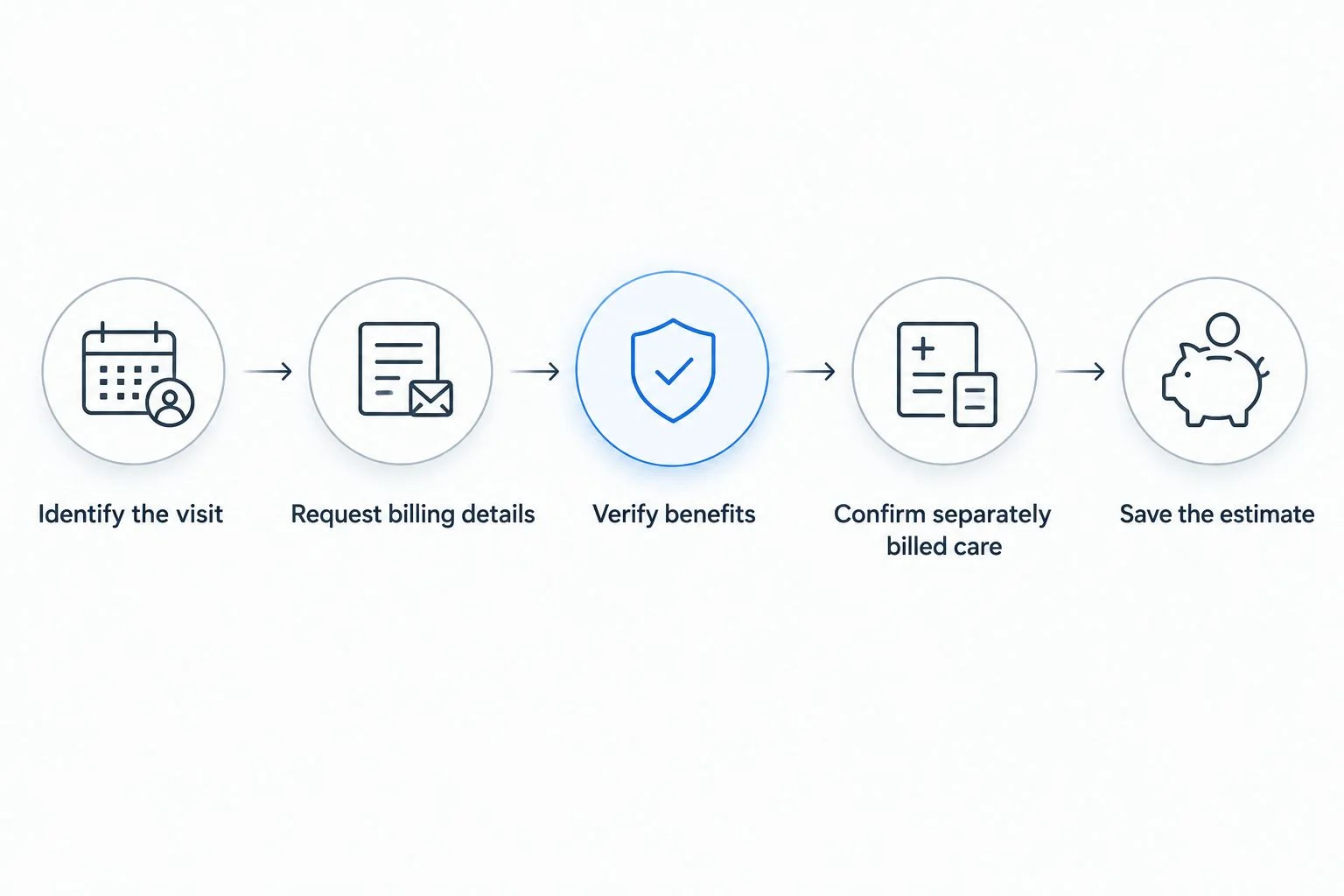
- Identify the visit. Ask whether you are scheduling an initial psychiatric evaluation, medication management, psychotherapy, or a combination of services.
- Request billing details. Ask the office for the clinician’s name, billing information, anticipated service codes if available, and an estimate describing included services.
- Verify benefits. Give those details to your insurer and ask about network status, deductible, copay, coinsurance, and any referral or authorization requirements.
- Confirm separately billed care. Ask about prescriptions, laboratory work, testing, and other services that are not included in the appointment estimate.
- Save the estimate. Keep the written estimate and your insurer’s reference information so you can compare them with later billing documents.
An estimate is not the same as a finalized insurance claim. If the appointment changes or additional services become necessary, ask the office how those changes affect the estimate.
For appointments scheduled later, recheck information if your insurance coverage changes before the visit. Keep the appointment date, clinician, and service description together so you are comparing the same details.
Does insurance cover psychiatrist visits in Ohio?
Insurance benefits depend on your specific plan and the service you receive. Ask about outpatient mental health benefits, then verify the clinician’s network status and your payment responsibility.
Coverage does not mean the visit is fully paid. A covered appointment can still involve a deductible, copay, or coinsurance, and a plan can have requirements you must meet before receiving care.
If you have Medicaid, confirm participation in your particular managed care plan with both the insurer and the office. Do not treat coverage for one mental health service as proof that every program or clinician is covered.
Is self-pay simpler than using insurance?
Self-pay can make the office’s appointment charge easier to identify, but it does not automatically make treatment less expensive. Ask what is included and whether anything can be billed separately.
If you are uninsured or choosing not to use insurance, federal rules generally entitle you to a Good Faith Estimate for qualifying nonemergency care. If you schedule 3–9 business days ahead, the estimate is due within one business day of scheduling; for 10 or more business days ahead, it is due within three business days. You can also request an estimate before scheduling, with a response due within three business days. Scheduling only 0–2 business days ahead does not carry that advance-estimate entitlement. Separate providers or facilities may supply separate estimates, and an estimate is not a guaranteed final price. See CMS guidance on Good Faith Estimates.
If you hope to seek reimbursement afterward, confirm the process with your insurer first. An itemized receipt or superbill does not guarantee that your plan will reimburse you.
What if you cannot afford the recommended appointments?
Tell the office before canceling or changing treatment on your own. Ask about billing arrangements and whether the clinician can discuss other clinically appropriate care options; do not assume a discount or payment plan exists.
You can also ask your insurer to identify participating mental health clinicians or contact a community mental health organization about assessment and access options. Confirm eligibility and appointment details directly rather than assuming that a service is free.
SOS Wellness offers psychiatry and medication management for children and adults in Ohio; assessment determines appropriate care. SOS accepts Ohio Medicaid, including managed plans, but coverage for your exact plan, service and clinician, authorization requirements and patient costs need confirmation. Call 513-928-3339 to ask about fees, estimates and payment arrangements. Outpatient scheduling is not a substitute for emergency help.
What should you check after the appointment?
When you use insurance, compare the office’s bill with your insurer’s explanation of benefits. The explanation of benefits describes how the insurer processed the claim; it is not itself a bill.
Check the patient name, appointment date, clinician, and services listed. If the patient responsibility differs from what you expected, ask the insurer how it applied your benefits and ask the office to explain the charges.
For a disputed bill, keep the estimate, explanation of benefits, receipts, and correspondence together. Describe the specific discrepancy when you call, such as an unexpected out-of-network designation or a service you do not recognize.
FAQ
How much will I personally pay to see a psychiatrist in Ohio?
Your payment depends on the appointment, the clinician’s billing arrangements, and your insurance benefits. Request a service-specific estimate and verify your expected responsibility with your insurer before booking.
Is the first psychiatrist appointment billed the same as follow-ups?
An initial psychiatric evaluation and a follow-up are different services, so request an estimate for each. Do not assume the first appointment’s billing applies to every later visit.
Will my insurance pay for an online psychiatrist appointment?
Your plan’s telehealth benefits determine whether and how it covers the appointment. Confirm the individual clinician, service, and video format with your insurer.
Are psychiatric medications included in the appointment bill?
Prescription medication is generally a separate expense from the clinician’s appointment. Check your pharmacy benefits and ask the prescriber about medication-related financial concerns before changing treatment.
Can I ask for an estimate if I am not using insurance?
Yes. If you are uninsured or not using insurance, you can request a Good Faith Estimate for qualifying nonemergency care before scheduling; it is generally due within three business days of your request. Scheduling at least three business days ahead also triggers estimate requirements, with deadlines described in the self-pay section above. Visits booked only 0–2 business days ahead do not carry that advance-estimate entitlement. An estimate is not a price guarantee.
Does Sos-wellness provide psychiatric care for children and adults?
Sos-wellness provides psychiatry and other outpatient mental health services for children and adults in Ohio. Confirm the appropriate appointment and billing details directly before scheduling.
Should I wait for a billing estimate during a mental health emergency?
No, do not delay emergency help to obtain a billing estimate. Call 911 for immediate danger or a medical emergency; call or text 988 for suicide or mental health crisis support.
One last thing
Ask what the estimate leaves out. That question often clarifies more than asking for the appointment charge again: you need to distinguish the evaluation from prescriptions, testing, and future visits.
Before booking, write down the service, expected payment, and separately billed items in one place. Bring unresolved questions to the office rather than trying to infer your responsibility from someone else’s experience.
If you are in immediate danger or experiencing a medical emergency, call 911. For suicide or mental health crisis support, call or text 988. Financial planning should not delay urgent help.
Further reading
Related reading
This article provides general educational information and does not replace an individual clinical assessment. Contact your healthcare provider about your own care.