

There is no single statewide price for therapy without insurance in Ohio. Your self-pay cost depends on the provider, appointment type, session length, treatment schedule, and any agreed financial assistance. Ask for a written estimate that separates the first visit from ongoing care before booking.
At a glance
- To compare self-pay therapy costs in Ohio, request a written estimate rather than relying on a statewide average.
- Compare intake charges, ongoing sessions, appointment frequency, and cancellation terms before choosing a provider.
- Eligible uninsured and self-pay patients generally can receive a Good Faith Estimate on request or when scheduling care at least three business days ahead.
- SOS Wellness offers outpatient mental health services in Ohio; an assessment helps determine which services fit your needs.
How much does therapy cost without insurance in Ohio?
Your provider’s written self-pay estimate is the useful number—not an advertised average. Ask what you would pay for your specific appointment and whether the initial assessment has a different charge from follow-up therapy.
Sos-wellness provides therapy, psychiatry, medication management, addiction treatment, and telehealth mental health services for children and adults in Ohio. If you are seeking outpatient care, explain the service you need before requesting an estimate; a therapy appointment and a medication-management appointment are different services.
Use this unranked guide to compare appointment formats and identify what belongs in your estimate. These are general formats, not a statement that every provider offers each one. This guide is published by SOS Wellness, which also offers therapy services.
| Appointment format | Potential fit | Practical benefit | Limitation to check | What to ask about billing |
|---|---|---|---|---|
| Individual therapy | Focused work on your own concerns | Dedicated time with a therapist | Requires a workable ongoing schedule | Session length and follow-up charges |
| Group therapy | Working on shared concerns with peers | Offers peer interaction and therapist guidance | Less individual attention; clinical fit matters | Whether intake and group meetings are billed separately |
| Family therapy | Addressing concerns involving family relationships | Brings relevant family members into treatment | Participation and consent need planning | Who attends and how the appointment is billed |
| Telehealth therapy | Attending remotely when clinically appropriate | Removes travel to the appointment | Requires privacy, suitable technology, and clinical suitability | Whether the self-pay charge differs from in-person care |
Why this matters
A session charge does not tell you the full commitment. Your treatment schedule, initial assessment, and any separate services determine what you need to budget.
For a useful comparison, give each provider the same description of what you need. Comparing a brief follow-up appointment with a full initial assessment produces a misleading result, even when both are described as mental health visits.
Compare equivalent appointments before comparing totals. A clear estimate helps you decide whether you can maintain the recommended care, not just attend the first visit.
What should your therapy estimate include?
Ask for the expected charges in writing and keep a copy. A verbal explanation helps, but a written estimate gives you something specific to review when the appointment confirmation or bill arrives.
- Initial assessment. Ask whether the first appointment differs from ongoing therapy in length, purpose, or charge. Confirm whether another assessment is expected before treatment begins.
- Ongoing sessions. Request the self-pay charge for the appointment length the clinician expects to use. Clarify whether that charge changes when a session runs longer or uses a different format.
- Treatment schedule. Ask about the initial recommended frequency and when you will review it together. The schedule should reflect clinical need rather than an assumption that every patient needs the same plan.
- Separate services. Confirm whether psychiatric evaluation, medication management, testing, or other care would involve separate appointments and billing. Do not assume those services are included in therapy.
- Payment terms. Ask when payment is due and request the cancellation and missed-appointment policy. Also ask how the practice handles billing questions or a change in the treatment plan.
You can use this wording: Please send the self-pay estimate for my first appointment and ongoing therapy, including the expected session length, schedule, and any separately billed services.
That request keeps the conversation practical. You do not need to know billing terminology to ask what care involves and what you would be responsible for paying.
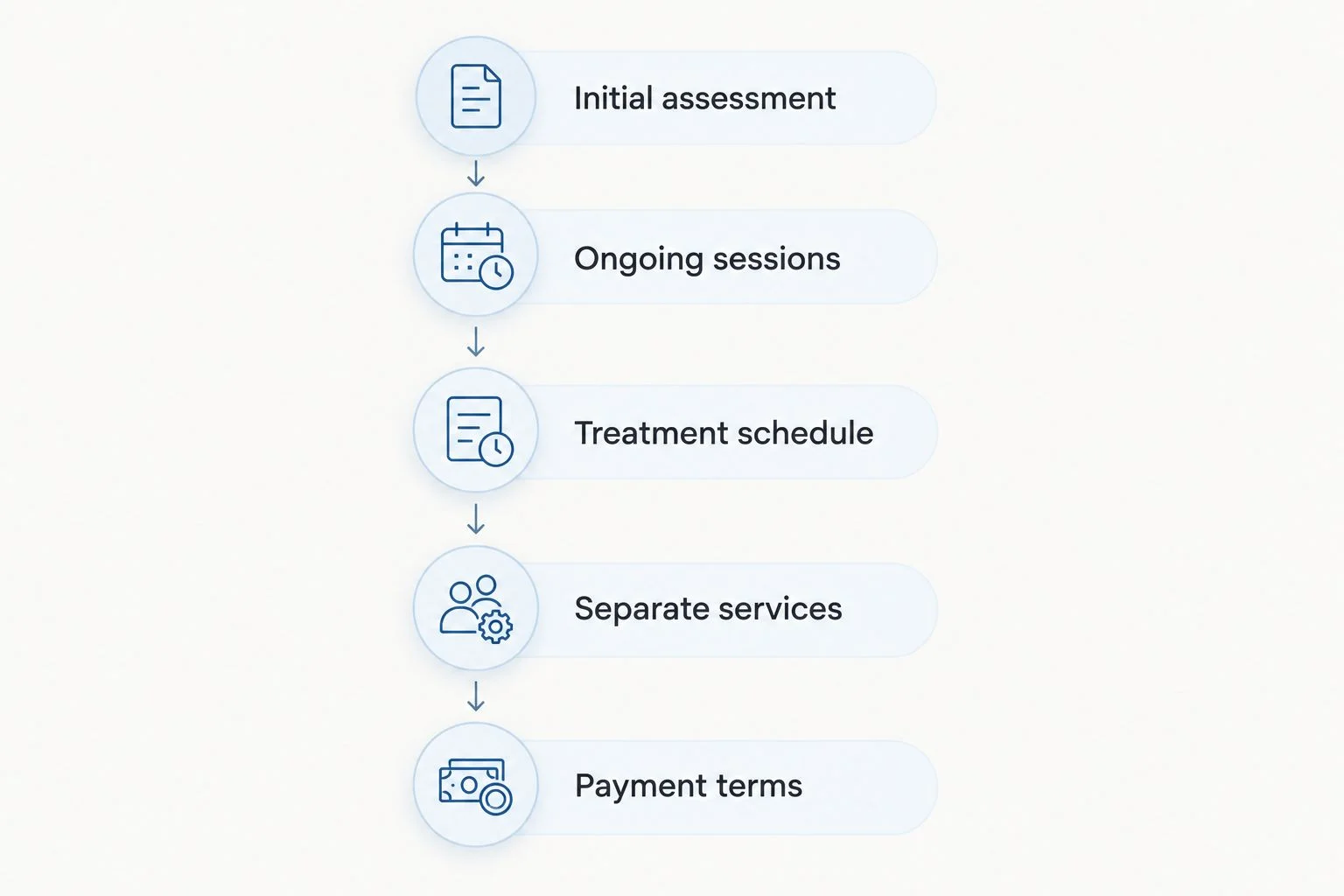
Compare the full treatment plan, not just the charge for a single appointment.
What is a Good Faith Estimate for therapy?
A Good Faith Estimate explains expected charges for scheduled healthcare. Under federal No Surprises Act protections, people who do not have insurance or are not using insurance generally have the right to receive one.
The Centers for Medicare & Medicaid Services explains these timing rules for eligible uninsured and self-pay patients. For appointments you arrange:
- Scheduled 3–9 business days ahead: the provider generally must give you the estimate within 1 business day after scheduling.
- Scheduled at least 10 business days ahead: the provider generally must give you the estimate within 3 business days after scheduling.
- Requested before scheduling: the provider generally must supply the estimate within 3 business days after your request.
These are federal estimate deadlines, not therapy-session lengths or promises about appointment access. An appointment scheduled less than 3 business days ahead does not trigger the same advance-estimate requirement.
Ask whether the estimate covers the first appointment or recurring therapy. A recurring-care estimate can cover up to 12 months and should describe the scope, frequency, and number of services; continued care then needs a renewed estimate. Separate clinicians or facilities may provide separate estimates, so request one from each involved in your care.
A Good Faith Estimate is not a guarantee that treatment needs will never change. If your clinician recommends additional care, ask for an explanation and an updated estimate before proceeding when possible. Keep the estimate and later bills together so you can check whether the services match.
How should you compare different therapy formats?
The right format depends on your treatment needs, privacy, and ability to attend. Choose a clinically appropriate service first, then compare its written terms.
Individual therapy: an option for focused personal work
Individual therapy gives you dedicated time to discuss your concerns with a therapist. Ask what the initial assessment covers and how the therapist will decide whether the treatment approach fits your goals.
The practical limitation is the ongoing commitment. Before beginning, explain any scheduling or payment constraints so you can discuss whether the proposed plan is workable rather than stopping unexpectedly later.
Group therapy: an option for shared therapeutic work
Group therapy brings people together around a treatment focus under professional guidance. Peer interaction can be part of the therapeutic work, but a group is not simply an interchangeable version of individual therapy.
Ask about screening, attendance expectations, confidentiality agreements, and whether individual appointments are also recommended. Do not assume a group program replaces another service or has a lower charge without checking.
Telehealth therapy: an option for avoiding travel
Telehealth lets you attend a therapy appointment remotely when the clinician considers it appropriate. It removes the journey to the office, but remote care does not automatically mean a lower session charge.
You still need a private place to speak and a suitable connection. For SOS telehealth, you must be physically in Ohio during visits. Ask what happens if the connection fails and how the clinician handles safety concerns; telehealth cannot provide on-site emergency monitoring.
Family therapy: an option for concerns involving relationships
Family therapy addresses concerns involving family members and their interactions. Ask who should attend, whose consent is needed, and how the clinician handles confidentiality.
For a child or teenager, clarify whether appointments include parent-only discussions or joint sessions. Understanding the planned format helps you request an estimate for the actual service rather than a generic therapy appointment.
Why your therapy total varies
Your therapy budget depends on more than the amount attached to a single booking. These are the details to clarify with each practice:
- Appointment purpose: an initial evaluation, ongoing therapy, and medication management involve different work. Confirm which service you are requesting.
- Session length: compare appointments of equivalent length. Ask how the practice handles a planned change in session duration.
- Attendance schedule: the recommended frequency determines how often a charge occurs. Review the schedule with your clinician as treatment progresses.
- Additional care: testing, psychiatric appointments, or other services can involve separate billing. Ask before assuming they are included.
- Practice policies: missed appointments, late cancellations, and payment arrangements affect your responsibilities. Request the written policy before booking.
Tell the practice about financial constraints during the first conversation. A clinician needs that information to discuss a plan you can realistically follow; it is not something you have to hide until a bill arrives.
How can you look for affordable therapy without insurance?
Ask practices whether they offer income-based fees or payment arrangements, how eligibility is determined, and whether an arrangement applies to ongoing treatment. Do not assume reduced fees or payment plans are available until confirmed. To ask SOS Wellness about self-pay charges and available arrangements, call 513-928-3339.
Community mental health providers and supervised university training clinics are other places to investigate. Ask whom they serve, how clinicians are supervised, what services they provide, and whether their care matches your needs. A referral suggestion is not confirmation of eligibility or an appointment.
You can also check Ohio Medicaid eligibility through official state resources. Eligibility depends on your circumstances, and coverage for a particular clinician or service needs separate confirmation.
If the recommended schedule is unaffordable, discuss that with your clinician as early as possible. Ask about clinically appropriate adjustments, payment arrangements, or lower-cost referrals so you can make an informed plan that considers both your budget and treatment needs.
Does online therapy cost less than in-person therapy?
Online therapy does not automatically have a lower self-pay charge than in-person therapy. Ask the same provider to explain the billing terms for each format rather than assuming the appointment location determines the charge.
Telehealth can remove travel and parking needs. Those practical differences matter, but they are separate from the clinician’s charge and should not replace a discussion about clinical fit.
Can you get therapy without having a diagnosis first?
You can contact a therapist without already having a diagnosis. The initial assessment is an opportunity to explain your symptoms, concerns, history, and goals so the clinician can recommend appropriate care.
Ask whether an intake assessment is required and whether it is billed separately. You do not need to diagnose yourself before requesting an appointment or a self-pay estimate.
What should you do if the bill differs from the estimate?
Ask the billing office for an itemized explanation and compare it with the written estimate. Check the appointment type, date, length, and any separately listed services before deciding what caused the difference.
Eligible uninsured or self-pay patients who received a Good Faith Estimate may use the federal patient-provider dispute process when a provider’s bill is at least $400 above that provider’s estimate. Filing generally must occur within 120 calendar days of receiving the initial bill. Review CMS dispute guidance promptly for eligibility and filing requirements; not every billing disagreement qualifies.
FAQ
What should I ask about therapy cost without insurance in Ohio?
Ask for a written self-pay estimate covering the initial assessment, ongoing session length, expected schedule, and separately billed services. Compare equivalent appointment types rather than relying on a statewide average.
Will my first therapy appointment be billed differently?
Your first therapy appointment can have different billing terms because it often includes an initial assessment. Ask the practice to separate intake and ongoing therapy in the written estimate.
Is online therapy always cheaper than office visits?
Online therapy is not automatically cheaper than an office visit. Confirm the provider’s self-pay terms for each format and consider travel needs separately.
Can I ask for a Good Faith Estimate before booking therapy?
Eligible uninsured and self-pay patients can request a Good Faith Estimate before scheduling. Federal guidance generally requires the provider to supply it within 3 business days of the request.
Does therapy include medication management?
Therapy does not automatically include medication management. Ask whether a prescribing appointment is recommended and whether it would be billed separately.
Does SOS Wellness provide mental health care for children and adults?
SOS Wellness provides mental health services for children and adults in Ohio, including therapy, psychiatry, medication management, addiction treatment, and telehealth. Ask which service fits your needs and request its self-pay terms.
What should I do if I need mental health help immediately?
Call 911 for immediate danger or a medical emergency, or call or text 988 for suicide and crisis support. Routine outpatient scheduling and billing questions should not delay urgent help.
One last thing
The most useful billing question is not just what a session costs—it is what the recommended plan includes. Before your first appointment, ask when you and the clinician will review progress, treatment frequency, and the plan’s financial demands.
Keep the written estimate somewhere you can find it. Clear expectations let you focus on care instead of trying to reconstruct a billing conversation later.
Further reading
Related reading
This article provides general educational information and does not replace an individual clinical assessment. Contact your healthcare provider about your own care.