

To prepare for your first psychiatric appointment, verify coverage, confirm an in-network clinician, complete intake, and prepare for the visit. SOS Wellness accepts Ohio Medicaid, including managed-care plans. Confirm your exact plan, clinician, service coverage, and appointment requirements before sending records or arranging care.
At a glance
- Start with active Medicaid coverage and clinician-level network confirmation.
- SOS Wellness accepts Ohio Medicaid, including managed-care plans; confirm your exact plan, clinician, and requested service before scheduling.
- Psychiatry, therapy, and telehealth describe different aspects of care; ask which appointment addresses your needs.
- Complete intake, prepare medication records, and confirm appointment instructions before your first psychiatric visit.
Why this matters
An office accepting Medicaid does not establish that a particular clinician participates in your specific plan. Coverage, network participation, referral requirements, and appointment scheduling are separate checks. Completing them in order helps you avoid repeating paperwork for the wrong appointment.
SOS Wellness offers outpatient mental health services for children, teens, and adults in Ohio. Its services include psychiatry, therapy, medication management, addiction treatment, and telehealth. The scheduling conversation still needs to establish which service fits your situation and whether your coverage applies.
Before making calls, distinguish the type of care from the way it is delivered:
| Care option | Potential fit | What it offers | Limitation to understand |
|---|---|---|---|
| Psychiatry | People seeking diagnostic assessment or medication evaluation | A medical assessment of mental health concerns and treatment options | An appointment does not guarantee a diagnosis or prescription |
| Therapy | People seeking help with emotions, behavior, coping, or relationships | Structured conversations and therapeutic treatment | Therapy alone does not include prescribing medication |
| Telehealth | People seeking a remote appointment when clinically appropriate | A way to receive eligible services remotely | It requires privacy, suitable technology, and confirmation that the service can be delivered remotely |
These options can overlap. A psychiatric appointment can take place through telehealth, and a treatment plan can include both psychiatry and therapy.
Before you start
- Gather coverage details. Have your Medicaid member information, current plan name, date of birth, and a reliable callback number. If you lack a card, ask your plan how to verify membership.
- Prepare care information. Collect your medication list, relevant records, preferred appointment format, and any caregiver or guardian documents the office requests. Use the office’s approved method for sensitive information.
- Check the non-obvious barrier. Ask whether the specific clinician is in network for your exact plan and accepting new patients in your age group. An office-wide answer is not enough.
For your coverage check, use current membership information rather than an old card or a saved directory entry. If coverage recently changed, resolve which plan is active before submitting intake paperwork.
Coverage check
- Verify active enrollment. Contact your Medicaid plan through its official member-services channel. Ask whether coverage is active for the intended appointment date and whether a managed-care plan administers your benefits.
- Ask about outpatient psychiatry. Explain that you need an initial psychiatric evaluation. Ask what network, referral, or authorization requirements apply to that service; do not assume another person’s requirements match yours.
- Check telehealth separately. If you want a remote visit, ask whether your plan covers that service and what conditions apply. Then confirm that the office offers an appropriate appointment format.
- Record the answer. Note the date, representative’s name or reference number when provided, and the next action. Keep this with your appointment information rather than relying on memory.
Expected result: You know which plan to give the office and which coverage questions remain unresolved. Active membership alone does not confirm that a particular appointment meets all plan requirements.
If you are applying for Medicaid rather than already enrolled, ask the relevant enrollment office about your application status. Tell the psychiatric office that coverage is not yet confirmed; do not describe a pending application as active insurance.
Keep your coverage notes separate from older paperwork. When the plan and office give different answers, ask them to clarify the exact clinician, service, and appointment format involved.
Provider check
- Request the right service. Tell the scheduler that you need a first psychiatric appointment, not only a general mental health appointment. Give the patient’s age and a brief description of the main concern.
- Confirm clinician-level participation. Provide your exact plan name and ask whether the proposed clinician participates. Ask the office how it verifies benefits before the visit.
- Check scheduling requirements. Ask whether you need a referral, prior records, an intake assessment, or another preliminary appointment. If a referral is required, clarify who must send it and how the office confirms receipt.
- Match the visit to your circumstances. Discuss in-person or telehealth preferences, accessibility needs, interpretation needs, and guardian participation. Ask what information the office needs to assess an appropriate appointment.
- Confirm the booking details. Repeat the appointment date, time, location or connection method, clinician’s name, and outstanding tasks. Ask how to reach the office if anything changes.
Expected result: You have either a confirmed appointment with clear prerequisites or a specific reason the office cannot schedule you.
If the office cannot help, ask your plan for other participating clinicians. Keep 2 backup providers on your call list so you have a next action without restarting the search. This is a practical organizing step, not a guarantee of appointment availability.
Intake preparation
- Request intake instructions. Ask which forms you must complete, how to submit them securely, and whether the office needs them before confirming the visit. Use the actual instructions supplied by the office.
- Create a medication list. Include prescription medicines, over-the-counter medicines, supplements, allergies, and previous psychiatric medication experiences. Copy doses from current labels rather than guessing.
- Write a symptom summary. Prepare a 1-page summary describing your main concerns, when they began, what has changed, and how they affect sleep, school, work, relationships, or daily activities.
- Identify useful records. Ask whether previous evaluations, discharge summaries, or treatment notes would help. Request records through the appropriate process; do not send an entire medical history without checking what is needed.
- Confirm permissions. If someone will help with scheduling or participate in care, ask what consent or authorization the office requires. For children, confirm guardian documentation and attendance requirements in advance.
Expected result: The office has the requested intake materials, and you have an accurate summary to bring to the appointment.
You do not need to choose your own diagnosis before seeking care. Describe what you experience in ordinary language, including what feels hardest and what you want help changing.
An intake packet should reflect your current medications, coverage, contact details, and circumstances. Update anything that changed after you first submitted it.
Visit readiness
- Reconfirm unresolved items. Check whether the office received required forms, referrals, or records. Ask whether anything still prevents the appointment from proceeding.
- Plan the appointment setting. For an in-person visit, confirm the destination and transportation. For telehealth, follow the office’s connection instructions and arrange a private place where you can speak safely.
- Prepare your questions. Write down 3 appointment questions: What are we evaluating? What treatment options fit my situation? What happens after this visit? Add any concern about medication, side effects, or coordination with another clinician.
- Bring an accurate history. Have your medication list, symptom summary, requested identification, and coverage details ready. Tell the clinician about substance use, physical health conditions, and previous treatment experiences without minimizing concerns.
- Clarify follow-up before leaving. Ask what the next step is, who will arrange it, and whom to contact about routine questions. If medication is discussed, ask how to use it safely and what to do if problems occur.
Expected result: You can explain why you sought care and leave understanding the next action. A first evaluation can lead to further assessment, therapy, medication discussion, or another recommendation; it does not guarantee a prescription.
The full sequence is straightforward: confirm coverage, check the provider, prepare intake, and get ready for the visit.
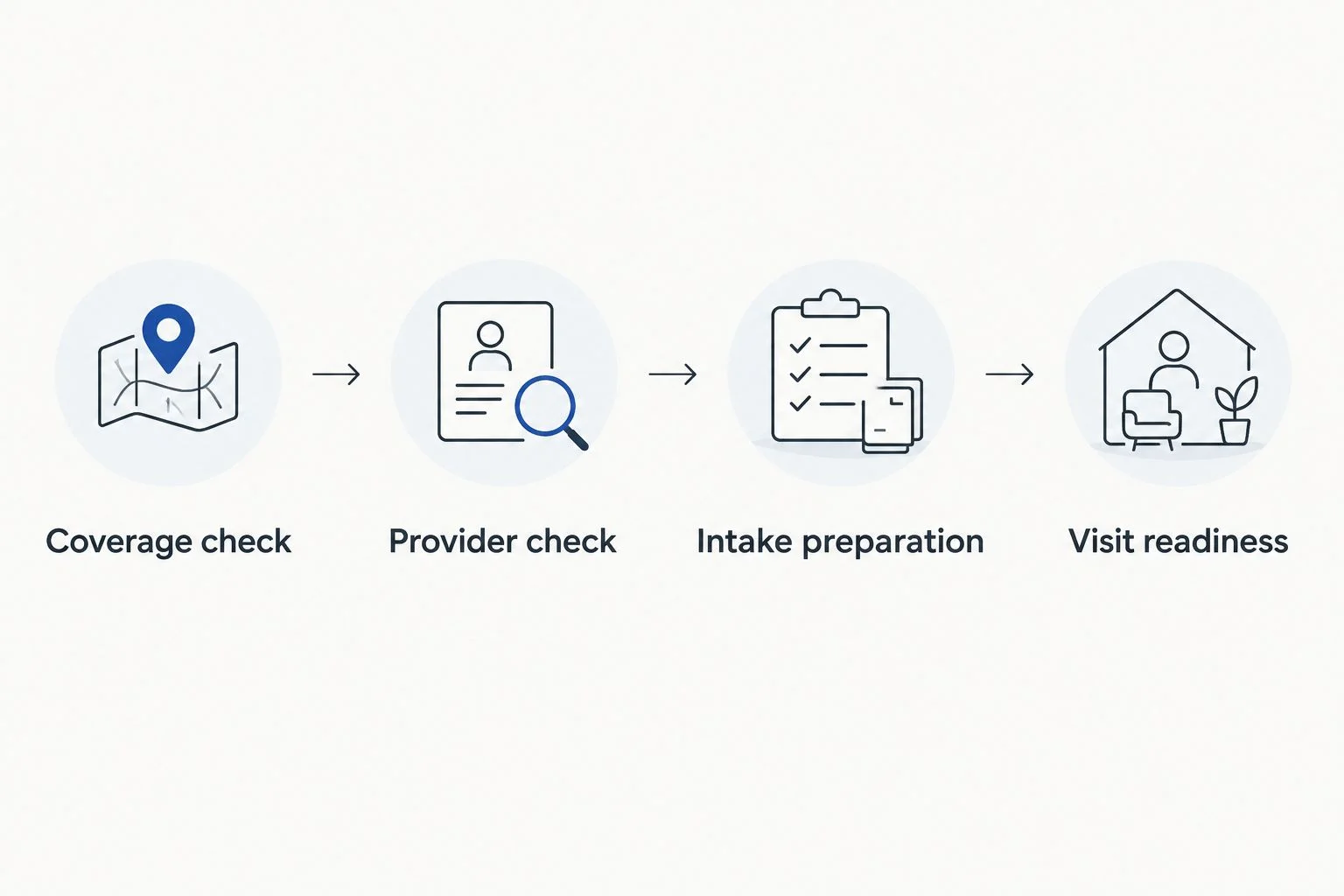
Confirm coverage and the clinician before completing appointment-specific paperwork.
When Medicaid changes before your appointment
An insurance change does not automatically mean you need to restart the clinical intake. It does mean the office needs updated information before relying on an earlier coverage check.
- Notify the office. Give the effective date and new plan details through its approved channel. Ask whether the existing appointment can remain scheduled while coverage is checked.
- Repeat the network check. Confirm the same clinician and appointment format with the new plan. Participation in your previous plan does not establish participation in the new one.
- Recheck prerequisites. Ask whether an existing referral or authorization remains usable or needs to be replaced. Get a clear answer before assuming earlier paperwork transfers.
- Update your appointment notes. Record the new instructions and confirm who is responsible for each remaining task.
Expected result: Your booking reflects current coverage rather than an outdated verification. Apply the same process if you switch plans after completing intake but before attending the visit.
Troubleshooting
The directory lists a clinician, but the office says no
Ask whether the disagreement concerns the exact plan, clinician, location, patient age, or new-patient scheduling. Give those details to member services and request help finding an appropriate participating clinician. A directory entry alone does not resolve the mismatch.
The referral was sent, but the office cannot find it
Confirm the receiving destination with the psychiatric office, then ask the referring office to check its transmission. Verify receipt afterward. Avoid repeatedly sending sensitive records to an unconfirmed destination.
You booked therapy but wanted a medication evaluation
Tell the scheduler directly that you are seeking psychiatric assessment or medication evaluation. Ask whether the existing appointment serves as a required intake or whether you need a different booking. Do not cancel until you understand the sequence.
Your telehealth connection fails
Use the backup contact method supplied by the office. Ask what to do if the visit cannot continue and whether rescheduling is necessary. Do not assume a regular telephone call can replace the planned appointment.
Your symptoms become urgent while you wait
Do not wait for a routine psychiatric appointment during an emergency. Call 911 for immediate danger or a medical emergency. Call or text 988 for suicide or mental health crisis support in the United States, and tell the scheduling office when your clinical needs change.
Customize your workflow
Build your checklist around the person receiving care. For a child, ask about guardian participation and relevant school information. For an adult already receiving therapy, ask how the psychiatric clinician can coordinate with the therapist after obtaining appropriate consent.
If substance use is part of the concern, say so during scheduling rather than waiting until the visit. SOS Wellness provides addiction treatment as well as mental health services; ask which evaluation fits your needs and confirm coverage for that service.
Routine outpatient psychiatric appointments differ from intensive outpatient programs and inpatient care. If a clinician recommends a different level of care, ask what that recommendation means, which provider can deliver it, and how to check the relevant benefits.
For your care plan, keep appointment instructions and coverage notes together. Store them securely and share only the information needed for the task.
FAQ
How do I go from Medicaid to my first psychiatric appointment in Ohio?
Verify active Medicaid coverage, confirm a participating psychiatric clinician, complete required intake, and prepare for the visit. Ask your plan and the office about referrals, authorization, and appointment format before assuming the booking is ready.
Does SOS Wellness accept my Medicaid plan?
SOS Wellness accepts Ohio Medicaid, including managed-care plans. Confirm your exact plan, proposed clinician, and requested service with staff and your plan. Network participation, prior authorization, and patient costs depend on the specific service and coverage; Medicaid acceptance does not guarantee payment for every appointment.
Do I need a referral for my first psychiatric appointment?
Ask your Medicaid plan and the psychiatric office whether a referral is required for your appointment. If it is, confirm who must send it and whether the office has received it.
Can my first psychiatric appointment happen through telehealth?
A first psychiatric appointment may take place through telehealth when the clinician offers it and determines it is appropriate. For SOS Wellness video visits, you must be physically in Ohio. Confirm plan coverage, office requirements, a private setting, connection instructions, and what to do if an urgent concern arises during the visit.
Will I get medication at my first psychiatric appointment?
A first psychiatric appointment does not guarantee medication. The clinician evaluates your concerns and history before discussing appropriate next steps, which can include further assessment or other treatment.
What should I bring to my first psychiatric evaluation?
Bring your current medication list, symptom summary, coverage information, and any identification or records the office requests. For a child’s appointment, also confirm guardian documentation and participation requirements.
What should I do if I need help before my appointment?
Contact the office about worsening symptoms and ask what guidance or appointment options may be available while you wait. SOS Wellness is an outpatient provider, not an emergency response service; do not wait for an office response in a crisis. Call 911 for immediate danger or a medical emergency, or call or text 988 for suicide or mental health crisis support in the United States.
One last thing
A confirmed appointment and verified coverage are different checkpoints. Before you consider scheduling finished, ask the office to identify anything still outstanding: coverage review, referral, forms, records, or attendance instructions. Leave that conversation knowing exactly who owns the next task.
Further reading
Related reading
This article provides general educational information and does not replace an individual clinical assessment. Contact your healthcare provider about your own care.