

Telehealth psychiatric medication management cost depends on the provider’s visit charges, your insurance benefits, and the appointments your treatment requires. To ask SOS Wellness about fees and an estimate for your care, call 513-928-3339. Your appointment charge also does not tell you the full cost of care: prescriptions, testing when needed, and separately billed therapy need their own coverage checks.
At a glance
- Telehealth psychiatric medication management cost depends on visit charges, insurance benefits, and your treatment plan.
- Ask about initial evaluations, follow-up visits, prescriptions, and any separately billed services before booking.
- SOS Wellness provides telehealth mental health services in Ohio; confirm payment terms directly before scheduling.
How much does telehealth psychiatric medication management cost?
Your useful number is your expected out-of-pocket responsibility, not just the provider’s appointment charge. For an insured visit, that means checking the clinician’s network status and your plan’s benefits. For self-pay care, it means requesting the charge for the specific appointment you need.
SOS Wellness provides psychiatric care, medication management, and telehealth mental health services to children and adults in Ohio. Before scheduling, ask which appointment fits your needs and what payment information you should confirm.
Use this breakdown to keep the different parts of care separate:
| Part of care | Potential fit | What to confirm | Limitation to understand |
|---|---|---|---|
| Initial evaluation | Starting care or reviewing a new concern | The evaluation charge and applicable insurance benefits | An evaluation does not guarantee a prescription |
| Medication follow-up | Reviewing benefits, side effects, and treatment changes | The follow-up charge and expected visit schedule | Follow-up needs depend on clinical circumstances |
| Prescription medication | Carrying out an agreed medication plan | Pharmacy coverage, formulary rules, and your responsibility | Appointment coverage does not establish medication coverage |
| Therapy | Working on symptoms, coping skills, and behavior patterns | Whether therapy is included or billed separately | A medication visit is not automatically a therapy session |
| Testing or monitoring | Meeting a clinical monitoring need | Where testing happens and how it is billed | A video appointment does not replace every in-person service |
The table is a checklist, not a statement that every patient needs every service. Ask the clinician which items apply to your care before treating them as part of your budget.
Why this matters
An appointment charge answers a narrow question: what a particular visit costs. It does not necessarily answer what you will spend to start treatment, fill a prescription, or continue follow-up care.
When budgeting, separate starting care from continuing care. An initial evaluation and an ongoing medication review serve different purposes, so ask about each rather than assuming the same billing applies.
You also need a plan you can continue safely. Tell the clinician if appointment expenses, transportation for testing, or pharmacy charges would make following the treatment plan difficult. That information belongs in the treatment conversation, not just the billing conversation.
Why your out-of-pocket cost varies
Your diagnosis alone does not determine what you pay. These factors explain why a quoted visit charge and your final responsibility can differ:
- Appointment type. Ask whether you are booking an initial psychiatric evaluation, a medication follow-up, or another service. Confirm the charge for that appointment rather than a general advertised service.
- Network status. Verify the specific clinician and practice with your insurer. A provider accepting insurance is not the same as that provider participating in your particular plan’s network.
- Benefit design. A copayment, deductible, and coinsurance work differently. Ask which applies to outpatient psychiatric telehealth under your plan.
- Medication coverage. Check the prescribed medication with your pharmacy benefit. Formulary restrictions and prior authorization requirements are separate from the appointment’s coverage.
- Follow-up needs. Ask when the clinician expects to reassess treatment. Medication changes, symptoms, and side effects can affect the follow-up plan.
- Separate services. Clarify whether therapy, laboratory work, or other monitoring would be billed outside the medication appointment. Do not assume every part of care is included.
Confirm the visit, the benefits, and the prescription separately. A clear answer about one does not settle the others.
How do you check your cost before booking?
Use the same sequence whether you are beginning treatment or changing providers. Keep the answers together so you can compare the appointment information with your insurance benefits.
Identify the appointment
Explain whether you are seeking a first evaluation, transferring medication management, or returning for follow-up. Ask the office which appointment type you need and whether records from a previous clinician would help.
Do not book a shorter follow-up simply because you expect it to require less expense. A new clinician needs enough information to assess your symptoms, history, and medication safety.
Confirm the benefits
Contact your insurer using the information on your insurance card. Ask about outpatient psychiatric telehealth with the specific clinician, including network participation and any referral or authorization requirements.
Before an appointment, confirm your current benefits rather than relying on a previous visit’s payment. Ask whether a deductible, copayment, or coinsurance applies to this service.
Check the prescription
If you already take medication, ask your pharmacy or insurer about coverage for that exact prescription. If treatment has not been decided, ask how to check coverage once the clinician makes a recommendation.
Do not assume the clinician will continue a previous prescription unchanged. Medication decisions require an assessment, even when your main reason for booking is ongoing management.
Request an estimate
Ask the office for a written estimate of your expected responsibility and what it includes. Clarify whether the estimate is for the appointment alone and what happens if additional services become necessary.
If you are uninsured or not using insurance, you generally can receive a Good Faith Estimate for requested or scheduled care. For appointments scheduled 3–9 business days ahead, it is due within one business day of scheduling; for appointments scheduled at least 10 business days ahead, within three business days. You can also request one before scheduling, with delivery within three business days. Scheduling only 0–2 business days ahead does not carry that advance-estimate entitlement. An estimate is not a price guarantee, and separate providers may issue separate estimates. See CMS guidance on Good Faith Estimates.
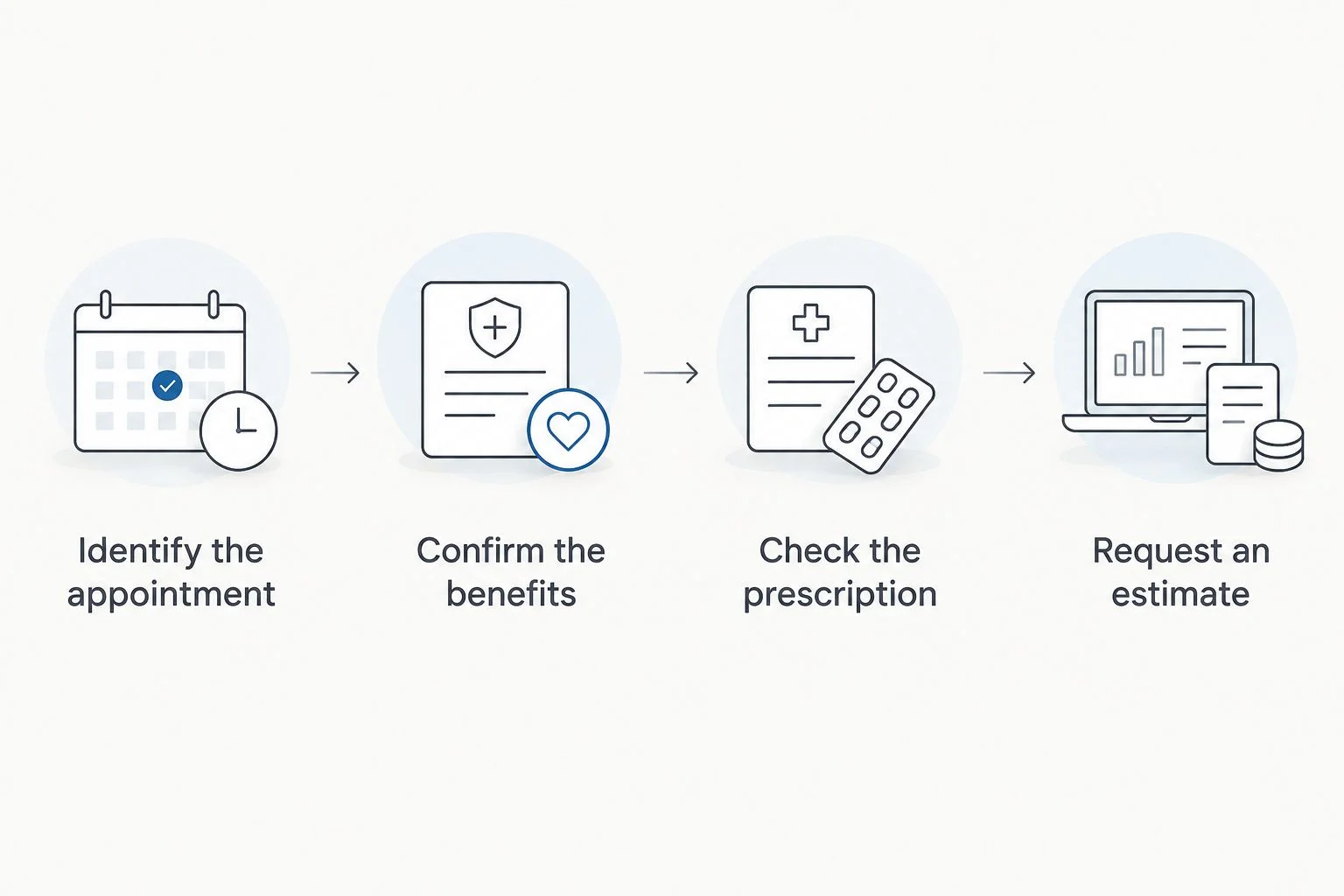
Check the appointment and medication separately before estimating your total responsibility.
Should you use insurance or pay directly?
Compare your actual payment responsibilities, not assumptions about which route is cheaper. Using insurance and paying directly have different billing considerations; neither is automatically the right financial choice for every patient.
| Payment route | Potential fit | Practical benefit | What to check carefully |
|---|---|---|---|
| Using insurance | Patients whose plan covers the selected clinician and service | Eligible charges can be processed under plan benefits | Deductibles, network rules, authorization, and cost sharing |
| Paying directly | Patients arranging care without an insurance claim | The office can explain its direct-payment terms | Whether payments count toward insurance benefits; do not assume they do |
Ask the office how it handles your chosen payment route before the appointment. If you hope to seek reimbursement yourself, first ask your insurer what documentation and eligibility rules apply.
Also distinguish billing access from clinical fit. A payment arrangement does not tell you whether a clinician treats your age group, manages your condition, or can provide the monitoring you need.
What should you ask about ongoing medication visits?
An initial appointment estimate is only the starting point. Before agreeing to ongoing care, ask how the clinician plans to review your response and what situations require another appointment.
Useful questions include:
- What determines when I need my next medication review?
- How should I report side effects between appointments?
- How are refill requests handled, and when is a visit required?
- Are forms, missed appointments, or late cancellations subject to separate billing terms?
- What happens if I need an examination or testing outside telehealth?
- Who should I contact about a billing question?
These questions clarify responsibilities; they do not imply that a particular practice charges for each item. Ask for the practice’s actual policies rather than assuming another provider’s rules apply.
SOS Wellness offers outpatient mental health care for children, teens, and adults, with Ohio telehealth options. Patients must be physically in Ohio during video visits. Staff can confirm service availability and age eligibility, and a clinician assesses whether remote care fits your symptoms and safety needs.
Is telehealth medication management cheaper than in-person care?
Telehealth medication management is not automatically cheaper than in-person care. Compare the charges and insurance benefits for the specific appointments rather than assuming the video format determines your payment.
Remote appointments can eliminate travel for the appointment itself, which is a practical advantage. The limitation is that examinations, testing, or urgent needs can still require care elsewhere; convenience and clinical suitability are separate questions.
Does insurance cover the medication as well as the appointment?
Insurance coverage for the appointment does not establish coverage for the medication. Check outpatient mental health benefits for visits and pharmacy benefits for prescriptions.
Ask whether the medication requires prior authorization or has other coverage requirements. If a pharmacy claim is rejected, contact the pharmacy, insurer, and prescribing office for the next step rather than stopping or changing treatment yourself.
Can you reduce expenses by spacing out follow-ups?
Follow-up timing should reflect clinical needs, not a schedule you set solely to reduce expenses. Discuss financial concerns openly so the clinician can consider them while maintaining appropriate monitoring.
Do not skip reviews, split doses, or stop medication without guidance. If continuing care feels financially difficult, raise that concern before you run out of medication so there is time to discuss the situation.
FAQ
What costs should I compare before choosing a telehealth provider?
Ask for the expected responsibility for your initial evaluation, follow-up visits, prescriptions, and any separate services. Confirm the clinician’s network status and your current benefits before treating an appointment estimate as your total cost.
Does a medication management appointment include therapy?
A medication management appointment does not automatically include a separate therapy service. Ask what the visit covers and whether any therapy would be scheduled or billed separately.
Can I get a prescription at my first telehealth appointment?
A first telehealth appointment does not guarantee a prescription. The clinician needs to assess your symptoms, medical history, current medications, and whether a proposed treatment is appropriate.
What if I cannot afford the medication my clinician recommends?
Tell your prescribing clinician and pharmacist before changing or stopping the medication. Ask them to review your coverage and discuss clinically appropriate alternatives or other payment arrangements that apply to your situation.
Can SOS Wellness help children and adults in Ohio?
SOS Wellness provides mental health services to children and adults in Ohio, including psychiatry, therapy, medication management, and telehealth. Confirm which appointment fits your needs and how billing applies before scheduling.
What should I do if I need urgent mental health help?
Call 911 for immediate danger or a medical emergency. In the United States, call or text 988 for suicide or mental health crisis support; do not wait for a routine medication appointment.
One last thing
Ask for the next-step plan, not just the next appointment’s charge. Before ending a visit, make sure you understand how to obtain your prescription, report a problem, arrange any required monitoring, and schedule follow-up.
For care you arrange, keep your estimate and insurance notes together. If a bill differs from what you expected, ask the office to explain the services billed and compare that explanation with your insurer’s benefit statement before drawing conclusions.
Further reading
Related reading
This article provides general educational information and does not replace an individual clinical assessment. Contact your healthcare provider about your own care.