

An ADHD assessment has no single standard duration: the time booked for an appointment is not the same as the time needed to complete a diagnosis. The full process includes a clinical interview, questionnaires, and a review of symptoms across your history and daily life. Ask the practice for both the scheduled appointment length and the expected timeline for reviewing information and discussing results.
At a glance
- How long does an ADHD assessment take? Separate appointment length from the complete diagnostic process.
- ADHD evaluation requires a symptom history, evidence of daily difficulties, and consideration of other explanations.
- Extra testing is not automatically necessary; ask what question each proposed test will answer.
- SOS Wellness provides outpatient mental health services for children, adults, and families in Ohio.
How long does an ADHD assessment take?
There is no universal appointment length or guaranteed completion date for an ADHD assessment. A booking labeled assessment does not tell you whether it covers the interview alone, the full evaluation, or a separate discussion of findings.
For a child, information from home and school helps establish whether difficulties occur in different settings. The Child ADD and ADHD Ohio Parents Guide provides additional context for parents preparing to discuss concerns.
Use these distinctions when asking a practice about its assessment process:
| Part of the process | What it involves | What to clarify before booking |
|---|---|---|
| Appointment time | A scheduled conversation with the clinician | What happens during this appointment? |
| Information gathering | Questionnaires, records, and observations from relevant people | What needs to arrive before the visit? |
| Diagnostic review | Considering symptoms, impairment, history, and other explanations | Is a separate feedback appointment needed? |
| Additional testing | Answering specific questions about learning or cognitive functioning | Why is testing recommended in your case? |
| Treatment planning | Discussing appropriate next steps after the assessment | Is this included or scheduled separately? |
Request the practice's current process rather than relying on someone else's experience. Two people attending the same practice do not necessarily need the same evaluation.
Why this matters
A short appointment is not automatically inadequate, and a long appointment is not automatically thorough. What matters is whether the clinician has enough relevant information to explain the conclusion and consider other causes of your difficulties.
You also need practical clarity. Arranging time away from work, collecting school feedback, and preparing records are easier when you know what the appointment includes. Ask what will be completed, not just how long you will be in the room.
An assessment should leave you understanding the findings and the next step. If the conclusion remains uncertain, ask what information is still needed and how the clinician plans to resolve that uncertainty.
What happens during an ADHD assessment?
The assessment is a clinical process, not simply a questionnaire score. The CDC's diagnostic guidance explains that there is no single test for ADHD; clinicians consider information from different parts of a person's life.
The sequence below describes the main tasks. A practice can arrange them across appointments or collect some information beforehand.
History review
The clinician asks about attention, activity level, impulsivity, and the effect of these difficulties on daily life. Expect questions about school, work, relationships, routines, sleep, medical history, and mental health.
Describe what happens rather than relying only on labels. For example, explain whether you lose track of instructions, miss responsibilities, interrupt conversations, or need extensive support to complete ordinary tasks. Include situations where you function well, too.
Questionnaires
Rating scales help organize observations and compare symptoms with established criteria. They support the clinical interview; they do not replace it or prove a diagnosis on their own.
For children, clinicians seek information from parents or caregivers and school staff when appropriate. For adults, a partner, relative, or someone familiar with earlier difficulties can provide useful context, with appropriate consent.
Diagnostic review
The clinician considers whether symptoms fit ADHD, cause meaningful impairment, and have another explanation. Sleep problems, anxiety, depression, learning difficulties, and substance use are examples of issues that deserve consideration.
Having another condition does not automatically rule out ADHD. The assessment needs to determine what is contributing to the difficulties and whether more than one condition is present.
Feedback discussion
The clinician explains the conclusion, the evidence supporting it, and any remaining uncertainty. Treatment recommendations should follow the findings rather than assume medication is the inevitable outcome.
Before leaving, ask how you will receive the results and who will explain them. Clarify whether documentation for school or work requires a separate request.
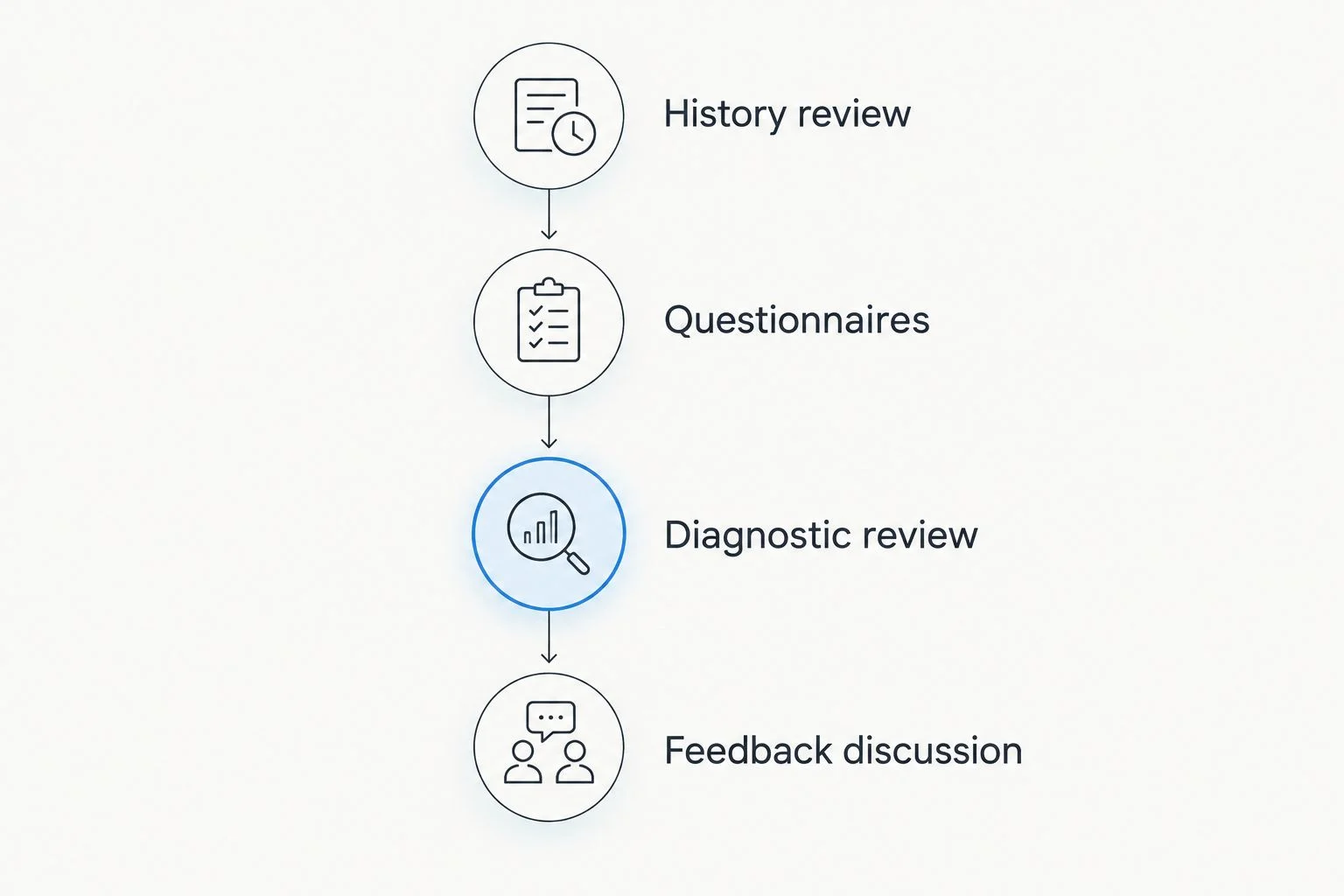
The interview is one part of the assessment, not the entire diagnostic process.
Why the ADHD assessment timeline varies
The timeline depends on the information needed to answer the diagnostic question. These factors explain why the appointment itself and the complete evaluation follow different schedules:
- Developmental history: The clinician needs to understand when difficulties began, not just what has happened recently.
- Information across settings: School, work, home, and relationships provide different evidence about day-to-day functioning.
- Questionnaire completion: The review depends on receiving relevant forms and understanding any differences between observers.
- Other health concerns: Sleep difficulties, mood symptoms, substance use, and medical history can require further clarification.
- Additional testing: Learning or cognitive questions require a different assessment scope from an ADHD-focused clinical evaluation.
- Feedback arrangements: Some practices discuss findings within the assessment process; others schedule a separate appointment.
When arranging an assessment, ask which tasks happen before the first appointment. You cannot control every scheduling step, but you can clarify your responsibilities and avoid arriving without requested information.
Adult assessments: what changes the process?
An adult ADHD assessment includes current functioning and childhood history. Diagnostic criteria require several symptoms to have been present before age 12—not every symptom or a childhood diagnosis. Assessment also considers symptom duration, impairment across settings, and other possible explanations.
Old report cards, previous evaluations, or observations from someone who knew you as a child help describe that history. Not having these records is a reason to discuss alternatives with the clinician, not a reason to decide for yourself that assessment is impossible.
Bring examples from different responsibilities. Strong performance in a structured job does not describe what happens with bills, appointments, household tasks, or relationships. Explain the effort and support behind your results, not just the results themselves.
If someone suggests a broad testing package, ask what it will establish beyond the clinical evaluation. More tests are useful when they answer a specific question, not simply because they make the appointment longer.
Children's assessments: why school information matters
A child's assessment considers development, behavior, learning, and functioning in different environments. Parent observations describe home life; teacher observations describe demands and behavior at school.
The CDC describes ADHD criteria that include symptoms lasting at least 6 months and symptoms present in 2 or more settings. These are diagnostic considerations, not a requirement to postpone seeking help when a child is struggling.
Bring existing school reports and any previous learning or developmental evaluations. Ask the practice which forms school staff should complete rather than requesting an unspecified letter.
Differences between home and school reports deserve discussion. Structure, task demands, support, and the situations being observed can differ. The clinician needs to understand the difference rather than simply average the answers.
For a child's assessment, ask whether the child and caregivers attend together throughout the appointment. Knowing the format helps you prepare without coaching the child toward particular answers.
Is additional testing necessary for an ADHD diagnosis?
Ask the clinician whether additional neuropsychological testing is needed for your evaluation and what question it would answer. ADHD diagnosis involves a multi-step assessment; no single test establishes the diagnosis.
The options below serve different purposes. Neither is automatically the right choice solely because it takes longer.
| Assessment approach | Potential fit | Main strength | Limitation |
|---|---|---|---|
| ADHD-focused clinical evaluation | Clarifying ADHD symptoms, history, and functional impairment | Connects symptoms with everyday difficulties and diagnostic criteria | Does not automatically provide a detailed learning or cognitive profile |
| Broader neuropsychological evaluation | Specific questions about learning, memory, or other cognitive abilities | Examines a wider range of cognitive functioning | Adds assessment tasks and does not replace clinical history |
Ask the referring clinician to explain the purpose of additional testing in plain language. A useful answer identifies the unresolved question and explains how the result would affect recommendations.
Do not select an assessment solely because it promises the fastest answer. Equally, do not assume that everyone needs the broadest testing available.
How can you prepare without overpreparing?
Prepare accurate information, not a case you feel you must prove. The goal is to understand your difficulties and identify appropriate support, whether or not the diagnosis is ADHD.
- Check the appointment scope. Confirm the scheduled length, who attends, and whether feedback is included.
- Complete requested forms. Answer based on ordinary functioning, including difficulties and strengths.
- Gather relevant records. Bring previous evaluations, available school reports, and a current medication list.
- Write concrete examples. Describe what happens, where it happens, and how it affects responsibilities or relationships.
- Prepare your questions. Ask what the findings mean and what happens if the conclusion is uncertain.
Do not stop prescribed medication or change your routine to influence the assessment. Ask the practice for any specific preparation instructions and discuss medication questions with your prescriber.
For telehealth, check privacy, device access, and connection instructions beforehand. Also confirm whether the practice considers the remote format appropriate for your assessment needs.
Can ADHD be diagnosed in a single appointment?
Ask whether the practice expects one appointment or several, what information it reviews beforehand, and what could require follow-up. Appointment count alone does not establish whether an assessment is adequate.
Ask what the clinician reviewed and whether any information remains outstanding. A clear explanation matters more than a promise of an immediate diagnosis.
Does an ADHD assessment include medication?
An ADHD assessment does not automatically include starting medication. Diagnosis and treatment planning are related but separate clinical decisions.
If medication is discussed, ask about the expected benefits, risks, alternatives, and follow-up arrangements. Also ask how therapy, practical supports, or school and workplace adjustments fit your needs.
Choosing an appropriate next step in Ohio
SOS Wellness offers outpatient mental health services for children, teens, and adults in Ohio. Services include psychiatry, therapy, medication management, addiction services and Ohio telehealth. SOS telehealth patients must be physically in Ohio during visits. An assessment helps determine which services fit a person's needs; staff can confirm eligibility and availability for the requested service.
These services are relevant when attention concerns overlap with other mental health needs. The limitation is that a general service description does not establish the format, appointment length, or documentation included in a specific ADHD assessment.
When contacting SOS Wellness, ask whether the practice provides the ADHD assessment you need, which ages it serves for that assessment, and what the process includes. Confirm appointment length, telehealth suitability, documentation and any proposed testing directly.
FAQ
How long does an ADHD assessment take from start to finish?
There is no universal start-to-finish timeline for an ADHD assessment. Ask separately about appointment length, information gathering, diagnostic review, and the discussion of results.
Does the first ADHD appointment always lead to a diagnosis?
No, the first appointment does not always lead to a diagnosis. A clinician needs enough relevant information to assess symptoms, impairment, developmental history, and other explanations.
Does ADHD have to be present for 6 months before diagnosis?
Symptoms lasting at least 6 months are part of ADHD diagnostic criteria. Do not wait to seek help if difficulties are affecting daily life; a clinician can assess the concerns and recommend support.
Can an adult get assessed without childhood school records?
An adult can discuss an ADHD assessment even without childhood school records. The clinician still needs to explore childhood symptoms and can discuss other ways to understand that history.
Does an online ADHD quiz count as an assessment?
An online ADHD quiz is not a diagnostic assessment. A screening result can help you describe concerns, but diagnosis requires clinical evaluation and consideration of other explanations.
Does SOS Wellness provide mental health care for children and adults?
SOS Wellness provides outpatient mental health services for children, adults, and families in Ohio. Ask directly whether its assessment process matches your specific ADHD evaluation needs.
What should I do if I need urgent help before an assessment?
Call 911 for an immediate medical emergency or immediate danger. In the United States, call or text 988 for suicide or mental health crisis support; a routine ADHD assessment is not emergency care.
One last thing
Ask for the next decision, not just the next appointment. Before you finish booking, find out what the clinician expects to determine at the visit and what would happen if more information is needed.
Knowing the next decision gives you more useful information than appointment duration alone. You should understand what you are preparing for, what the evaluation can establish, and how you will receive an explanation of the findings.
Further reading
Related reading
This article provides general educational information and does not replace an individual clinical assessment. Contact your healthcare provider about your own care.