

School concerns can prompt an ADHD assessment, but they do not establish that medication is needed. Gather school observations, arrange a clinical evaluation, and discuss treatment options: educational eligibility and a clinical ADHD diagnosis are separate decisions, and neither automatically leads to medication.
At a glance
- School records can inform an ADHD assessment. Qualified school-based evaluators may assess within their professional scope; educational eligibility and treatment decisions remain distinct.
- SOS Wellness provides outpatient psychiatry, therapy, and medication management for children and adults in Ohio.
- School supports can proceed while a clinician evaluates ADHD symptoms, other explanations, and treatment options.
- Share teacher observations, relevant health history, and treatment goals before discussing ADHD medication.
Why this matters
School evaluations examine learning, classroom functioning, and eligibility for educational services. Qualified school-based evaluators may also assess ADHD within their professional scope. An ADHD diagnostic assessment considers symptoms, developmental history, impairment across settings, and other possible explanations. Educational eligibility does not itself determine a diagnosis or treatment; a prescriber must assess whether medication is appropriate.
SOS Wellness provides outpatient psychiatry, therapy, and medication management for Ohio families; it does not provide emergency or after-hours crisis care. A child's treatment depends on an individual assessment.
Keep school support and medical care on parallel tracks. You can ask the school about classroom needs before a medication decision, and a clinician may begin assessing ADHD before school testing is complete. Ask each team what information it needs and which decisions remain pending.
Before you start
- Gather records and access. Collect teacher observations, report cards, attendance information, prior evaluations, and any existing Individualized Education Program (IEP) or Section 504 plan. Identify who has legal authority to consent to healthcare and who can communicate with the school.
- Prepare the health history. Bring the child's current medications and supplements, previous treatment responses, sleep concerns, developmental history, and relevant family medical history. Write down concrete examples of difficulties at home and school.
- Resolve the records-sharing gotcha. Do not assume a school request sends records to a clinician automatically. Ask both offices what permission they need, where records should go, and how you can confirm receipt; education and healthcare records follow different privacy requirements.
Use a secure channel approved by the receiving organization. Avoid sending a child's detailed health information through an ordinary group message involving teachers, relatives, and other families.
School records
Request and organize the educational picture
- Put your concern in writing. Describe what the child struggles with, such as starting assignments, following instructions, staying seated, or managing transitions. Ask the school how to request an evaluation when a disability is suspected; do not describe ADHD as already confirmed unless a clinician has diagnosed it.
- Ask for specific observations. Request examples of when difficulties occur, what happens beforehand, and which supports help. A statement such as “leaves work unfinished during independent reading” gives more useful information than “does not try.”
- Keep the original reports. Save evaluation documents, teacher comments, and school communications together. Keep a separate summary of your questions so your own interpretation does not replace the evaluator's findings.
- Separate support from diagnosis. Ask the school what assistance can begin now and whether an IEP or Section 504 evaluation is appropriate. A medical diagnosis does not automatically establish eligibility for either plan; educational needs and applicable criteria matter.
Expected result: You have a readable school record that describes the child's functioning, not just a suspected label. You also know which educational decisions remain open.
School testing can identify learning needs that deserve attention even if the eventual clinical diagnosis is not ADHD. Preserve those findings rather than treating the report only as a document needed for a prescription.
Clinical assessment
Arrange the medical evaluation
- Book an ADHD assessment. Explain the child's age, main concerns, existing diagnoses, and any urgent safety issues when requesting an appointment. Ask what records and questionnaires the clinician needs before the visit.
- Collect information across settings. Complete the requested parent forms and ask the school who can provide teacher observations. Rating scales organize information, but no questionnaire alone establishes ADHD.
- Describe the timeline. Explain when symptoms began, how long they have persisted, and where they interfere with daily life. Include settings where the child functions well, not only difficult situations.
- Review other explanations. Discuss sleep difficulties, anxiety, depression, trauma exposure, learning problems, and relevant medical concerns. These can resemble ADHD, occur alongside it, or change the treatment plan.
- Confirm the assessment outcome. Ask whether the clinician has enough information, whether further evaluation is needed, and what the next step is. An appointment can appropriately end with more information gathering rather than a prescription.
Expected result: You understand the clinician's working explanation, any remaining questions, and the next decision—not simply whether medication was offered.
CDC diagnostic guidance describes symptoms lasting at least 6 months, several symptoms present before age 12, and symptoms in at least 2 settings, with clear interference in functioning. Children younger than 17 generally need at least six symptoms in the relevant symptom category; people 17 and older need at least five. Assessment also considers developmental appropriateness and whether another condition better explains the symptoms. No single test or questionnaire establishes ADHD, and missing childhood records does not automatically prevent assessment.
Include recent observations alongside older records. A previous evaluation helps establish history, but it may not reflect current classroom demands or health concerns.
The sequence below connects school information with diagnostic assessment, treatment decisions, and follow-up. Teams may share relevant findings while making distinct educational and healthcare decisions.
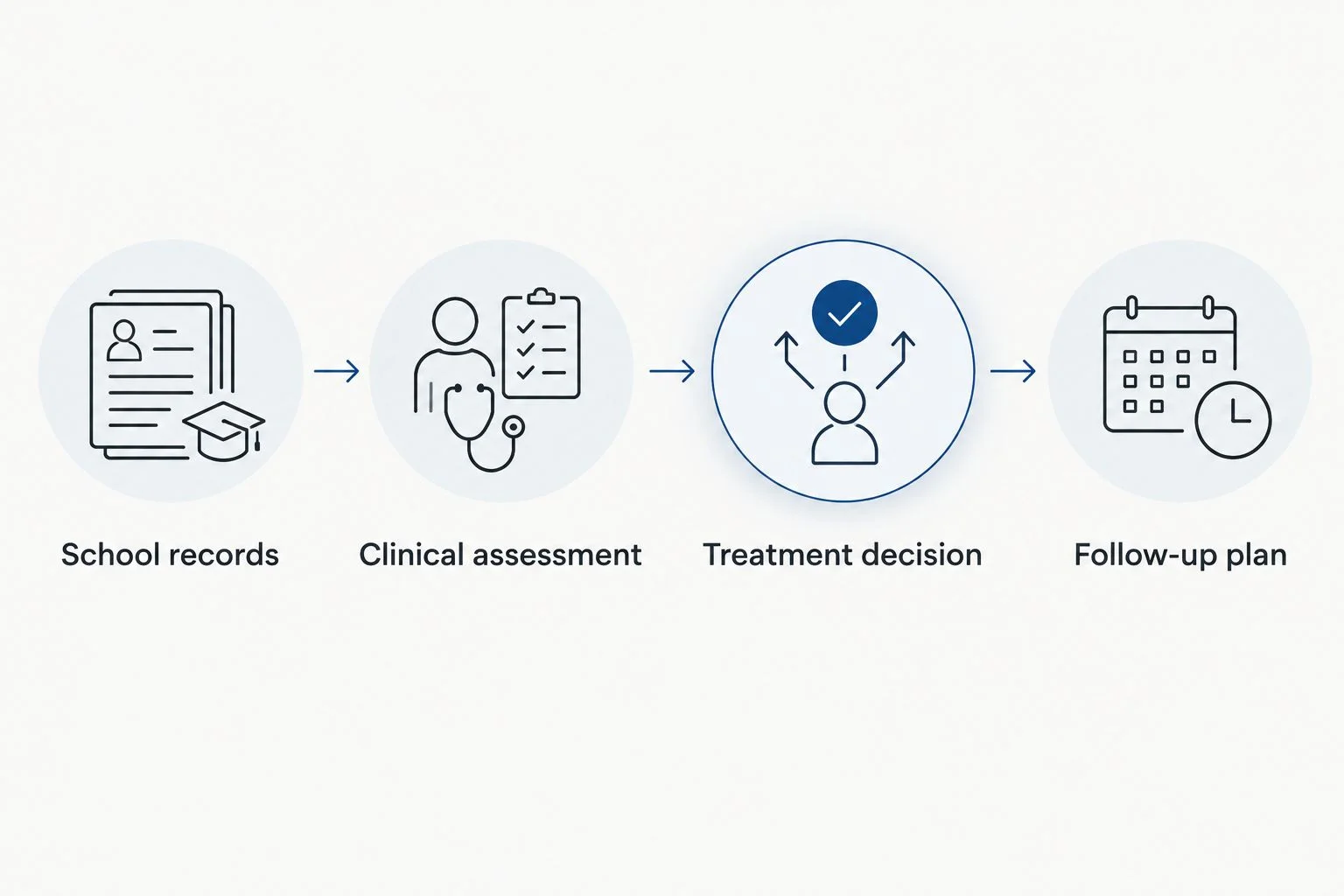
School records inform the clinical assessment; they do not determine the prescription.
Treatment decision
Agree on goals before discussing a prescription
- Choose functional goals. Describe the change you want to see: completing morning routines, participating in lessons, or having fewer conflicts over homework. Avoid making a quieter classroom the only measure of success.
- Review age-appropriate options. Ask how parent training in behavior management, classroom support, therapy for co-occurring concerns, and medication fit the child's needs. Recommendations differ by age, impairment, and clinical history.
- Discuss benefits and drawbacks. Ask what each option targets, what it does not address, and how you will judge whether it helps. Include the child's concerns in language they understand.
- Complete the safety review. Before prescribing, the clinician reviews relevant medical history and checks appropriate baseline measures. Report heart-related symptoms, family cardiac history, appetite concerns, sleep problems, and all current medicines or supplements.
- Confirm consent and instructions. If medication is prescribed, ask for clear instructions about use, monitoring, missed doses, and when to contact the prescriber. Never share medication or change the dose without guidance.
Expected result: You have an agreed treatment plan with specific goals, informed consent, and clear instructions. Medication is one possible component, not the required endpoint of the evaluation.
What each part of care contributes
| Care component | Potential fit | Main benefit | Limitation |
|---|---|---|---|
| School supports | Addressing classroom barriers | Changes tasks, routines, or the learning environment | Does not replace a medical assessment |
| Parent training | Building consistent responses and routines | Teaches practical behavior-management skills | Requires practice and does not resolve every symptom |
| ADHD medication | Treating ADHD symptoms when clinically appropriate | Can improve attention, impulsivity, or hyperactivity | Requires prescribing oversight and monitoring for adverse effects |
| Therapy for co-occurring concerns | Addressing anxiety, mood, or emotional difficulties | Targets problems that need their own treatment | Is not interchangeable with medication for core ADHD symptoms |
These approaches can be combined. For younger children, parent training in behavior management has a central role; ask the clinician how age changes the recommended treatment sequence.
SOS Wellness provides psychiatry, therapy, and medication management. Ask which service fits your child's assessment needs rather than assuming that a medication-management visit replaces every part of an initial diagnostic evaluation.
Follow-up plan
Close the loop between home, school, and clinician
- Confirm the next contact. Before leaving the appointment, establish how follow-up will happen and whom to contact with concerns. Ask what requires a routine message, a prompt call, or emergency care.
- Track benefits and difficulties. Use the same functional goals agreed at the treatment visit. Record sleep, appetite, mood, and relevant symptoms without changing several routines at once if you can avoid it.
- Request targeted school feedback. Ask teachers to describe observable changes in task completion, participation, or classroom functioning. Keep requests manageable and use any forms the clinician supplies.
- Return the information to the prescriber. Report both improvements and problems, including the child's own experience. Do not increase, stop, or restart medication based only on a school comment.
Expected result: The clinician receives comparable information from home and school and can assess benefit, tolerability, and the need for adjustments.
Keep follow-up records focused on daily functioning, not grades alone. Share changes in symptoms, sleep, appetite, mood, and the child's experience so the clinician can assess treatment alongside school feedback.
If medication must be taken during school, ask the school nurse about required authorization and medication-handling procedures. Do not assume a teacher can accept or administer it informally.
When a school plan changes after treatment starts
A new teacher, classroom, or educational evaluation can reveal a different pattern of difficulty. Treat that information as a reason to reassess the plan, not proof that the child needs a higher dose.
- New academic difficulty: Ask whether the work exposes a learning need, an attention problem, or both. Share examples with the clinician and school team.
- Different behavior by setting: Compare task demands, routines, sleep, and the timing of symptoms. Differences between home and school are useful clinical information.
- Improved symptoms but continuing struggles: Review accommodations, organizational supports, and co-occurring conditions rather than expecting medication to solve every problem.
Bring the updated school report to the next clinical discussion. Ask whether goals, supports, monitoring, or treatment need revision, and identify who will communicate each change.
For your records, retain earlier observations alongside new ones. Replacing the old report entirely makes it harder to see what changed and when.
Troubleshooting
The school says to get a diagnosis first
Ask whether the school is requesting medical information or declining to consider an educational evaluation. Put your concerns in writing and ask about its evaluation process. A medical diagnosis is not required before a public-school Section 504 evaluation; if the school determines that a medical assessment is necessary, it must ensure that assessment at no cost to parents. A diagnosis alone does not establish Section 504 eligibility. IDEA eligibility likewise depends on applicable disability criteria and the need for special education, not a diagnosis alone.
Teacher forms have not arrived
Ask the clinician whether existing reports or observations from another relevant adult can help while you obtain the requested forms. Do not complete a teacher questionnaire yourself or present your observations as the teacher's.
The assessment does not confirm ADHD
Ask what explains the child's difficulties and what additional evaluation or support is appropriate. Keep addressing documented learning and emotional needs rather than treating the absence of an ADHD diagnosis as the end of care.
Medication helps attention but causes problems
Contact the prescriber with specific observations about appetite, sleep, mood, or other changes. Do not adjust the dose independently. For immediate danger or a medical emergency, call 911; for a suicide or mental health crisis, call or text 988.
Customize your workflow
Build a shared plan around responsibilities, not just appointments. Identify who gathers school feedback, who maintains the medication list, who communicates with the clinician, and how the child can report concerns privately.
If several caregivers are involved, keep instructions consistent across households. Share the current clinician-approved plan with people responsible for administering medication, while limiting access to sensitive information to those who need it.
Ask SOS Wellness about assessment, therapy, or medication management based on the questions that remain. The useful next step is the service that addresses the unresolved need—not automatically the most intensive option.
FAQ
Does a school evaluation mean my child needs ADHD medication?
No. A school evaluation addresses educational functioning and support needs, and qualified school-based evaluators may assess ADHD within their professional scope. A prescriber reviews the diagnostic evidence, health history, and treatment needs before considering medication. Neither a school evaluation nor an ADHD diagnosis automatically leads to a prescription.
Can my child get an ADHD assessment before the school finishes testing?
Yes. A clinical assessment can begin while school testing is underway. The clinician still needs adequate information about symptoms, impairment, history, and functioning across settings.
Does an IEP or Section 504 plan count as an ADHD diagnosis?
No. An IEP or Section 504 plan documents educational services or accommodations, not a standalone medical diagnosis. Bring the plan to the clinician because its observations can inform the assessment.
What should I bring to the first ADHD appointment?
Bring school reports, relevant teacher observations, prior evaluations, and a current medication and supplement list. Include developmental history, sleep concerns, previous treatment responses, and examples of difficulties at home.
Can ADHD medication replace classroom accommodations?
No. Medication and classroom accommodations address different aspects of a child's needs. Continue reviewing educational supports even when symptoms improve with treatment.
What if my child seems different at home and school?
Share both accounts with the clinician rather than choosing one as correct. Differences in expectations, routines, symptom timing, and setting help the clinician understand the pattern.
Does SOS Wellness provide services for children in Ohio?
SOS Wellness provides mental health services for children and adults in Ohio, including psychiatry, therapy, and medication management. Ask which service is appropriate for your child's assessment and treatment needs.
One last thing
Ask your child what a better school day would feel like. “I can finish without feeling stuck” and “I still feel like myself” reveal things that a completed assignment cannot. Bring that perspective to treatment reviews alongside adult observations.
Further reading
Related reading
This article provides general educational information and does not replace an individual clinical assessment. Contact your healthcare provider about your own care.