

Parents’ ADHD family therapy is care that helps caregivers and children change stressful interactions with the aim of making home life more manageable. For Ohio families seeking family therapy for parents of children with ADHD, the key is distinguishing work on family relationships from parent training that teaches specific behavior-management skills.
At a glance
- Choose support based on your goals: family therapy addresses relationships, while behavioral parent training teaches practical caregiver skills.
- SOS Wellness offers family therapy and psychiatric care in Ohio; confirm whether ADHD-specific parent training is available for your child’s age and needs.
- Behavioral parent training teaches caregivers skills; family therapy addresses communication and conflict. Ask which approach a clinician provides.
- Choose one difficult routine, track what happens, and coordinate home support with your child’s school.
Why family therapy matters for Ohio parents
ADHD can affect attention, impulse control, and the ability to organize tasks. At home, those difficulties can show up as repeated reminders, unfinished homework, arguments over transitions, or a child who needs more support than siblings.
That does not make either the parent or child the problem. The useful treatment target is the interaction: what happens before a difficult moment, how everyone responds, and what helps afterward. Parents also need space to address frustration without making a child responsible for adult stress.
SOS Wellness provides therapy, psychiatry, medication management, and telehealth mental health services to children, adults, and families in Ohio. This guide is published by SOS Wellness, which offers these services. Before choosing a clinician, ask about ADHD experience, caregiver participation, and whether behavioral parent training is available and appropriate for your family.
For your care plan, separate these goals:
- Parenting skills: Learn clear instructions, predictable routines, reinforcement, and consistent responses.
- Family relationships: Reduce blame, improve communication, and work through disagreements.
- Clinical treatment: Evaluate symptoms and discuss treatment with qualified clinicians.
Family therapy is not a replacement for an ADHD evaluation or medication management when those are needed. It addresses a different part of care: how family members understand and respond to each other.
How to choose and use family therapy
Start with one difficult routine
Begin at home with observation, not a complete parenting overhaul. Choose one recurring difficulty, such as leaving for school, starting homework, or getting ready for bed.
Keep a brief record for 7 days. This is a practical starting exercise, not a diagnostic test or a promised treatment timeline. Record what happened before the difficulty, what your child did, and how adults responded.
Describe behavior rather than character. Writing that your child left the table before finishing a task gives a therapist more useful information than writing that your child was lazy or disrespectful.
- Name one routine you want to improve.
- Record the instruction your child received.
- Note distractions, transitions, and signs of tiredness.
- Describe your response without judging yourself.
- Include moments when the routine went well.
Ask for ADHD-specific parenting support
Family therapy and behavioral parent training are not interchangeable. Family therapy focuses on relationships and interactions; behavioral parent training teaches caregivers concrete ways to support behavior. A clinician can incorporate both, but you need to ask what the treatment includes.
Ask your child’s clinician whether structured parent training in behavior management is appropriate and how it would fit with other care. The plan should account for your child’s age, symptoms, and other needs.
Use the child ADD and ADHD Ohio parents’ guide to organize your questions before an appointment. SOS Wellness offers therapy for families; ask whether the clinician provides ADHD-focused parent training, family relationship work, or referrals for either.
- Ask about the clinician’s training and experience in structured ADHD behavioral parent training.
- Ask which ages the clinician serves and whether treatment teaches behavior-management skills.
- Ask who attends and when parents meet separately.
- Request examples of between-session practice.
- If you need remote care, ask whether this specific service is offered by telehealth.
Agree on one shared response
You can begin by comparing how caregivers respond to the same situation. A child receives a confusing message when one adult repeats a demand, another withdraws it, and another adds a consequence that nobody discussed.
Choose 1 shared instruction for the routine you are working on. Keep it specific and within your child’s current abilities. Agreement does not require identical parenting personalities; it requires a predictable response to the chosen situation.
A therapist can help caregivers resolve disagreements without asking the child to take sides. This matters when households, schedules, or caregiving responsibilities differ. The goal is a workable agreement, not a judgment about who is the better parent.
- Write the instruction in plain language.
- Check that your child understands the task.
- Agree on how adults will acknowledge effort.
- Discuss consequences away from the child.
- Plan what happens when a caregiver gets overwhelmed.
Practice skills without turning home into a clinic
Start with a small change you can repeat. For example, make the next step visible, reduce competing distractions, and acknowledge the behavior you want to see. A therapist can help tailor those strategies instead of giving your family a generic checklist.
Use 2 check-in questions after practice: What helped? What made it harder? These questions support adjustment without turning every evening into an assessment.
Avoid treating a difficult day as proof that treatment failed. Look at whether the plan was understandable, realistic, and consistently supported. Also ask whether anxiety, sleep problems, learning difficulties, or other concerns need clinical attention rather than another parenting strategy.
- Break a difficult task into clear actions.
- Give your child an understandable next step.
- Acknowledge effort and the specific behavior.
- Review difficulties when everyone is calmer.
- Bring unsuccessful strategies back to the therapist.
Coordinate home, school, and clinical care
Begin with information sharing. Ask your child’s teacher which situations are hardest and what already helps. Bring that information to the treating clinician rather than assuming school behavior and home behavior will look identical.
In school conversations, distinguish clinical treatment from educational support. A medical ADHD diagnosis is not required to request a public-school Section 504 evaluation, and a diagnosis alone does not automatically establish eligibility. Section 504 accommodations and IDEA special education have different eligibility requirements; IDEA eligibility includes a need for special education. Ask the school which evaluation process fits your child’s needs. If the school determines that a medical assessment is necessary for its Section 504 evaluation, it must ensure that assessment is provided at no cost to parents.
Ask SOS Wellness how therapy and psychiatric care can be coordinated when your child uses both. Information sharing should follow consent requirements and respect the child’s privacy, including age-appropriate discussions about what caregivers need to know.
- Ask teachers for concrete examples.
- Share strategies that help at home.
- Ask the school about an evaluation when needed.
- Discuss consent before clinicians exchange information.
- Tell the prescribing clinician about concerning changes.
Review progress and adjust the plan
Choose outcomes that describe daily life, not just whether your child seems more compliant. A calmer homework start, fewer repeated instructions, or a parent recovering more quickly after frustration can all be useful treatment goals.
Bring your original routine record to a review appointment. Compare similar situations and discuss both improvements and difficulties. Progress should include the parent’s ability to respond, not only the child’s behavior.
A treatment plan should also explain what happens if the approach is not helping. That can include changing the goal, adapting the strategies, assessing another condition, or seeking a clinician with more specific training.
- Define what improvement would look like.
- Review the same routine rather than unrelated events.
- Include your child’s perspective when appropriate.
- Identify barriers to practicing the plan.
- Agree on the next change with the clinician.
Compare your support options
Choose the approach by the problem you need help solving. Relationship conflict, behavior-management skills, medication questions, and school difficulties overlap, but they are not the same treatment target.
Telehealth is a way to deliver care, not a separate treatment method. The important questions are what the clinician does, who participates, and whether your household can use the format privately and effectively.
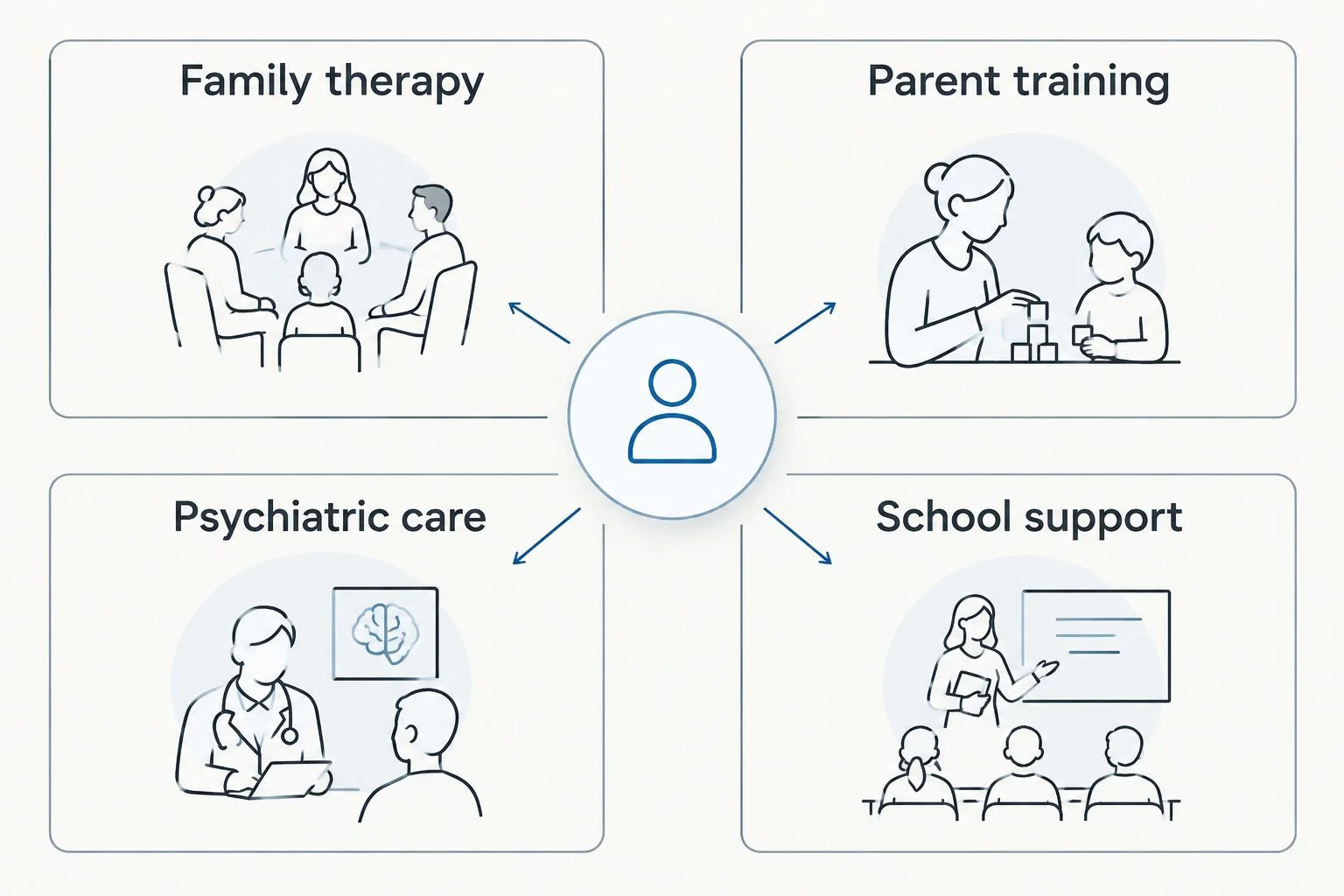
Choose support by the problem it addresses, not by the appointment format.
| Option (unranked) | Needs it may address | Main benefit | Key limitation |
|---|---|---|---|
| Family therapy | Families experiencing recurring conflict or caregiver disagreement | Addresses communication and interaction patterns | Does not automatically include ADHD-specific behavior-management training |
| Parent training | Caregivers seeking practical responses to ADHD-related difficulties | Teaches skills caregivers practice between sessions | Requires practice and does not replace diagnostic evaluation |
| Psychiatric care | Children needing diagnostic assessment or medication discussion | Addresses clinical symptoms and medication decisions | Does not replace family communication work or parenting support |
| School support | Children whose difficulties affect learning or school participation | Addresses needs in the educational setting | School eligibility and services differ from clinical treatment |
| Telehealth therapy | Families able to participate in a private remote setting | Removes the need to travel to the appointment | Privacy, technology, engagement, and clinical suitability need consideration |
Ask a prospective provider to explain how these options fit together. A clear answer names the treatment goal, the clinician’s role, and the work expected outside appointments.
Explore support for your family
Review therapy and psychiatric care, then ask about ADHD-focused caregiver support.
Common mistakes parents make
Assuming any family therapist provides parent training
A clinician can be skilled at family communication without providing structured ADHD behavior-management training. Ask directly about the methods used and what you will practice. Choose demonstrated fit with your goal, not the service label alone.
Expecting the child to do all the changing
Parent-focused treatment asks adults to adjust instructions, routines, and responses. That is not an admission of fault. It recognizes that caregivers control parts of the environment that a child cannot change independently.
Using therapy to settle who is right
Caregivers often arrive with different explanations for the same behavior. Turning the session into a contest makes a shared plan harder. Bring a concrete example and ask what each adult can do differently next time.
Confusing telehealth with treatment intensity
An online appointment does not tell you whether care is individual therapy, family therapy, parent training, or a more intensive program. Compare the actual treatment structure and clinical suitability before comparing convenience.
Changing medication or abandoning evaluation on your own
Family work and clinical treatment can serve different purposes. Do not stop, start, or change a child’s prescribed medication based on a difficult week or advice from another family. Discuss concerns with the prescribing clinician.
FAQ
What is the best family therapy for parents of children with ADHD in Ohio?
The best fit addresses your family’s specific goal and includes ADHD-focused parenting skills when those are needed. Ask about behavioral parent training, caregiver participation, and coordination with your child’s other clinicians rather than relying on the family therapy label.
Is family therapy the same as behavioral parent training?
No. Family therapy addresses relationships and communication, while behavioral parent training teaches caregivers specific behavior-management skills. A clinician can combine approaches, but you should confirm what the treatment includes.
Does my child need to attend every family therapy appointment?
Not necessarily; attendance depends on the treatment approach and your child’s needs. Parent-focused sessions can teach caregiver skills without the child present, while other sessions include the child or additional family members.
Can Ohio parents use telehealth for ADHD family support?
Telehealth may be appropriate depending on the treatment, your child’s needs, and your household’s privacy and technology. SOS Wellness requires patients to be physically in Ohio during video visits. Ask whether the family or parent-focused service you need is available remotely, how emergencies are handled, and whether your plan covers it.
Can family therapy replace ADHD medication?
Family therapy is not a direct substitute for medication management. It addresses relationships and caregiver responses, while medication decisions belong with the prescribing clinician and depend on the child’s clinical needs.
What should I bring to the first appointment?
Bring examples of difficult routines, your main goals, and relevant school or clinical information. Include what already helps and ask the provider which records or participants are needed before the visit.
What should I do if my child is in immediate danger?
Call 911 for an immediate emergency or life-threatening danger. In the United States, call or text 988 for suicide or mental health crisis support; routine family therapy appointments are not emergency care.
One last thing
Bring an example of a good day, not just a difficult one. The instruction that worked, the transition that went smoothly, or the moment your child accepted help can give a therapist something concrete to build on.
For your next appointment, finish this sentence: We want help making this routine easier for everyone. That is a more useful starting point than asking a clinician to fix your child.
Further reading
Related reading
This article provides general educational information and does not replace an individual clinical assessment. Contact your healthcare provider about your own care.