

Yes, adults can get an autism diagnosis in Ohio through a qualified clinician who evaluates adults and has experience assessing autism. A screening questionnaire is not a diagnosis; a full evaluation considers your current experiences, developmental history, daily functioning, and other possible explanations for your symptoms.
At a glance
- Adult autism diagnosis Ohio: seek a clinician experienced in evaluating adults, not just administering screening questionnaires.
- Childhood records help, but missing report cards or an unavailable parent do not automatically prevent an evaluation.
- Autism, ADHD, and anxiety can overlap; an assessment should consider both alternative and coexisting conditions.
- SOS Wellness provides Ohio mental health care; ask directly whether adult autism evaluations are offered.
Why this matters
An adult autism evaluation can help explain longstanding difficulties with communication, sensory experiences, routines, or relationships. It can also help you identify support needs without treating every struggle as a personal failure.
SOS Wellness is an option for Ohio adults seeking outpatient mental health care. Its stated services include psychiatry, therapy, medication management, addiction treatment, and telehealth; when contacting SOS Wellness, ask specifically about adult autism assessment rather than assuming a general psychiatric appointment includes one.
The right next step is an appropriate evaluation, not proving that you fit every description of autism you have encountered online. Your clinician should consider what you experience, how long it has been present, and how it affects your life.
Can adults get diagnosed with autism in Ohio?
Yes. Autism can be diagnosed in adulthood, including when nobody recognized the signs during childhood. Adult recognition does not mean autism began in adulthood: diagnostic criteria require symptoms to have been present during early development, although they can become clearer when demands exceed a person's coping strategies.
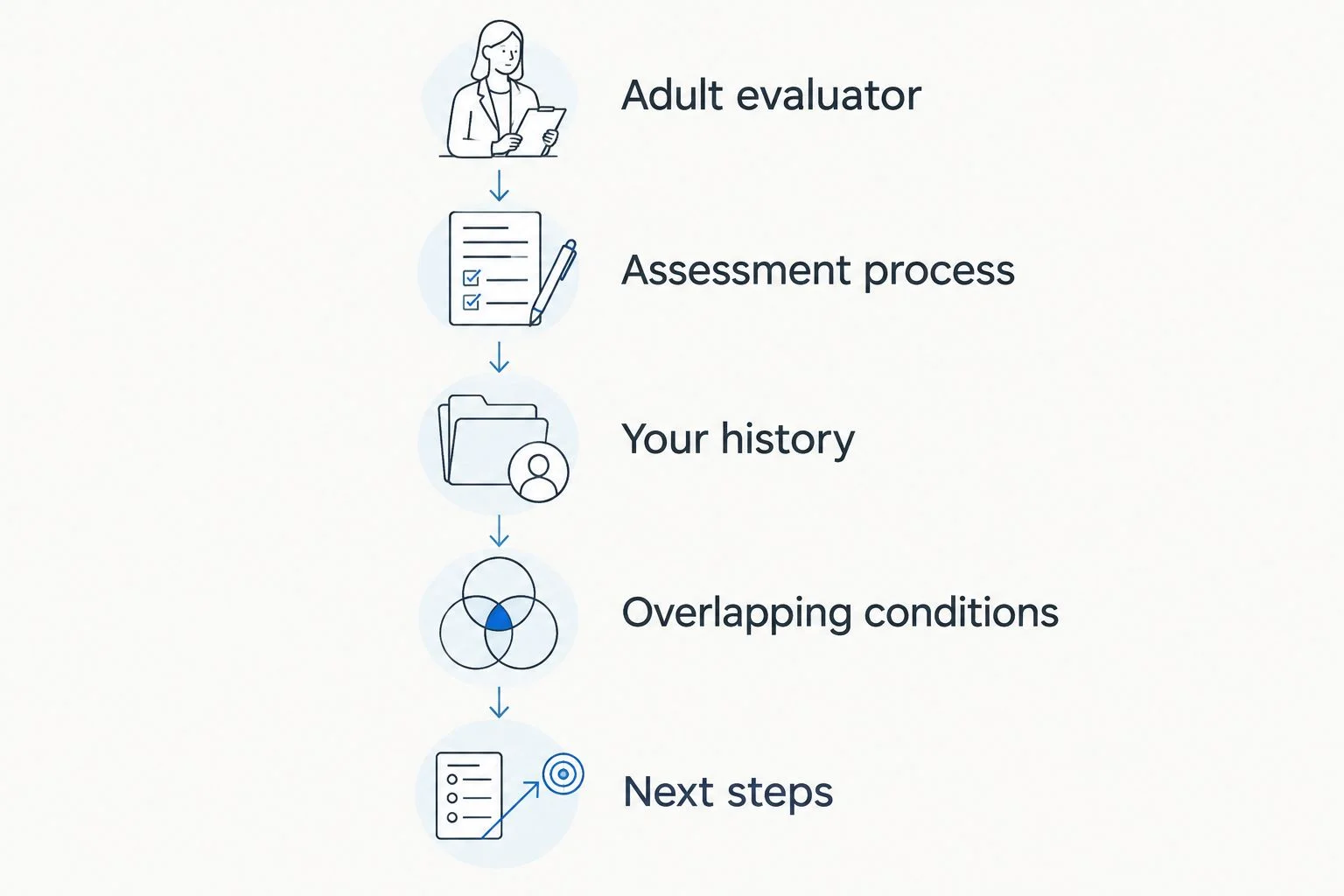
To seek an adult autism evaluation in Ohio, start with these steps:
- Find an adult evaluator. Ask whether the clinician evaluates adults for autism, what relevant training they have, and whether the appointment is diagnostic or only a screening.
- Confirm the assessment process. Ask about interviews, developmental history, questionnaires, observation, and any additional testing the clinician considers appropriate.
- Prepare your history. Bring examples from childhood and adulthood, including experiences at school, work, home, and in relationships. Available records can help, but do not delay asking for care because your records are incomplete.
- Discuss overlapping conditions. Explain previous diagnoses, current medications, sleep concerns, substance use, and any history of anxiety, depression, ADHD, or trauma.
- Request an explanation and next steps. Ask how the clinician reached the conclusion, what remains uncertain, and what support recommendations follow from the findings.
A useful assessment explains the reasoning. You should leave understanding why the findings support autism, another explanation, or the need for further evaluation.
Confirm that the appointment includes an adult autism evaluation before preparing for it.
What does an adult autism evaluation look for?
An autism evaluation looks for a developmental pattern, not a single personality trait. Preferring quiet spaces, feeling socially exhausted, or disliking unexpected changes does not establish autism on its own.
The DSM-5-TR diagnostic framework requires persistent difficulties in all 3 social-communication domains: social-emotional reciprocity, nonverbal communication, and developing, maintaining, or understanding relationships. It also requires features in at least 2 of 4 restricted or repetitive behavior domains, early developmental onset, and clinically significant effects on current functioning.
The four restricted or repetitive domains involve repetitive movements, use of objects, or speech; insistence on sameness or routines; highly restricted or fixated interests; and unusual sensory responses or interests. The clinician also assesses alternative and coexisting conditions. The pattern must not be better explained by intellectual disability or global developmental delay; autism and intellectual disability can coexist.
Describe actual situations rather than trying to translate yourself into diagnostic language. For example, explain what happens when a meeting changes unexpectedly, how you interpret indirect requests, or how noise affects your ability to complete a task.
Does masking affect the evaluation?
Masking means hiding, suppressing, or compensating for traits to meet social expectations. You might rehearse conversations, copy another person's expressions, or appear comfortable during an interaction that leaves you exhausted afterward.
Tell the evaluator about both your outward behavior and the effort behind it. A polished conversation during an appointment does not, by itself, resolve whether you meet diagnostic criteria.
Screening, diagnostic assessment, or broader testing?
Choose an appointment that answers your question. Screening, diagnostic assessment, and broader psychological testing have different purposes; none should be presented as interchangeable.
| Option | Potential fit | What it contributes | Main limitation |
|---|---|---|---|
| Autism screening | Deciding whether to seek further assessment | Identifies experiences that warrant discussion | Cannot establish or rule out autism by itself |
| Adult autism diagnostic assessment | Determining whether autism criteria are met | Combines clinical history, current functioning, and appropriate assessment methods | Depends on relevant clinician experience and the information available |
| Broader psychological or neuropsychological evaluation | Exploring a more complex diagnostic question | Can examine additional areas such as attention, learning, or cognition when indicated | Not every adult needs broad testing to answer an autism question |
Ask the clinician why the proposed approach fits your situation. A longer list of tests is not automatically more informative than a focused assessment with a clear clinical rationale.
If you need documentation for a particular purpose, ask the receiving organization what it requires before arranging testing. An employer, school, or benefits program can have documentation requirements separate from the clinician's diagnostic process.
Why adult autism evaluations vary
Adult evaluations differ because clinicians are answering different questions with different information. These factors affect the assessment process:
- Developmental information. Childhood records or an interview with someone who knew you early in life can clarify when traits began.
- Coexisting conditions. ADHD, anxiety, depression, and other conditions can require additional assessment rather than an either-or decision.
- Communication needs. The clinician should consider how you communicate and what adjustments help you participate meaningfully.
- Compensating strategies. Learned social scripts and routines can make difficulties less visible during a brief appointment.
- The referral question. Seeking diagnostic clarification differs from seeking a broader evaluation of attention, learning, or daily functioning.
- Documentation needs. A report intended to guide treatment can serve a different purpose from paperwork requested by an outside organization.
Ask what is included before scheduling. Find out whether you will receive a feedback appointment, a written report, and recommendations tailored to the assessment findings.
Can I get diagnosed without childhood records or a parent's help?
Yes, an adult autism evaluation can proceed without a parent's participation or childhood report cards. The clinician still needs to investigate early development and explain how the available evidence supports the conclusion.
You can bring your own memories, school comments, previous evaluations, or observations from another person who knew you when you were young. Examples of friendships, play, sensory experiences, routines, and school transitions can be useful.
Be clear about what you remember and what you do not. You do not need to reconstruct an exact childhood timeline or turn uncertainty into certainty to deserve an evaluation.
An evaluator can also explain when missing information limits diagnostic confidence. That is different from automatically excluding you because a parent is unavailable, unwilling to participate, or unable to remember details.
Can autism be confused with ADHD or anxiety?
Autism, ADHD, and anxiety can share outward features, and they can occur together. Difficulty concentrating, avoiding social situations, or becoming overwhelmed does not identify the cause on its own.
The evaluator should ask what drives the difficulty. Avoiding a gathering because you fear judgment differs from avoiding it because the noise is overwhelming, although both experiences can happen together.
An ADHD assessment examines patterns of inattention and/or hyperactivity-impulsivity. An autism assessment examines social communication and restricted or repetitive patterns across development; a thorough clinical history helps distinguish overlapping experiences without assuming only one diagnosis is possible.
Do not stop an existing treatment or medication because an online description feels more accurate than a previous diagnosis. Bring that concern to your prescribing clinician and discuss whether reassessment is appropriate.
What should I ask before booking an evaluation?
Ask direct questions before committing to an appointment. You are checking whether the clinician's service matches your goal, not testing whether you know enough about autism.
- Do you diagnose autism in adults, including people not identified during childhood?
- Who conducts the evaluation, and what relevant experience do they have?
- Is this appointment a screening, a diagnostic assessment, or a referral consultation?
- How do you assess developmental history when family members cannot participate?
- How do you consider masking, ADHD, anxiety, and other possible explanations?
- What written documentation and feedback are included?
- If the findings do not support autism, will you explain alternative explanations and treatment recommendations?
If you want a virtual appointment, ask whether that clinician can appropriately assess your situation remotely and whether any portion requires an in-person visit. Telehealth mental health care and a remote autism diagnostic assessment are not automatically the same service.
For insurance questions, contact both the practice and your health plan. Verify the specific assessment service and clinician rather than relying only on whether a practice generally accepts your insurance.
What happens after an adult autism diagnosis?
A useful next step is a support plan tied to your daily life. Depending on your needs, that discussion can include communication preferences, sensory adjustments, workplace concerns, therapy, or treatment for coexisting mental health conditions.
Medication may be considered for coexisting conditions or specific associated symptoms, rather than as a treatment for autism itself. A prescribing clinician can discuss whether it is appropriate, including potential benefits, risks, and monitoring.
You can generally choose whether to share a diagnosis with family, friends, or an employer. Privacy protections and disclosure requirements can vary by situation, including accommodation requests and legal obligations. Before sharing a report, ask what information the recipient needs and why.
If an assessment does not result in an autism diagnosis, your difficulties still deserve attention. Ask which findings explain your experiences and what practical help is recommended now.
FAQ
Am I too old to get an autism diagnosis in Ohio?
No. Adults can receive an autism diagnosis in Ohio when a qualified clinician determines that diagnostic criteria are met. The evaluation considers developmental history even when autism was not recognized during childhood.
Can an online autism test tell me whether I am autistic?
No. An online screening questionnaire cannot diagnose autism. Use the results as a starting point for discussing specific experiences with a clinician experienced in adult assessment.
Do I need my parents to attend an adult autism evaluation?
No, a parent's attendance is not automatically required. The evaluator should explain how they gather developmental information and how missing records or family input affect the assessment.
Can I have both autism and ADHD?
Yes, autism and ADHD can occur together. An evaluation should consider each condition rather than assuming that an existing ADHD diagnosis rules out autism.
Can I get an adult autism diagnosis through telehealth?
Some adult autism evaluations can include telehealth, but the clinician must decide whether remote assessment is appropriate for your situation. Confirm that the appointment is diagnostic and ask whether an in-person component is required.
Does SOS Wellness offer adult autism evaluations?
Contact SOS Wellness to confirm whether adult autism diagnostic evaluations are offered. Its services include psychiatry, therapy, medication management, addiction treatment, and Ohio telehealth mental health care. Patients must be physically in Ohio during SOS telehealth visits; availability of general telehealth care does not establish that an autism evaluation can be completed remotely.
What should I do if I need urgent mental health help?
Call or text 988 for suicide or mental health crisis support in the United States. Call 911 for immediate danger or a medical emergency; do not wait for an autism evaluation to seek urgent help.
One last thing
You do not have to wait for diagnostic certainty to explain what makes daily life harder. For your first appointment, bring concrete examples of difficult situations, what you experience internally, and what already helps.
That information is useful whether the eventual explanation is autism, another condition, or more than one condition. The goal is an accurate understanding and appropriate support, not simply a label.
Further reading
Related reading
This article provides general educational information and does not replace an individual clinical assessment. Contact your healthcare provider about your own care.