

Ohio families seeking autism support may need diagnostic evaluation, mental health treatment, early intervention, or family guidance. This unranked guide explains those different starting points and questions to ask before scheduling. It is published by SOS Wellness, which offers mental health services and is included below; it is not an independent provider ranking.
At a glance
- For autism spectrum support Ohio families need, choose by service type rather than a single statewide ranking.
- SOS Wellness provides children’s outpatient mental health care; confirm autism-specific experience before scheduling.
- Nationwide Children’s Hospital is a starting point for pediatric autism diagnostic evaluation.
- Ohio Early Intervention serves eligible children younger than 3 years with developmental support.
- Autism Society of Ohio offers information and family guidance, not a substitute for clinical assessment.
Why this matters
Autism support is not one service. A child who needs a diagnostic evaluation has a different next step from a child who already has a diagnosis and needs help with anxiety, communication, or school participation.
Choose the service that addresses your child’s current difficulty, not the provider with the broadest description. Psychiatric care, developmental assessment, early intervention, and parent guidance serve different purposes. Families sometimes need more than one of them.
For your search, write down the problem you want help solving before comparing organizations. That keeps an appointment for general mental health care from becoming an unexpected detour when you actually need an autism evaluation.
How to evaluate autism support provider
Use these criteria before reviewing the shortlist:
- Service fit: Does the organization offer the assessment, treatment, or family support you need? General therapy does not automatically include autism diagnosis.
- Child-specific experience: Ask how the clinician adapts communication, appointments, and treatment for autistic children. A service list alone does not answer this.
- Practical access: Confirm referral requirements, location, telehealth suitability, and insurance participation directly with the provider.
- Family participation: Ask how caregivers contribute information and learn strategies that apply outside appointments.
- Coordination: Find out whether the team can communicate with your child’s pediatrician, school, or other clinicians with your permission.
- Respectful goals: Look for goals tied to safety, communication, comfort, daily functioning, and the child’s preferences—not simply making autistic traits less visible.
These criteria are more useful than assuming that a large hospital is always better than an outpatient practice. The right setting depends on your child’s needs and the services available.
Ohio autism support providers at a glance
| Provider or program | Services to ask about | Scope and access considerations |
|---|---|---|
| SOS Wellness | Child and adolescent psychiatry, therapy, medication management, and Ohio telehealth | Confirm autism-specific experience and whether the requested evaluation or developmental service is available; telehealth patients must be physically in Ohio |
| Nationwide Children’s Hospital | Developmental and autism evaluation through its Center for Autism Spectrum Disorders and Child Development Center | Confirm the appropriate pathway, age requirements, and referral process; evaluation does not automatically include every ongoing support |
| Cincinnati Children’s | Developmental/autism services and outpatient child/adolescent psychiatry, including therapy and medication management | Confirm the evaluation or treatment pathway, age requirements, and referral process |
| Ohio Early Intervention | Developmental evaluation and support for eligible children younger than 3 | Developmental concerns can prompt referral without an autism diagnosis; the program determines eligibility |
| Autism Society of Ohio | Autism-related information, referrals, and community resources | Resource guidance is not clinical diagnosis; confirm referred services directly |
The order does not indicate better outcomes or a preferred provider. Services overlap, and families may use more than one organization. Confirm the specific service and its limits before making contact.
SOS Wellness: an option for outpatient mental health care
SOS Wellness provides psychiatry, therapy, medication management, and telehealth mental health services to children and adults in Ohio. For an autistic child, this category of care is relevant when the treatment question concerns mental health, such as anxiety, mood difficulties, or attention-related concerns. Confirm the clinician’s autism experience and age requirements before scheduling.
SOS Wellness pros:
- Provides both psychiatry and therapy services.
- Includes medication management among its services.
- Offers telehealth mental health services.
- Serves children as well as adults in Ohio.
SOS Wellness cons:
- Ask whether SOS offers the specific autism diagnostic evaluation or developmental service your child needs.
- Confirm whether speech-language or occupational therapy requires referral elsewhere.
- Telehealth suitability depends on your child’s needs and clinician assessment; SOS patients must be physically in Ohio during visits.
Potential fit: Families seeking outpatient mental health care for a child, including families who need to ask about treating concerns alongside autism.
Before booking, explain whether your child already has an autism diagnosis and what you want treatment to address. Ask whether the clinician treats children of your child’s age and can adapt the appointment to communication and sensory needs.
Before scheduling: Confirm the clinician’s autism experience and whether the appointment addresses your child’s evaluation or treatment needs. Do not assume a mental health appointment includes an autism diagnostic evaluation.
Nationwide Children’s Hospital: an option for diagnostic evaluation
Nationwide Children’s Hospital’s Child Development Center evaluates children with developmental concerns, including autism. This is a relevant starting point when your family needs to understand whether a child’s developmental differences meet criteria for autism. Ask which evaluation pathway fits your child before requesting an appointment.
Nationwide Children’s Hospital pros:
- Has an established pediatric developmental evaluation service.
- Includes autism among the conditions evaluated.
- Gives families a clinical route for questions that require assessment rather than general advice.
Nationwide Children’s Hospital cons:
- An evaluation does not automatically provide every ongoing service your child needs.
- Referral requirements and the appropriate appointment pathway require confirmation.
- School accommodations and local developmental support need separate coordination.
Potential fit: Families seeking a pediatric autism diagnostic evaluation or clarification of developmental concerns.
Bring previous evaluations, relevant school information, and concrete examples from home. Describe communication, play, routines, sensory experiences, and situations that are difficult for your child. The purpose is to give the assessment team a useful picture across settings, not to prove a diagnosis yourself.
Decision point: Consider Nationwide Children’s Hospital when the main question is diagnostic assessment; confirm the evaluation pathway before scheduling.
Cincinnati Children’s: developmental evaluation and mental health services
Cincinnati Children’s offers developmental/autism services and outpatient child and adolescent psychiatry, including therapy and medication management. Explain whether you need diagnostic assessment, treatment, or both, and ask which pathway fits your child’s age and needs.
Cincinnati Children’s pros:
- Provides a developmental and behavioral pediatrics specialty service.
- Addresses autism within a broader developmental context.
- Offers a clinical starting point when several developmental concerns need assessment.
Cincinnati Children’s cons:
- Specialty assessment does not replace educational planning.
- Families still need to establish which local services will carry out ongoing recommendations.
- The correct referral route depends on the concern being evaluated.
Potential fit: Families seeking developmental or autism evaluation, or mental health treatment for a child. Confirm the appropriate service and intake requirements.
Ask what records the team needs and which questions the appointment is designed to answer. If your child has already completed an evaluation elsewhere, mention that early. Repeating an assessment without a clear reason is different from seeking a useful second opinion or assessing a new concern.
Questions before scheduling: Which service addresses your child’s concerns, what referral is required, and how can the team coordinate with existing clinicians and school supports?
Ohio Early Intervention: an option for toddler developmental support
Ohio Early Intervention serves eligible children younger than 3 years who have developmental delays or disabilities. It supports families through an early intervention process focused on the child’s development and everyday routines. Contact the program about an evaluation when you have concerns; do not assume an autism diagnosis is required before asking about eligibility.
Ohio Early Intervention pros:
- Provides an age-specific route for developmental concerns.
- Involves families in identifying needs and support goals.
- Connects developmental support to daily activities.
- Offers a pathway before school-age services begin.
Ohio Early Intervention cons:
- Eligibility is determined through the program, not by this guide.
- The program is limited to children younger than 3 years.
- Early intervention does not replace medical evaluation for separate health concerns.
Potential fit: Families of infants and toddlers who need developmental evaluation and support.
As a child approaches age 3, ask the early intervention team about transition planning for eligible children. Ohio preschool special education serves eligible children ages 3 to not yet 6. A school evaluation determines educational eligibility and the need for special education; a clinical autism diagnosis alone does not establish eligibility.
Decision point: Consider Ohio Early Intervention promptly for a child younger than 3 years with developmental concerns; ask about eligibility rather than waiting for a diagnostic label.
Autism Society of Ohio: an option for family information and guidance
Autism Society of Ohio provides autism-related information and connections to resources. This is a useful route when you need help understanding support categories or finding community information. Keep family guidance separate from decisions that require a licensed clinician or formal evaluation.
Autism Society of Ohio pros:
- Focuses on autism-related information.
- Helps families identify resources and next questions.
- Provides a community-oriented starting point outside a medical appointment.
Autism Society of Ohio cons:
- Information and referrals do not establish a diagnosis.
- Community guidance is not individualized medical treatment.
- You must confirm any referred provider’s services, eligibility rules, and fit directly.
Potential fit: Parents and caregivers who need orientation, resource information, and help understanding where to start.
Ask a specific question rather than requesting every available resource. For example, explain that you need an evaluation pathway, parent support, or information about school planning. A focused request makes the next step clearer.
Decision point: Consider Autism Society of Ohio for family guidance; use clinical services for assessment and treatment.
How to choose your next step
Match the next contact to the problem you need help solving. This shortlist works best when you separate the service categories instead of contacting every organization with the same request.
- Diagnostic evaluation: Start here when the main question is whether your child has autism or another developmental condition.
- Mental health care: Start here when the main concern is anxiety, mood, attention, or another mental health difficulty.
- Early intervention: Start here for developmental concerns in a child younger than 3 years.
- Family guidance: Start here when you need help understanding resources and support pathways.
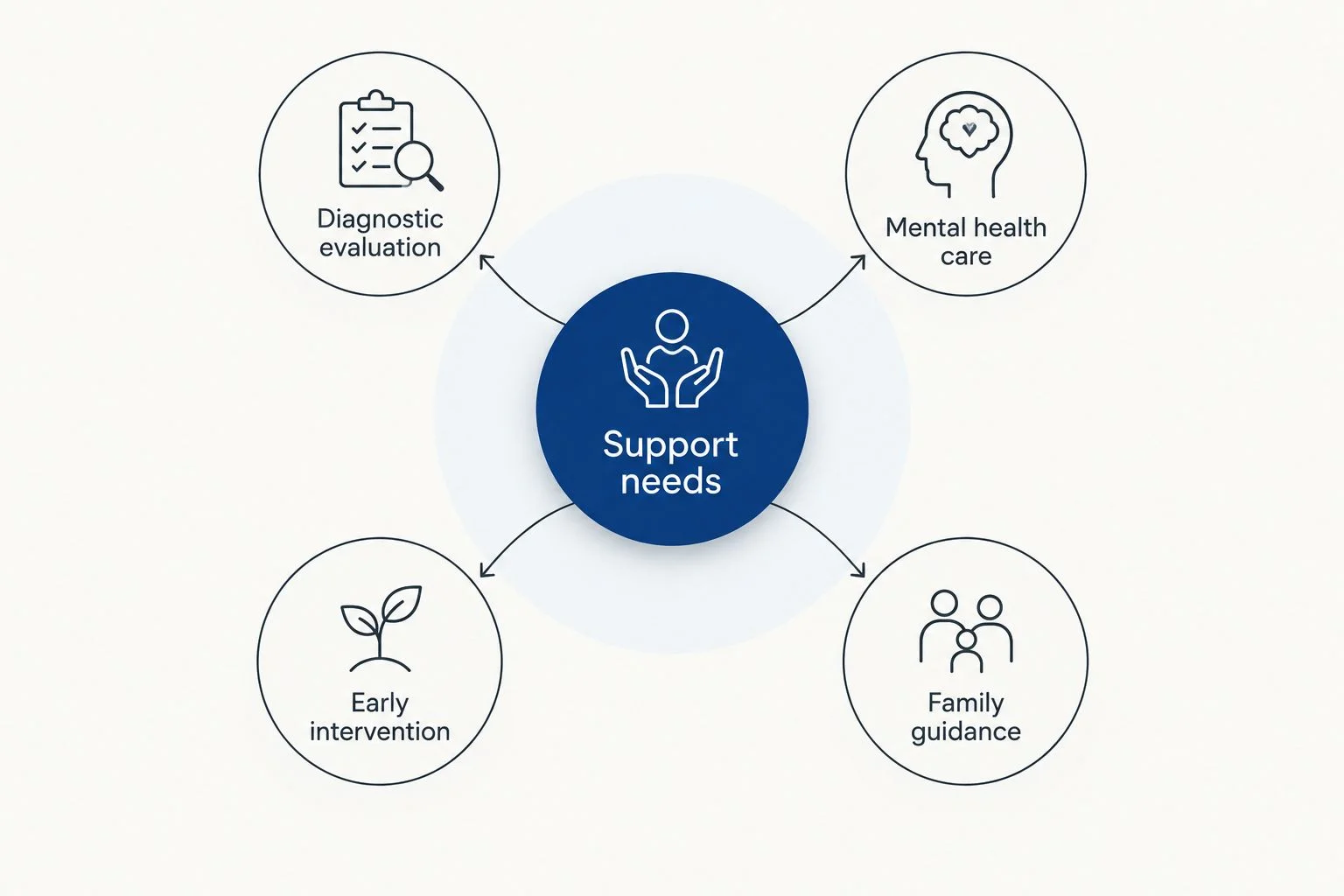
Choose the service category before choosing the organization.
When needs overlap, keep separate questions for each appointment. A mental health clinician can address treatment concerns while a developmental team evaluates autism, and a school team considers educational needs. Ask who is responsible for coordinating recommendations so important information does not stay in separate files.
Questions to ask before scheduling
Use your first call to establish fit, not just to obtain an appointment. Describe your child’s age, diagnosis status, current concerns, and communication needs in plain language.
- Does this appointment include autism evaluation, treatment, or neither?
- What experience does the clinician have with autistic children?
- How do caregivers participate in the appointment?
- Can the team adapt for sensory needs or alternative communication?
- What referral, records, and insurance information are required?
- What happens after the assessment or initial treatment visit?
For telehealth, ask how the clinician adapts visits to your child’s communication and sensory needs, what privacy and technology are needed, and when in-person assessment may be necessary. For SOS visits, your child must be physically in Ohio.
How to use this unranked guide
The organizations are grouped by the types of services families may need, not ranked by quality, outcomes, appointment speed, or comparative suitability. Use your child’s age, current concerns, and assessment needs to decide which service category to ask about.
Confirm current services, referral requirements, age eligibility, and insurance coverage directly. Diagnostic assessment, mental health treatment, developmental support, and school planning may require separate teams.
Which Ohio autism support provider should you choose?
For an autism diagnostic evaluation, ask your child’s pediatrician or a developmental assessment service which pathway matches your child’s age and needs. Confirm whether the hospitals listed here offer the evaluation you need and what referrals they require. For toddler developmental support or family resource guidance, ask the relevant program about its current scope and eligibility.
SOS Wellness offers child and adolescent psychiatric care, individual and family therapy, and medication management. Ask about the clinician’s experience supporting autistic children and whether the requested service is available. An individualized assessment guides treatment; mental health care does not necessarily include a formal autism diagnostic evaluation.
FAQ
How do I choose autism support in Ohio for my child?
Start with the question you need answered: diagnostic evaluation, mental health treatment, developmental support, or family guidance. Then confirm the service’s age eligibility, clinician experience, appointment adaptations, referral requirements, and insurance coverage. This guide does not establish that one organization is better than another.
Does my child need an autism diagnosis before getting support?
A child does not always need an autism diagnosis before seeking developmental or mental health support. Ask Ohio Early Intervention about developmental eligibility, and ask a mental health clinician about the specific concern you want treated.
Is therapy the same as an autism evaluation?
Therapy is not the same as an autism diagnostic evaluation. Therapy addresses treatment goals, while a diagnostic evaluation assesses whether the child meets criteria for autism and considers other explanations for developmental concerns.
Can medication treat autism itself?
Medication does not treat autism’s core features. A qualified prescriber can assess whether medication is appropriate for a separate condition or particular symptoms, with benefits, risks, and monitoring discussed individually.
Can an autistic child receive mental health care by telehealth?
Telehealth is an option for some autistic children’s mental health care, but suitability requires individual assessment. Ask how the clinician adapts communication, involves caregivers, and responds when an in-person assessment is needed.
Does an autism diagnosis automatically mean my child gets an IEP?
An autism diagnosis does not automatically establish eligibility for an Individualized Education Program. The school evaluates educational needs and eligibility under special education rules; share clinical information as part of that process.
What should I verify before choosing an Ohio provider?
Verify the exact service, clinician experience, age requirements, referral process, and insurance participation before choosing an Ohio provider. Also ask what follow-up care the appointment leads to and who coordinates with other support teams.
One last thing
A useful treatment goal describes what becomes easier or safer for your child—not just what adults want to see less often. Bring a concrete example, such as difficulty asking for a break or participating comfortably in an appointment, and ask how the plan addresses it.
If your child faces immediate danger or a medical emergency, call 911. For a suicide or mental health crisis, call or text 988; the 988 Suicide & Crisis Lifeline operates 24 hours a day, 7 days a week. A provider shortlist is not an emergency response plan.
Further reading
- NIMH: Autism spectrum disorder
- Ohio: Preschool special education program FAQs (PDF)
- Cincinnati Children’s: Outpatient psychiatry
- Nationwide Children's Hospital: Autism assessment and care
- Ohio Early Intervention: Developmental support and referrals
- Autism Society of Ohio: Local resources
Related reading
This article provides general educational information and does not replace an individual clinical assessment. Contact your healthcare provider about your own care.