

Choosing OCD care involves comparing treatment methods, clinician experience and the level of support you need. This unranked decision guide covers exposure and response prevention (ERP), medication assessment, combined care, intensive programs and care for young people. It is published by SOS Wellness, which offers Ohio psychiatry, therapy, medication management and telehealth services and has a commercial interest in care inquiries. Confirm each clinician’s OCD-specific expertise before choosing care.
At a glance
- When comparing OCD care in Ohio, ask about the clinician’s exposure and response prevention training and experience treating OCD.
- SOS Wellness provides Ohio mental health services; confirm OCD-specific treatment methods before booking.
- Medication management and ERP address different treatment needs and can be combined.
- Choose treatment intensity around daily functioning, safety, and the clinician’s assessment.
Why this matters
OCD involves unwanted obsessions and compulsions that interfere with daily life. Compulsions include visible actions, such as checking, and mental rituals, such as reviewing memories or silently repeating phrases. Treatment needs to address that cycle, not just help you feel calmer during appointments.
When choosing a clinician, consider both professional credentials and OCD-specific treatment experience. The International OCD Foundation identifies ERP as a first-line psychotherapy for OCD; NIMH also describes psychotherapy and medication as established treatment options.
This guide compares treatment routes by purpose without ranking them or individual Ohio clinicians. Some routes work together. The right starting point depends on your symptoms, age, previous treatment, safety needs and ability to manage daily responsibilities.
How to evaluate OCD treatment in Ohio
Use these criteria before comparing providers:
- ERP training: Ask how the clinician learned ERP and how they use it with OCD, including mental compulsions.
- Treatment structure: Look for an assessment, agreed goals, exposure planning, and practice between appointments.
- Medication coordination: Ask who handles prescriptions and how the therapist and prescriber communicate when both are involved.
- Age-appropriate care: Children need developmentally appropriate treatment and clear guidance for caregivers.
- Appropriate intensity: The setting should match your functional difficulties and safety needs, rather than convenience alone.
- Progress tracking: Ask how the clinician tracks symptoms, functioning, and changes in compulsive behavior.
Credentials matter, but a license does not establish ERP expertise. Ask for an explanation of what treatment will involve. A clinician should be able to describe the approach in plain language without promising a cure.
OCD treatment options at a glance
| Treatment route | Potential fit | Service or approach | Key limitation |
|---|---|---|---|
| Outpatient ERP | Starting OCD-specific psychotherapy | Planned exposure while reducing rituals | Requires practice and willingness to experience discomfort |
| OCD-focused psychiatric care | Assessing medication needs | Prescription assessment and monitoring | Medication management does not teach ERP skills |
| Combined ERP and medication | Needing both behavioral treatment and prescribing | Addresses symptoms through coordinated approaches | Requires communication across clinicians |
| Intensive ERP-based care | Symptoms seriously disrupting daily functioning | More concentrated treatment support | A general intensive program is not necessarily OCD-specific |
| Child and adolescent OCD care | Young people whose caregivers need guidance | Developmental adaptation and family involvement | General child therapy is not automatically OCD treatment |
Outpatient ERP: an option for starting OCD-specific therapy
Exposure and response prevention is a form of cognitive behavioral therapy. You work with a clinician to approach situations, thoughts, or sensations that trigger obsessions while reducing the compulsions used to seek relief. Exposures should be planned collaboratively, not imposed as surprises.
The aim is not to prove that every feared outcome is impossible. It is to help you respond differently to uncertainty and distress. ERP can address checking, contamination fears, unwanted intrusive thoughts, and mental rituals; the plan should reflect your actual symptom pattern.
Outpatient ERP pros:
- Directly targets the obsession-compulsion cycle.
- Builds skills you can practice outside appointments.
- Can address both visible rituals and less obvious mental compulsions.
Outpatient ERP cons:
- Practice involves discomfort rather than immediate reassurance.
- Appointment attendance alone is not enough; between-session work matters.
Potential fit: Someone seeking OCD-specific psychotherapy who can participate safely in outpatient treatment.
Ask the clinician what happens when an exposure becomes another ritual. For example, repeating an exercise until it feels perfectly complete can preserve the same cycle treatment is meant to change. An OCD-trained clinician should recognize that distinction.
Decision point: Ask whether outpatient ERP fits your symptoms, preferences and support needs. Seek a clinical assessment rather than designing difficult exposures on your own.
OCD-focused psychiatric care: an option for medication assessment
Psychiatric care evaluates whether medication belongs in your treatment plan. Selective serotonin reuptake inhibitors, commonly called SSRIs, are established medication options for OCD. A prescriber reviews symptoms, other health conditions, current medicines, potential side effects, and treatment response.
SOS Wellness provides psychiatry and medication management in Ohio. Those services make SOS Wellness an option for seeking a mental health assessment, but they do not by themselves establish that a particular clinician specializes in OCD. Ask directly about the prescriber’s OCD experience and coordination with ERP providers.
OCD-focused psychiatric care pros:
- Provides medical assessment before prescribing decisions.
- Supports monitoring of benefits and side effects.
- Can coordinate treatment when depression or other conditions are also present.
OCD-focused psychiatric care cons:
- Medication management does not replace learning how to reduce compulsions.
- Finding an appropriate medication plan requires follow-up, not just an initial prescription.
Potential fit: Someone considering medication, reviewing an existing prescription, or needing assessment of overlapping symptoms.
Bring a written medication history if you have one. Include what you took, how you responded, and why treatment stopped; do not change or discontinue medication without discussing it with your prescriber.
Decision point: Consider OCD-focused psychiatric care for prescribing decisions, not as a substitute for assessing ERP.
Combined ERP and medication: an option for coordinated treatment
Combined treatment pairs OCD-specific psychotherapy with medication management. ERP addresses your responses to obsessions; medication is assessed and monitored by a prescribing clinician. The combination is a treatment option, not a requirement for everyone with OCD.
Coordination matters because different clinicians see different parts of the picture. Your therapist needs to know about changes that affect participation, while your prescriber needs an accurate account of functioning and symptoms. With your permission, they should have a clear way to communicate.
Combined ERP and medication pros:
- Includes both behavioral treatment and prescribing support.
- Allows medication concerns and therapy progress to inform the care plan.
- Gives you distinct professionals for distinct treatment tasks.
Combined ERP and medication cons:
- Separate appointments add organizational demands.
- Poor communication can leave you carrying conflicting instructions between clinicians.
Potential fit: Someone whose clinical assessment supports both ERP and medication, including people who have not improved enough with one approach alone.
Ask who coordinates the plan and whom to contact about different concerns. A therapy question, a medication side effect, and an immediate safety concern need different responses. Establish those responsibilities before confusion develops.
Decision point: Consider combined care when assessment supports both approaches; do not assume more treatment automatically means better treatment.
Intensive ERP-based care: an option for major daily disruption
Intensive treatment provides more concentrated support than routine outpatient appointments. Depending on the program, care can take place through an intensive outpatient program, partial hospitalization, or another structured setting. These labels describe care arrangements, not proof of OCD expertise.
When comparing Ohio programs for OCD treatment, ask whether ERP is part of treatment and who delivers it. Supportive groups and general coping skills are not the same as OCD-specific ERP, though they may serve other clinical needs. Consider treatment content, intensity and safety support together.
Intensive ERP-based care pros:
- Provides a structured setting for concentrated treatment work.
- Offers additional support when routine outpatient care does not meet assessed needs.
- Can help organize treatment around significant functional impairment.
Intensive ERP-based care cons:
- Participation can disrupt work, school, or caregiving responsibilities.
- You need a plan for continuing care after the program ends.
Potential fit: Someone whose OCD substantially disrupts daily functioning or whose clinician recommends a higher level of care.
Ask about individual exposure work, handling mental rituals, caregiver involvement, and transition planning. Virtual delivery also requires an assessment of whether the format suits your clinical needs and home environment.
Decision point: Choose treatment intensity through clinical assessment. For OCD-focused treatment, ask about ERP expertise; do not delay necessary stabilization or higher-level care simply because a program does not provide ERP. Ask how OCD-specific treatment will be coordinated or continued afterward.
Child and adolescent OCD care: an option for family-guided treatment
Children and teenagers need treatment adapted to their understanding, developmental stage, and daily routines. An OCD clinician should distinguish compulsions from other repetitive behaviors and assess how symptoms affect home life, school, friendships, and sleep. Caregiver involvement should have a clear purpose.
Family accommodation means participating in rituals or changing routines to help someone avoid distress. Parents often do this out of care, not because they caused OCD. Treatment can help families reduce accommodation while staying supportive and avoiding blame.
Child and adolescent OCD care pros:
- Adapts explanations and exposure work to the young person.
- Gives caregivers practical guidance about reassurance and rituals.
- Can address school-related difficulties with appropriate consent and coordination.
Child and adolescent OCD care cons:
- Changes in family responses can initially feel difficult.
- General pediatric counseling does not establish experience treating OCD.
Potential fit: Children and teenagers who need OCD-specific treatment with caregiver participation.
SOS Wellness serves children, adults, and families in Ohio. For a child’s OCD treatment, confirm the individual clinician’s age range and ERP experience rather than treating broad pediatric services as proof of specialization.
Decision point: Ask about developmentally adapted OCD treatment and caregiver guidance. Reassurance alone is not ERP, but supportive care may still be needed alongside OCD-specific treatment.
How to choose your next appointment
Use these 4 steps to turn a search into a treatment decision:
- Describe symptoms. Write down obsessions, visible rituals, mental rituals, avoidance, and effects on daily life.
- Confirm expertise. Ask whether the clinician provides ERP for OCD and how treatment is structured.
- Check fit. Discuss age range, telehealth suitability, medication coordination, and the recommended care setting.
- Plan follow-up. Ask how progress will be reviewed and what happens if the initial plan is not helping.
A useful first appointment produces more than a label. You should understand the proposed approach, your role in treatment, and the next decision. Bring 1 written symptom summary rather than trying to remember every detail under pressure.
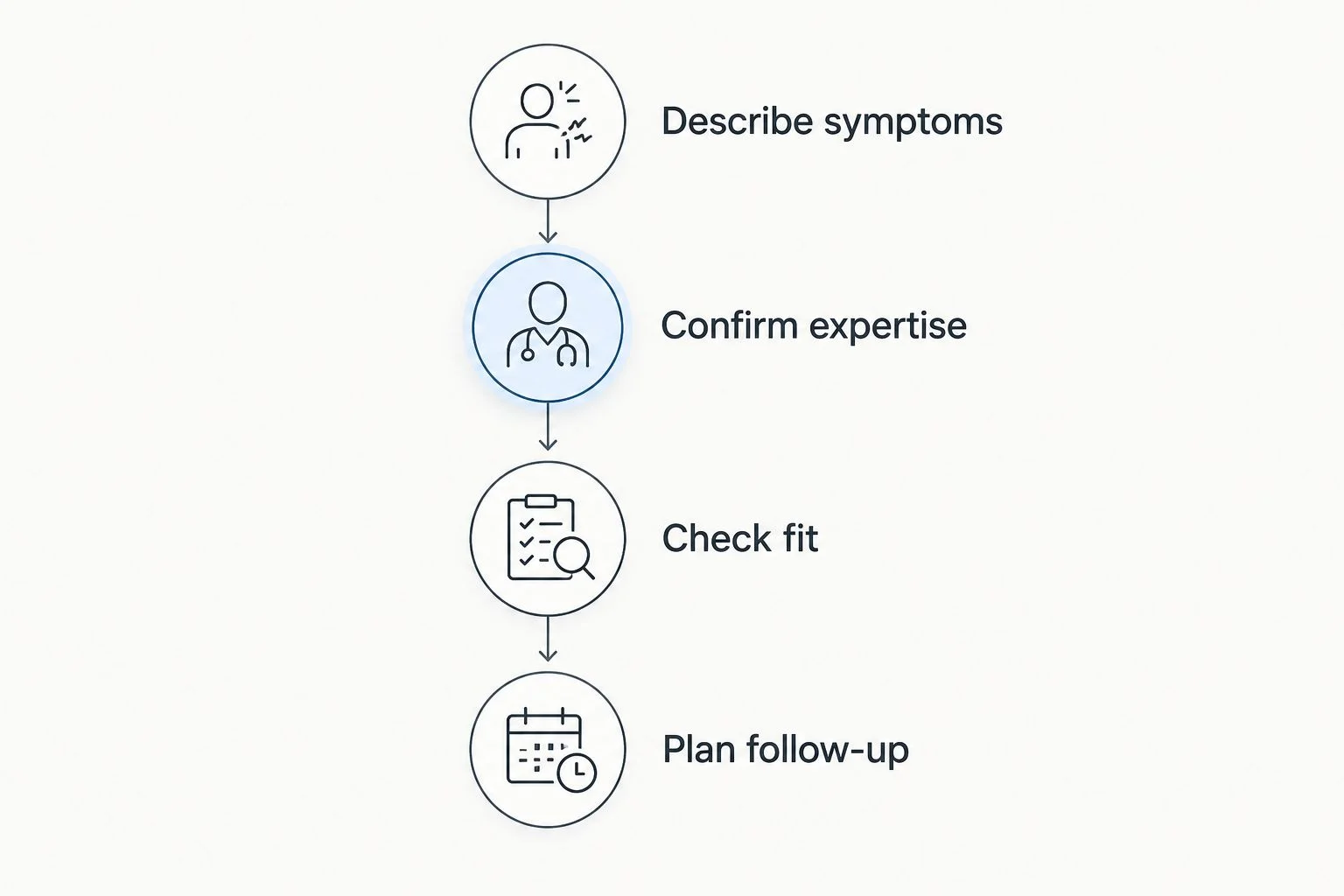
Confirm OCD-specific expertise before choosing a treatment setting.
For your consultation, ask 3 direct questions: Do you provide ERP for OCD? How do you address mental compulsions? How will we know whether treatment is helping? Listen for specific explanations, not guarantees.
Explore Ohio mental health care
Review psychiatry, therapy, and telehealth services, then ask about OCD-specific clinical experience.
How to use this unranked treatment guide
The order of these sections is not a ranking of effectiveness or providers. They describe different decisions: choosing OCD-specific psychotherapy, assessing medication, coordinating both approaches, considering greater treatment intensity and adapting care for young people. These options can overlap within an individualized care plan.
No provider’s general service list establishes specialist skill, treatment results, or suitability for your situation. Use the selection criteria above and an individual clinical assessment to compare options.
Which OCD treatment should you choose?
If you are undecided, seek an individualized assessment of symptoms, safety and treatment needs. Ask about ERP, whether medication assessment would be useful and what level of care fits your functioning and support needs.
SOS Wellness is an Ohio option for people seeking psychiatry, therapy, and telehealth mental health services. Confirm OCD-specific expertise before selecting a clinician. Your best choice is a treatment plan that names the method, fits your needs, and includes a way to review progress.
FAQ
How should I choose OCD treatment in Ohio?
ERP is an established first-line psychotherapy for OCD. Compare clinicians’ OCD experience, treatment methods, age eligibility, care settings and coordination options. An assessment can help determine whether ERP, medication or combined care fits your needs.
Is ERP better than general talk therapy for OCD?
ERP specifically targets the obsession-compulsion cycle, while general supportive talk therapy does not necessarily do that. Ask whether therapy includes planned exposure and response prevention rather than discussion or reassurance alone.
Does SOS Wellness provide OCD treatment?
SOS Wellness lists OCD among its care areas and offers psychiatry, therapy, medication management and Ohio telehealth. Confirm the individual clinician’s OCD assessment experience, ERP training and availability before scheduling OCD-focused treatment.
Can OCD treatment work through telehealth?
Telehealth may suit some mental health care needs. For OCD, ask whether the clinician offers ERP by video and whether your assessment supports that format. Discuss privacy, safety, connectivity, exposure planning and access to in-person support if needed. SOS patients must be physically in Ohio during virtual visits.
Do I need medication as well as ERP?
Not everyone needs both medication and ERP. A clinical assessment should guide whether psychotherapy, medication, or a combined approach fits your symptoms and treatment history.
When should I consider intensive OCD treatment?
Seek an assessment for more intensive care when OCD seriously disrupts daily functioning or routine outpatient treatment does not meet your needs. Ask whether the program provides OCD-specific ERP or coordinates it elsewhere. Necessary stabilization should not be delayed while searching for an ERP program.
How do I find an OCD specialist for my child?
Look for a clinician experienced in both pediatric OCD and developmentally adapted ERP. Ask how caregivers participate and how treatment addresses family accommodation without blaming the child or parents.
What should I do if I need urgent mental health help?
Call 911 for an immediate life-threatening emergency, or call or text 988 for suicide and crisis support in the United States. Urgent safety concerns need immediate help rather than waiting for an outpatient OCD appointment.
One last thing
An intrusive thought is not the same as an intention. OCD can involve unwanted thoughts that conflict with what a person values, and repeatedly seeking certainty about those thoughts can become a compulsion. Describe the thought, your reaction, and any rituals honestly so a qualified clinician can assess the full pattern, including safety.
Further reading
Related reading
This article provides general educational information and does not replace an individual clinical assessment. Contact your healthcare provider about your own care.