

Online anxiety treatment has no fixed deadline for improvement. Therapy and medication may need several weeks of follow-up to assess sustained benefit, but safety concerns and side effects may require earlier attention. A recommended therapy course is not the same as a predicted time to symptom relief. Your diagnosis, treatment plan, and changes in daily functioning help your clinician decide when to reassess.
At a glance
- There is no single time to improvement; agree on follow-up timing with your clinician rather than waiting for a fixed deadline.
- CBT course length depends on the diagnosis and individual needs; a session count does not predict when relief will begin.
- SOS Wellness offers Ohio telehealth for psychiatric care and therapy. Patients must be physically in Ohio during visits, and staff confirm suitability and availability.
- Measure progress through sleep, avoidance, and daily activities—not just whether anxiety disappears.
How long does online anxiety treatment take to work?
There is no single reliable average for online anxiety treatment. The treatment, diagnosis, and goals matter more than whether you attend through a screen. Feeling understood after an appointment is valuable, but it is different from a sustained reduction in anxiety.
The guideposts below draw on NHS antidepressant information and NICE guidance on generalized anxiety disorder in adults. NICE is UK guidance, not an Ohio treatment standard. Course length and medication review schedules do not predict when relief will begin or describe results measured at SOS Wellness.
| Treatment | Timing guidepost | When it may be considered | Main limitation |
|---|---|---|---|
| CBT | UK NICE guidance describes usually 12–15 weekly sessions for adult generalized anxiety disorder, with fewer or more depending on clinical needs | People seeking structured work on anxious thinking, avoidance, and behavior | Course length does not predict first benefit or apply to every diagnosis |
| Medication | Response and reassessment timing depend on the medicine, condition, and individual | People whose assessment supports medication and ongoing monitoring | Side effects may arise before benefit; no medicine is guaranteed to help |
| Combined care | No single timetable; therapy and medication need separate progress reviews | People whose clinician recommends both approaches | The plan needs coordination and manageable treatment tasks |
SOS Wellness offers therapy and medication management through Ohio telehealth when clinically appropriate. This guide is published by SOS Wellness, a provider of these services. An assessment determines the recommended care plan; a visit does not guarantee a prescription or establish a recovery timeline.
Why this matters
An unclear timeline creates two problems: stopping before a treatment has had a fair trial, or continuing without a useful review. You need a plan that explains what improvement should look like and when to reassess it.
For a treatment plan starting, ask your clinician to separate early changes from longer-term goals. Sleeping more consistently, attending work, or returning to an avoided activity can show progress even while anxiety remains uncomfortable.
Online appointments also need a practical setup. Privacy, a reliable connection, and a clear plan for urgent help make it easier to participate safely; they do not replace the clinical work itself.
CBT course length is not a countdown to relief
NICE guidance describes high-intensity CBT for adult generalized anxiety disorder as usually 12–15 weekly one-hour sessions, with fewer if recovery occurs sooner or more if clinically needed. This UK treatment format is not an Ohio service requirement or a prediction of when improvement will begin.
CBT helps you identify patterns that maintain anxiety and practice different responses. Depending on your needs, that can involve examining predictions, reducing avoidance, and gradually approaching situations you fear.
The useful question is not just how many appointments you have attended, but what you can do differently between them. Discuss whether the exercises make sense, whether you can complete them, and whether the goals match the situations you actually struggle with.
Online CBT still requires participation outside the call. If you understand an exercise during a session but cannot use it afterward, tell your therapist; adjusting the task is more useful than quietly repeating an approach you cannot follow.
Does every type of anxiety use this schedule?
The 12–15 weekly sessions recommendation applies to adult generalized anxiety disorder, not every condition involving anxiety. Panic disorder, social anxiety, obsessive-compulsive disorder, and anxiety in children need condition-specific assessment and treatment planning.
Discuss repetitive checking, unwanted intrusive thoughts, and rituals during assessment. OCD treatment may include CBT with exposure and response prevention, which involves planned exposure and reducing compulsive responses with trained clinical guidance. The guide to online treatment for OCD symptoms offers related questions to discuss with a clinician.
Antidepressant treatment: response and review timing vary
NHS antidepressant guidance says effects may start within 1–2 weeks and take up to 8 weeks to work fully. This is a general guide, not a universal maximum for every anxiety condition, medicine, or dose change. Agree on an individualized review plan, and contact your clinician sooner if symptoms worsen, side effects become difficult, or instructions are unclear.
Some antidepressants are used to treat anxiety, but that timeline does not describe every medicine prescribed for anxious symptoms. Ask your prescriber which medicine you are taking, what it is intended to change, and how the dose affects the review plan.
Do not change the dose or stop a prescribed medicine on your own. Stopping some antidepressants abruptly can cause withdrawal symptoms; your prescriber can explain how to make a change safely.
Medication also has limits. Reduced physical tension or worry does not automatically undo avoidance habits, relationship difficulties, or disrupted routines, so your clinician might recommend therapy alongside it.
When should medication be reviewed?
UK NICE guidance recommends reviewing medication effectiveness and side effects every 2–4 weeks initially for adult generalized anxiety disorder. This is a guidepost rather than a universal schedule: safety concerns and individual risks may require earlier or more frequent contact. Agree on your follow-up schedule with your prescriber.
Leave the prescribing visit knowing when the next review will happen and what should trigger an earlier call. SOS Wellness provides outpatient care, not emergency response; extended scheduling phone hours do not establish urgent clinical availability. For immediate danger or a medical emergency, call 911. For a mental health or suicide crisis, call or text 988.
Why online anxiety treatment timelines vary
A useful estimate comes from your treatment plan, not a generic countdown. These factors explain why two people attending online appointments can need different courses of care:
- Diagnosis: Generalized anxiety, panic, social anxiety, and OCD do not share an identical treatment plan. An accurate assessment helps match the approach to the problem.
- Symptom severity and daily functioning: Difficulty eating, sleeping, attending school, or caring for yourself changes what needs attention first.
- Treatment fit: A therapy approach or medicine can require adjustment when it is not addressing the main difficulty or causes unacceptable effects.
- Practice and attendance: CBT depends on applying skills between sessions. Missed appointments and exercises that are too difficult need discussion rather than blame.
- Other health concerns: Depression, substance use, sleep problems, and physical illness can affect assessment and treatment decisions.
- Age and family involvement: Children and teenagers need age-appropriate care, with parent or caregiver involvement considered as part of the plan.
These factors are reasons to personalize care, not reasons to assume you will recover slowly. Give your clinician concrete examples of what anxiety is preventing you from doing.
How can you tell whether online treatment is helping?
Look for changes in functioning alongside changes in how you feel. Anxiety can remain present while you begin doing things that previously felt impossible; that deserves recognition without treating it as complete recovery.
Use the following review sequence with your clinician. It works best when the goals describe your own life rather than an abstract instruction to feel less anxious.
- Set a baseline. Describe your current sleep, worry, avoidance, and ability to handle daily responsibilities. Include situations that reliably bring on symptoms.
- Choose goals. Identify meaningful activities you want to return to, such as attending a class, making a phone call, or leaving home independently.
- Track changes. Keep brief notes on what you attempted, what happened, and what remained difficult. Your clinician can also use a validated symptom questionnaire.
- Review together. Compare symptoms and functioning with your starting point. Discuss side effects, missed sessions, or exercises that were unclear.
- Adjust the plan. Agree on what stays the same, what changes, and when you will review it again. Do not make medication adjustments independently.
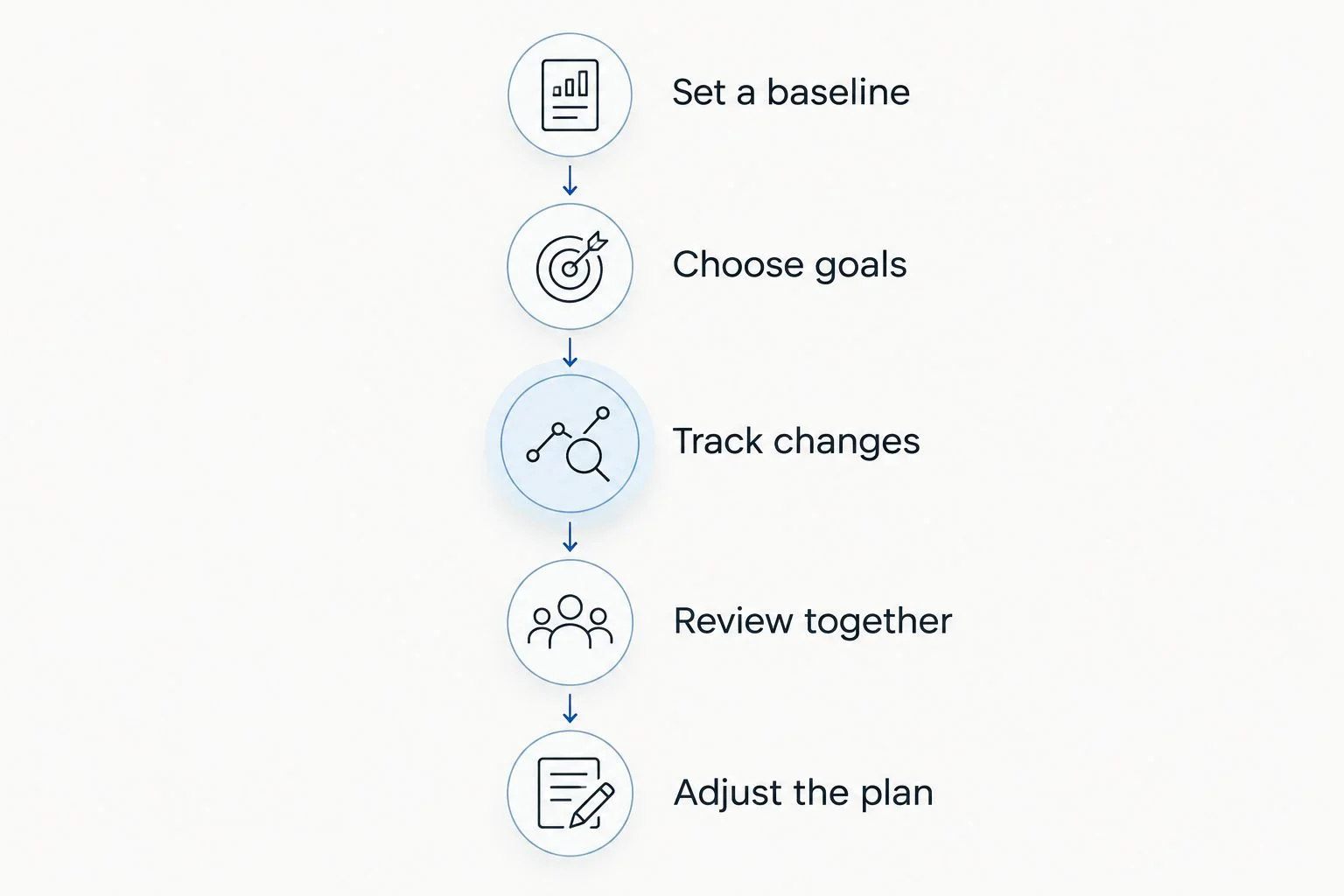
Review both symptoms and daily activities before deciding whether the treatment plan needs to change.
Bring the same goals to follow-up appointments so the comparison stays useful. A difficult day does not erase progress, and a calm appointment does not establish that treatment is complete.
What if online anxiety treatment is not helping?
Ask for a treatment review rather than simply waiting longer. Describe what has stayed the same, what has worsened, and what you have been able to practice or take as prescribed.
Your clinician can reconsider the diagnosis, treatment approach, medication tolerability, and whether online appointments meet your needs. A private space or connection problem also deserves attention if it prevents you from speaking openly or completing sessions.
Sometimes the right change is a different therapy approach, medication adjustment, in-person assessment, or a higher level of support. The decision should follow your symptoms, functioning, and safety—not a wish to make telehealth work at all costs.
Before starting with SOS Wellness or another provider, ask who coordinates therapy and prescribing when both are part of your plan. Clear responsibility makes it easier to raise concerns without waiting for the wrong appointment.
Can online anxiety treatment help children and teenagers?
Children and teenagers need an assessment and treatment plan suited to their age and development. Adult medication and CBT timelines should not be used as promises for a child.
Parents can help by describing changes in school attendance, sleep, friendships, and family routines. The child or teenager also needs an appropriate opportunity to describe their own experience; outward behavior does not reveal every worry.
Ask how caregivers will participate and how the clinician will coordinate safety concerns. Medication questions for a young person belong with the prescribing clinician, including the plan for monitoring mood and behavior changes.
When should you get help sooner?
Do not wait for a treatment milestone if you feel unsafe or symptoms are sharply worsening. New thoughts of self-harm, inability to care for yourself, or serious medication reactions need prompt attention.
- Call 911 for immediate danger or a medical emergency.
- Call or text 988 in the United States for suicide or mental health crisis support.
- Contact your treating clinician promptly for worsening symptoms, troubling side effects, or uncertainty about continuing treatment.
These safety routes remain relevant when your appointments happen online. Know your current location during a telehealth visit and discuss how your clinician handles an emergency.
FAQ
How long does online anxiety treatment take to work?
There is no single reliable timeline for improvement. Therapy session counts describe a treatment course, not when relief will begin, and medication response varies by medicine and person. Agree on review points with your clinician and seek earlier help for worsening symptoms or troubling side effects.
Can I feel better after my first online therapy appointment?
You can feel relief after an initial appointment, but that is not the same as sustained improvement in anxiety. Look for changes in daily functioning and your ability to respond differently to anxious thoughts or situations.
Should I stop anxiety medication if it has not helped yet?
Do not stop or change prescribed medication without speaking with your prescriber. Response varies by medicine, condition, and person; ask when benefit should be assessed and what would prompt a change. Worsening symptoms or troubling side effects warrant earlier contact rather than waiting for a fixed deadline.
Does online anxiety treatment work faster than in-person care?
Online delivery does not establish a shorter treatment timeline. Compare the proposed treatment, clinician fit, privacy, and safety plan rather than assuming the appointment format determines speed.
How often should I check in after starting medication for anxiety?
UK NICE guidance recommends medication reviews every 2–4 weeks initially for adult generalized anxiety disorder, with closer monitoring where risks require it. Your prescriber should set a schedule based on your medicine, symptoms, age, and safety needs, including when to seek earlier help.
What if I still feel anxious when CBT ends?
Remaining anxiety does not by itself show that CBT failed. Review changes in avoidance and daily functioning with your therapist, then agree whether you need further treatment or a plan for maintaining progress.
Can I use online anxiety care during a mental health emergency?
A routine online anxiety appointment is not an emergency response service. Call 911 for immediate danger or a medical emergency, or call or text 988 for suicide or mental health crisis support in the United States.
One last thing
Less avoidance can be a meaningful improvement even before anxiety feels much quieter. If you made the appointment, entered the classroom, or completed the task while still feeling nervous, bring that example to your next session.
For care, write down what you want your life to include again. That gives you and your clinician a more useful target than a deadline for never feeling anxious.
Further reading
- NIMH: Psychotherapies
- NIMH: Getting mental health support virtually
- NIMH: Generalized anxiety disorder
Related reading
This article provides general educational information and does not replace an individual clinical assessment. Contact your healthcare provider about your own care.