

Yes—telehealth providers can prescribe Xanax in Ohio when the prescriber is authorized to treat you, applicable controlled-substance rules permit it, and an evaluation supports the prescription. An online appointment is not a guarantee of Xanax, and some situations require an in-person visit. Start with an anxiety assessment, not a service promising a particular medication.
At a glance
- Start with an assessment by a clinician authorized to treat you in Ohio; a telehealth visit does not guarantee a Xanax prescription.
- Xanax is a Schedule IV controlled substance with dependence, withdrawal, and interaction risks.
- SOS Wellness provides Ohio mental health care; its listed services do not establish a Xanax prescribing policy.
- Ask about current telehealth requirements, medication management, and follow-up before scheduling.
Why this matters
Searching for a particular medication can obscure the more useful question: what treatment fits your symptoms and keeps you safe? Anxiety, panic, sleep problems, medication effects, and substance withdrawal can overlap, but they do not call for the same response.
SOS Wellness serves Ohio individuals and families seeking outpatient mental health care. Its services include psychiatry, therapy, medication management, addiction treatment, and telehealth. SOS telehealth patients must be physically in Ohio during visits. These services do not establish whether a clinician will prescribe Xanax remotely.
Choose an evaluation that addresses your symptoms, medical history, and safety—not an advertised prescription outcome. This guide explains the prescribing decision, what to prepare, and which questions to ask before booking.
Can telehealth providers prescribe Xanax in Ohio?
Yes, but the decision has separate legal and clinical requirements. Xanax is the brand name for alprazolam, a benzodiazepine classified federally as a Schedule IV controlled substance. Being available through telehealth does not remove controlled-substance prescribing requirements.
Confirm the following with the practice before you schedule:
- Ohio authorization. The clinician must be authorized to provide care where you are physically located during the appointment.
- Prescribing authority. The clinician needs the professional authority and applicable controlled-substance registration to prescribe alprazolam.
- Visit requirements. The appointment must meet current federal and Ohio requirements, including any applicable in-person examination requirements or exceptions.
- Clinical assessment. The clinician must determine whether alprazolam is appropriate after reviewing your symptoms, history, medications, and risks.
- Follow-up plan. You need clear instructions about monitoring, refills, side effects, and what to do if the treatment is not helping.
These are separate checks. A clinician’s legal ability to prescribe does not mean Xanax is the right treatment, and a previous prescription does not require a new clinician to continue it.
Does an online visit replace an in-person examination?
Not automatically. The DEA’s Fourth Temporary Extension permits specified controlled-medication prescribing through telemedicine through December 31, 2026, subject to federal and state requirements. It can allow prescribing without a prior in-person examination when its conditions are met, but it does not guarantee a prescription. Ohio requirements, the clinician’s authority, practice policies, and your clinical circumstances still matter. Do not assume a phone call, questionnaire, or video appointment satisfies every requirement.
Before a visit, ask: “Can this appointment include an assessment for controlled medication, and would I need an in-person examination?” An administrative answer establishes the appointment’s scope; the prescribing decision still belongs to the treating clinician.
How to seek an appropriate telehealth assessment
You do not need to arrive knowing which medication you should take. Your job is to describe what is happening accurately enough for the clinician to assess the problem.
Describe symptoms
Explain what you experience, when it happens, and how it affects daily life. Useful details include sudden episodes of intense fear, ongoing worry, disrupted sleep, missed work, or difficulty leaving home.
Distinguish symptoms from your interpretation of them. For example, describe a racing heart and dizziness rather than assuming every episode is a panic attack. New or severe physical symptoms sometimes require medical assessment outside a routine mental health visit.
Share history
List previous diagnoses, therapy, medications, benefits, and unwanted effects. If Xanax helped before, explain what improved and what did not; if you needed increasing amounts or struggled when stopping, disclose that too.
Include alcohol, cannabis, opioids, sleep medicines, supplements, and medications prescribed elsewhere. An accurate medication history protects you from dangerous combinations. Do not stop prescribed treatment simply to prepare for the appointment.
Review options
Ask the clinician to explain the diagnosis being considered and the reasons for each treatment recommendation. A useful discussion covers expected benefits, important risks, alternatives, and how progress will be assessed.
You can ask directly about Xanax without demanding it: “Would alprazolam be appropriate for my symptoms, and what makes it suitable or unsuitable?” That question leaves room for a medically grounded answer.
Plan follow-up
Before the visit ends, clarify who manages prescriptions, how to report problems, and what happens if you cannot attend the next appointment. If a benzodiazepine is prescribed, ask about duration, monitoring, and how discontinuation would be managed.
Do not interpret a prescription as permission to change the dose yourself. Follow the written directions and contact the prescriber when the plan is unclear.
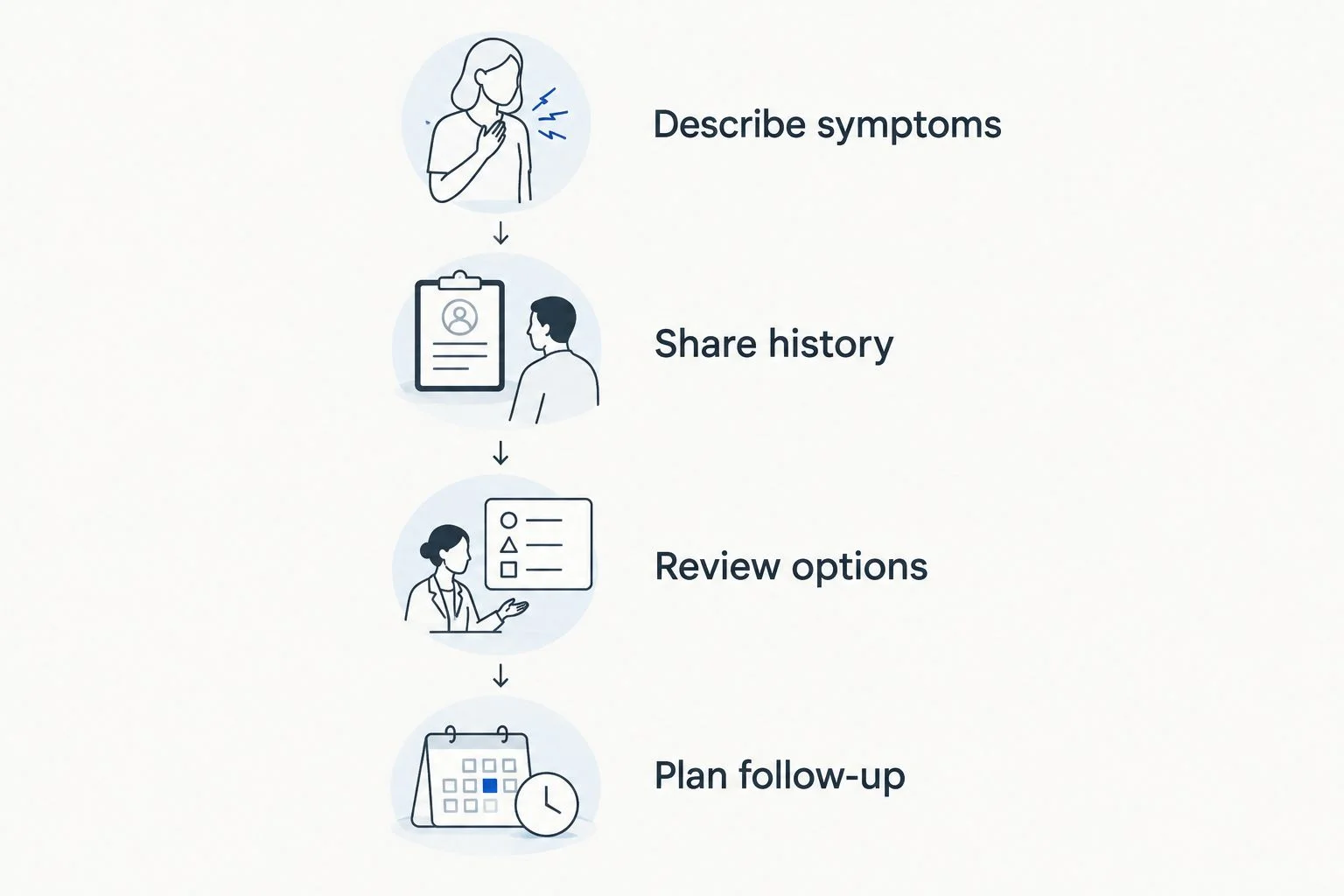
The appointment should connect your symptoms and history to a treatment and follow-up plan.
Which treatment approach fits the problem?
Xanax is not the only option for anxiety, and treatment choices are not interchangeable. The comparison below describes broad roles, not a recommendation that you start any particular treatment.
| Approach | Best for discussion when | Potential benefit | Main limitation |
|---|---|---|---|
| Cognitive behavioral therapy | You want skills for anxiety, panic, and avoidance | Addresses patterns that maintain anxiety | Requires participation and practice; improvement is not immediate |
| SSRIs or SNRIs | Persistent anxiety warrants a daily medication assessment | Used to treat several anxiety disorders | Benefits develop over time, and side effects need monitoring |
| Alprazolam | A clinician identifies a specific role after assessing risks | Can reduce anxiety symptoms relatively quickly | Carries sedation, misuse, dependence, and withdrawal risks |
| Combined treatment | Symptoms and functioning warrant both therapy and medication | Addresses symptoms alongside coping and behavior | Requires coordination and follow-through |
Therapy: skills beyond immediate symptom relief
Cognitive behavioral therapy helps you examine unhelpful thought patterns and change behaviors that maintain anxiety. For panic symptoms, treatment can include learning to respond differently to feared sensations and reducing avoidance.
Its limitation is practical: knowing a coping skill is different from using it consistently. Ask how sessions, between-session practice, and progress reviews would work for your circumstances.
Daily medication: a different role from rapid relief
SSRIs and SNRIs are used for several anxiety disorders, depending on the diagnosis and individual medication. They are not immediate-relief substitutes for alprazolam, and the clinician should explain the expected course and monitoring.
Daily medication also has trade-offs, including side effects and discontinuation considerations. “Not a benzodiazepine” does not mean “risk-free,” so review the full plan rather than choosing by category alone.
Alprazolam: potential relief with important risks
Alprazolam can reduce anxiety symptoms relatively quickly, but that benefit does not settle whether it fits your situation. Sedation, impaired coordination, interactions, and dependence all affect the decision.
Physical dependence can develop even when benzodiazepines are taken as prescribed. Dependence is not the same as addiction, but both deserve attention. Do not suddenly stop regular benzodiazepine use without medical guidance.
Why Xanax prescribing decisions vary
Two people reporting anxiety can receive different recommendations for sound clinical reasons. The relevant question remains whether the proposed treatment fits your diagnosis, risks, and circumstances.
- Symptoms and diagnosis. Panic disorder, generalized anxiety, trauma-related symptoms, and other conditions require different assessments and treatment plans.
- Current medications. Opioids and other sedating medicines can increase the dangers associated with benzodiazepines.
- Alcohol and substance use. An honest discussion helps the clinician assess interactions, withdrawal, and treatment needs without relying on assumptions.
- Medical history. Breathing problems, pregnancy, and other health considerations can change the risk-benefit decision.
- Previous response. Benefits, side effects, dose changes, and difficulties stopping medication inform the next recommendation.
- Care setting and requirements. The clinician’s prescribing authority, current telehealth rules, and practice policies affect what the appointment can provide.
A decision against Xanax should still include an explanation and an appropriate next step. Ask what the clinician recommends instead and which symptoms or risks the alternative is intended to address.
Can I get an existing Xanax prescription refilled online?
An existing prescription does not guarantee an online refill. A new clinician must make an independent assessment, and an established clinician still needs to meet applicable prescribing requirements.
Bring your medication list and relevant treatment records. Ask about continuity before your supply runs low, rather than assuming a same-day appointment will result in a prescription.
If you take alprazolam regularly and are running out, contact the current prescriber promptly. If you cannot reach them, seek prompt medical advice rather than waiting for a routine telehealth appointment or managing withdrawal yourself. Do not borrow medication, increase another sedative, or change your dose without medical guidance. Call 911 for seizures or another medical emergency.
Can a phone-only appointment be enough?
Under the federal temporary pathway allowing specified controlled-medication prescribing without a prior in-person examination through December 31, 2026, alprazolam prescribing requires real-time audio-video communication. The distinct audio-only exception for certain opioid-use-disorder medicines does not apply to Xanax. Other applicable federal and Ohio requirements still matter; a video visit does not guarantee a prescription.
Before booking, confirm whether your assessment requires video or an in-person examination. Also tell the practice where you will physically be during the visit.
What happens if a clinician does not recommend Xanax?
A clinician who does not recommend Xanax should explain the reasoning and discuss appropriate care. The next step can include therapy, another medication assessment, a medical evaluation, or a different level of support.
Ask: “What is the plan for the symptoms affecting me now, and how will we know whether it is working?” You deserve a clear plan even when the requested medication is not part of it.
Safety comes before the prescription
The FDA’s benzodiazepine boxed warning addresses abuse, misuse, addiction, physical dependence, and withdrawal. FDA safety communications also warn about combining benzodiazepines with opioids and other central nervous system depressants, including alcohol.
Do not share alprazolam or take someone else’s prescription. Avoid alcohol and review other sedating medicines with your prescriber. Do not drive or operate machinery until you know how alprazolam affects you, and never do so while sleepy or impaired.
Call 911 for a suspected overdose, slowed breathing, inability to wake someone, seizures, or another medical emergency. If opioid overdose may be involved, give available naloxone according to its directions and follow dispatcher advice; emergency care is still necessary even after improvement. Call or text 988 for a suicidal or mental health crisis; call 911 when there is immediate danger or a medical emergency. A routine telehealth appointment is not an emergency service.
Where to check requirements
For prescribing requirements, consult current DEA and HHS telemedicine guidance and the rules of the relevant Ohio licensing board. The extension described above does not establish the rules after December 31, 2026. FDA-approved alprazolam labeling and FDA benzodiazepine safety communications explain medication risks; they do not establish an individual’s eligibility for a prescription.
Ask the practice which requirements apply to your appointment. An older webpage, social media claim, or previous experience does not establish what a clinician can prescribe today.
FAQ
How do I get Xanax prescribed through telehealth in Ohio?
Start with an evaluation by a clinician authorized to treat you in Ohio. The clinician must assess whether alprazolam is appropriate and whether current controlled-substance requirements permit remote prescribing; no appointment guarantees a prescription.
Does SOS Wellness prescribe Xanax online?
SOS Wellness’s listed services include telehealth and medication management, but those listings do not establish a Xanax prescribing policy. Ask the practice about the scope of its appointments before scheduling.
Can I ask a telehealth psychiatrist about Xanax?
Yes, you can ask whether Xanax is appropriate for your symptoms. Describe your history honestly and ask about benefits, risks, alternatives, and follow-up rather than requesting a guaranteed outcome.
Is Xanax a controlled substance?
Xanax, or alprazolam, is a Schedule IV controlled substance. Its prescribing requirements and risks differ from those of medications that are not controlled substances.
Can I stop Xanax if I cannot get a refill?
Do not suddenly stop regular Xanax use without medical guidance because withdrawal can be serious. Contact your prescriber promptly; seizures or another medical emergency require 911.
Can therapy help if I do not take Xanax?
Yes, evidence-based therapy, including cognitive behavioral therapy, is a treatment option for anxiety and panic symptoms. A clinician can help determine whether therapy alone or combined treatment fits your needs.
Will a past Xanax prescription guarantee a new one?
No, a past Xanax prescription does not guarantee a new prescription or refill. The treating clinician must review your current circumstances and make an independent prescribing decision.
One last thing
Before you book, ask what the appointment can evaluate—not what medication it promises. Confirm visit requirements, explain any current benzodiazepine use, and ask how follow-up works. That preparation makes the appointment useful whether the outcome is alprazolam, another treatment, or an in-person assessment.
Further reading
- NIMH: Psychotherapies
- NIMH: Getting mental health support virtually
- DEA: Telemedicine prescribing extension through December 2026
- FDA: Benzodiazepine safety warnings
Related reading
This article provides general educational information and does not replace an individual clinical assessment. Contact your healthcare provider about your own care.