

When comparing SOS Wellness and Thriveworks, start with your location, care needs, and the individual clinician. SOS Wellness offers Ohio outpatient therapy, psychiatric care, medication management, addiction recovery services, and telehealth options. Confirm Thriveworks' current services and clinician options directly. This guide is published by SOS Wellness, one of the providers discussed, and is an unranked decision guide—not an independent assessment of treatment quality.
At a glance
- Compare the specific clinician, service, location, and payment arrangement rather than organizational size alone.
- SOS Wellness offers therapy, psychiatric care, medication management, and addiction recovery services in Ohio; an assessment determines appropriate care.
- Ask Thriveworks which services and clinicians are available for your location and needs.
- For either provider, confirm clinician fit, insurance participation, appointment availability, and how treatment planning works.
Why this matters
A provider can offer the right service and still be the wrong match for your needs. Therapy, psychiatric evaluation, medication follow-up, and addiction treatment address different parts of care. Start with the problem you need help with, not the size of the organization.
For your decision, separate the organization from the clinician. A recognizable provider name does not tell you whether a particular professional treats your condition, works with your age group, or participates in your insurance plan. Those details belong in your decision before you commit to ongoing appointments.
Neither provider can be ranked as better from a service list alone. SOS Wellness publishes outpatient mental health and addiction recovery services in Ohio. Compare the care each provider can actually offer for your needs, including clinician experience, coordination, location, and payment terms.
Neither choice replaces emergency care. If someone is in immediate danger or has a medical emergency, call 911. For suicidal thoughts or an emotional crisis in the United States, call or text 988.
Care options compared
| Care question | SOS Wellness | Thriveworks |
|---|---|---|
| Location | Offices in Middletown and Cincinnati (Norwood); Ohio telehealth | Confirm services and clinicians for your location |
| Therapy | Individual, group, and family therapy; child/adolescent and adult care | Offers therapy; confirm age eligibility, family services, and clinician fit |
| Psychiatry | Psychiatry and medication management | Offers psychiatry; confirm the clinician and scope of care |
| Substance-use concerns | Addiction services, including medication-assisted treatment and adult IOP; assessment determines suitability | Ask about substance-use services, clinician experience, and referrals |
| Telehealth | Patients must be physically in Ohio during visits | Confirm online service availability and location requirements |
| Payment | Accepts Ohio Medicaid, including managed plans; verify exact coverage and costs | Confirm insurance participation and self-pay arrangements for the specific service |
The table compares the starting points, not treatment results. It does not establish that either organization produces better outcomes, has shorter waits, or offers a better match for every diagnosis. Your next step is to verify the details that affect your own care.
Ohio-focused care: a defined local starting point
If you live in Ohio and need several kinds of outpatient support, an Ohio-focused provider gives you a clear place to start. You can ask about therapy, psychiatric evaluation, medication follow-up, and addiction treatment within the same initial inquiry. That is useful when you know something is wrong but do not yet know which appointment to request.
Ask which services are appropriate after assessment and whether they involve separate clinicians or schedules. An organization's service list does not guarantee access to every service or coordination between clinicians.
Before booking, explain what you need in plain language. For example, say that you want help with anxiety and a review of your medication, rather than asking only for a generic mental health appointment. Ask which service should come first and how referrals between services work.
For SOS Wellness telehealth appointments, you must be physically in Ohio during the visit. If you will travel or move out of state, discuss continuity and any transfer arrangements with the care team before your appointment.
Thriveworks: a national provider search
If you are searching outside Ohio or comparing several possible locations, ask Thriveworks which services it currently offers in each location. SOS telehealth requires you to be physically in Ohio; neither an organization's size nor its geographic reach establishes clinical fit.
Search by your actual location and clinical need, then assess the individual clinician. Confirm credentials, treatment experience, age eligibility, and payment arrangements.
If you expect to move, ask about continuity before starting. Confirm whether your clinician can see you in the destination state, whether another clinician would take over, and how records would transfer. A national organization does not automatically mean your existing clinician can continue treating you everywhere.
The tradeoff is that you still have to narrow the search. Geography, condition-specific experience, insurance participation, and the type of appointment all remain important. Choose a national network for the search scope, not as a shortcut around those checks.
Both offer therapy; clinician fit matters
Therapy is not a single interchangeable service. Your appointment should address the concern bringing you in, whether that is anxiety, mood symptoms, family stress, or difficulty functioning at school or work. Ask what approach the clinician uses and how you will agree on treatment goals.
For scheduled talk therapy, compare the individual clinician's experience and approach. Neither provider's name or organizational size establishes which clinician will suit your needs.
Use the same questions for both:
- Do you regularly work with the concern that brought me here?
- Do you treat people in my age group?
- How will we decide what progress looks like?
- What happens if your approach is not a good fit?
The benefit of either route is access to a therapy search. The limitation is that a service listing does not establish the therapeutic relationship. Give yourself permission to discuss a poor fit rather than assuming you must stay with the first clinician you meet.
Both offer psychiatry; medication follow-up needs scrutiny
If you want a psychiatric assessment or medication management, request that service directly. A therapy appointment is not automatically a prescribing appointment. You should know who will evaluate your symptoms, who can prescribe, and who handles follow-up questions.
For psychiatric evaluation or medication-related care, compare the actual care arrangement. Ask how the clinician reviews current prescriptions, side effects, other medical conditions, and previous treatment.
Medication follow-up also needs a clear process. Ask whom to contact about an adverse effect, how refill requests work, and what to do when symptoms worsen between appointments. Do not wait until you are running out of medication to learn the process.
The strength of either option is the ability to seek psychiatric care. The limitation is that offering psychiatry does not establish which medications a particular clinician will prescribe or whether outpatient treatment is appropriate for your situation. Never stop or change a prescribed medication solely because you are switching providers.
Substance-use care: ask about treatment scope
SOS Wellness offers outpatient addiction services. If your mental health concerns involve alcohol or other substances, describe both when requesting an assessment. Ask each provider what treatment it can offer and whether another level of care may be needed.
A listed addiction service does not establish that every substance-use condition can be treated in that setting. Ask about assessment, available treatments, follow-up, and referrals.
For Thriveworks, ask directly whether the specific clinician treats substance-use concerns, what treatment is offered, and when a referral is needed. A therapist's experience with addiction and a provider's addiction treatment service are not automatically the same thing. Clarify the distinction before choosing.
Outpatient care has limits. If you are concerned about withdrawal, overdose, or immediate safety, seek medical assessment rather than using a routine appointment as the emergency plan. Do not attempt a potentially dangerous withdrawal without medical guidance.
Online care: confirm availability and treatment fit
Telehealth removes the need to travel to the appointment, but it does not remove the need for privacy, state eligibility, or clinical assessment. For either provider, ask whether online visits are suitable for the service you need. The answer can differ between therapy, medication follow-up, and a more complex evaluation.
Discuss whether online care fits your clinical needs, privacy, connectivity, and safety circumstances. A video visit cannot provide an on-site physical examination or emergency monitoring.
Think about your actual environment. Can you speak freely without being overheard? Can you stay engaged rather than answering from work, a moving vehicle, or a busy shared room? These practical details affect whether you can use the appointment well.
If online care is not suitable, ask about alternatives. Do not choose telehealth only because it is easier to schedule when your clinician recommends a different setting or a higher level of support.
Explicit family scope: an Ohio household inquiry
The Ohio provider explicitly serves individuals, families, children, and adults. That gives parents a clear starting point when they are asking about a child's symptoms or trying to understand options for the household. It does not mean every family member will receive the same treatment or see the same professional.
For child or family care, confirm the clinician's age range and the specific appointment type before scheduling. Ask who will participate and how treatment goals will be set.
With Thriveworks, check the individual clinician's age groups and family-related services. Ask whether the appointment is for the child, the parent, or the family together. Also clarify how parent participation and confidentiality are handled.
For either provider, describe what you are seeing rather than assigning a diagnosis yourself. Changes in sleep, school participation, mood, or relationships give the clinician useful context. Ask what information to bring and whether existing records would help.
Pricing: compare the billing arrangement, not a headline
For a comparison, request the current billing terms for the exact clinician and service. Distinguish insurance billing from self-pay arrangements, and ask whether the same terms apply to therapy, psychiatric evaluations, and follow-up appointments. Do not assume that one service's billing arrangement applies to another.
With insurance, confirm both provider participation and your plan's benefits. A deductible, copay, coinsurance, or authorization requirement can affect your responsibility. Ask your insurer as well as the provider when you need clarification.
With self-pay, ask what the quoted appointment covers and how follow-up visits are billed. The practical advantage is a clearer direct billing arrangement; the tradeoff is that you are responsible for understanding the full terms. Neither model is automatically the better financial choice.
Before booking, work through this sequence:
- Care goal: Name the main concern and the service you are requesting.
- Clinical needs: Confirm age group, clinician qualifications, and treatment scope.
- Practical fit: Check location, visit format, billing, and follow-up arrangements.
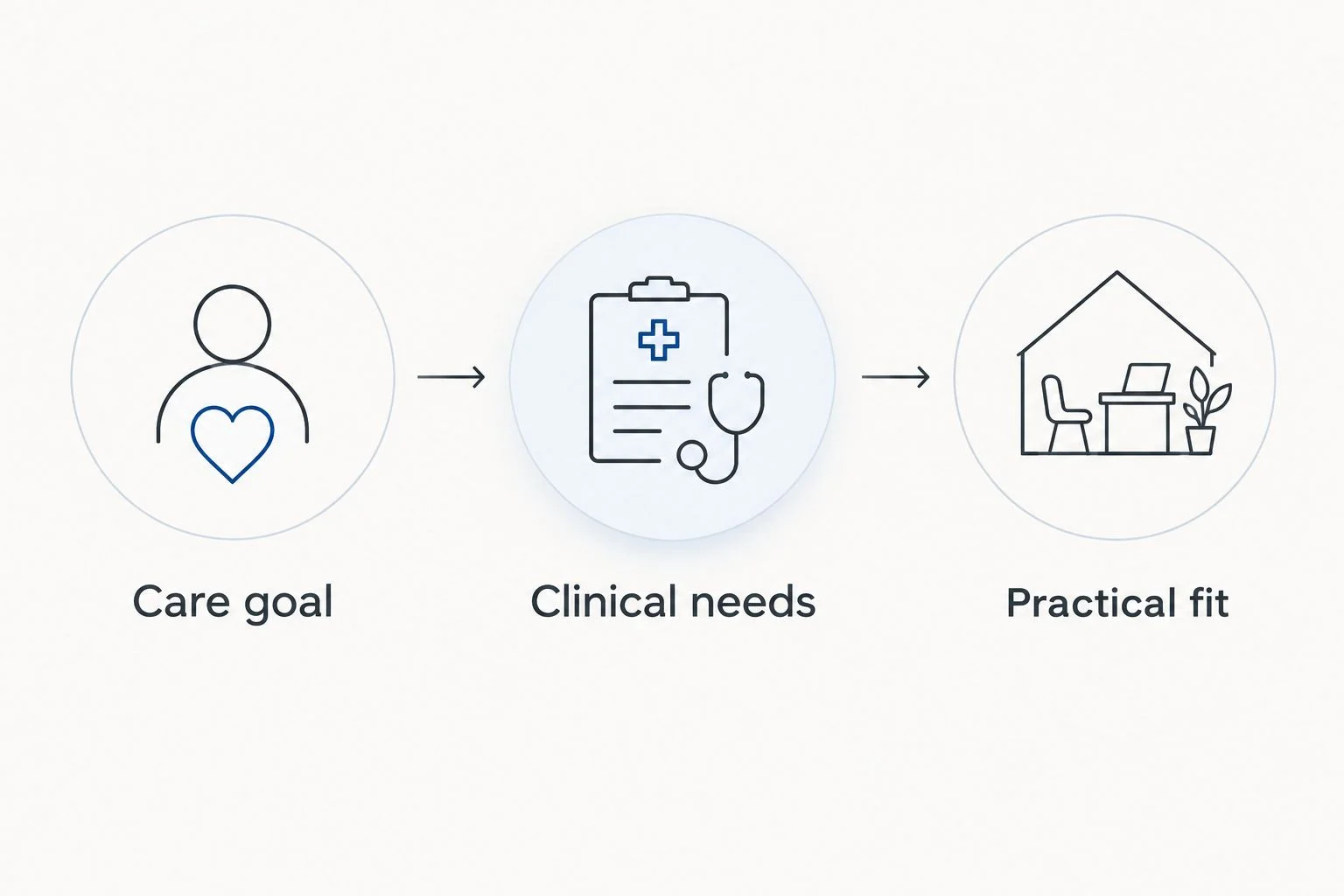
Confirm the right service before comparing appointment logistics.
Keep the answers together so you compare equivalent appointments. A therapy session and an initial psychiatric evaluation answer different needs; treating them as interchangeable makes the comparison less useful.
Choose care based on your needs
Consider SOS Wellness if you are an Ohio resident seeking outpatient care
SOS offers therapy, psychiatry, medication management, addiction services, and Ohio telehealth. If these services are relevant to your needs, ask which are clinically appropriate and available to you, and how clinicians would communicate with your consent. The service list alone does not establish a better fit.
Confirm the specific clinician and treatment arrangement before committing. A broad service list is the beginning of your assessment, not a promise that every service fits your situation.
Consider Thriveworks if you are searching a national network
Thriveworks offers therapy and psychiatry. If your search includes locations outside Ohio, confirm its current reach and the specific services available where you will be. Geographic scope alone does not establish treatment suitability or continuity with the same clinician.
Then narrow the choice to the clinician. For your decision, confirm treatment experience, state eligibility, insurance, and the plan for follow-up rather than choosing on network size alone.
| Decision area | What to verify with either provider |
|---|---|
| Location | Office location and where you must be physically located for video visits |
| Therapy | Clinician experience, approach, age eligibility, and treatment goals |
| Psychiatry and medication care | Assessment process, prescribing clinician, and follow-up arrangements; a visit does not guarantee a prescription |
| Addiction treatment | Available services, clinical suitability, and referral options |
| Telehealth | Service availability, privacy, emergency arrangements, and clinical suitability |
| Child and family care | Age range, appointment type, and family participation |
| Billing | Exact plan network, service benefits, authorization requirements, and estimated patient costs |
FAQ
Is SOS Wellness better than Thriveworks?
Neither provider can be declared better from its service list or geographic reach. Compare the specific clinician, relevant treatment options, appointment format, coordination arrangements, and costs for your circumstances.
Which provider should I choose for therapy?
Choose the clinician whose treatment experience, approach, and appointment arrangements fit your needs. Both providers offer therapy, so ask the same questions about your concern, age group, and treatment goals.
Can I get medication management instead of therapy?
Request a psychiatry or medication-management appointment specifically rather than assuming a therapy visit includes prescribing. Confirm who will evaluate you, manage follow-up, and answer medication questions.
Which option should I contact about addiction treatment in Ohio?
SOS offers Ohio outpatient addiction services; ask whether they fit your assessed needs. You can also ask Thriveworks about its current substance-use services and referrals. The appropriate setting depends on clinical assessment, including withdrawal risk and medical or psychiatric stability.
Can I keep my online clinician if I move to another state?
Do not assume your online clinician can continue treating you after an interstate move. Confirm licensing, the provider's arrangements, and any transfer plan before relocating.
How do I compare what I will pay for care?
Request the current billing terms for the exact clinician, appointment type, and insurance plan. Confirm benefits with your insurer and ask the provider about self-pay terms, follow-up billing, and cancellation policies.
What should I do if I need mental health help immediately?
Call 911 for immediate danger or a medical emergency. In the United States, call or text 988 for suicidal thoughts or an emotional crisis; do not rely on a routine outpatient appointment for emergency support.
One last thing
Ask how care is coordinated when you need both therapy and medication management. Receiving those services through the same organization does not automatically mean the clinicians share a treatment plan. Clarify communication, consent, and who handles questions between visits before you begin.
Further reading
Related reading
This article provides general educational information and does not replace an individual clinical assessment. Contact your healthcare provider about your own care.