

A treatment directory can help you identify providers, but it cannot replace a clinical assessment. For addiction treatment in Ohio, your next step may be contacting a clinician, checking insurance benefits or continuing a provider search. This unranked decision guide compares resources with different roles: SOS Wellness provides clinical care, while treatment directories help you find options. SOS Wellness publishes this guide and has a commercial interest in its own services; inclusion does not establish superiority or suitability for an individual.
At a glance
- SOS Wellness is one option to ask about outpatient addiction treatment and mental health services in Ohio; individual suitability requires assessment.
- FindTreatment.gov is a treatment directory, not a provider delivering your care.
- An insurance provider directory helps check network participation; confirm coverage before scheduling.
- Ask a qualified clinician to help determine the appropriate level of care. Outpatient and residential care are treatment settings; telehealth is a delivery format that may be suitable for some services.
Why this matters
Searching for addiction treatment often means comparing things that do different jobs. A treatment directory helps you discover providers. A clinical provider evaluates your needs and delivers services. Your insurer helps explain benefits and network requirements.
Those roles are not interchangeable. A useful listing does not establish that a program offers the right level of care, accepts your coverage, or treats the concerns you want addressed.
For an Ohio treatment search, start with the question that changes the whole decision: Do you need help finding options, or are you ready to contact a provider for an assessment? If you are unsure whether you need withdrawal management, outpatient treatment, or another setting, ask a qualified clinician rather than choosing from a directory description alone.
Recovery.com alternatives at a glance
These options are not ranked. The table describes possible uses, not quality ratings or endorsements. Treatment services, search tools and referral resources serve different purposes; none establishes an individual care plan. Recovery.com is a treatment directory with educational resources and paid advertisers, not a treatment center.
| Option | Potential fit | Standout function | How it differs from Recovery.com | Main limitation |
|---|---|---|---|---|
| Recovery.com | Comparing addiction treatment providers | Treatment discovery and comparison | It is the directory being compared | Browsing does not replace clinical assessment |
| SOS Wellness | Outpatient addiction and mental health services in Ohio | Addiction treatment alongside psychiatry, therapy, and medication management | A care provider rather than a treatment directory | Outpatient services are not a substitute for medically necessary inpatient care |
| FindTreatment.gov | Broad searches for substance use and mental health treatment | SAMHSA's treatment facility locator | A federal treatment search resource | You still need to contact facilities and confirm fit |
| Your insurance provider directory | Finding providers listed in your plan's network | Network-based provider search | Starts with your insurance plan rather than general treatment discovery | A network listing does not establish clinical suitability or benefit approval |
| Your primary care clinician | Getting help deciding where to start | Clinical discussion and referral | Starts with your health needs rather than directory browsing | A referral is not the same as enrollment in addiction treatment |
There is no single replacement that performs every role. You can use a directory to identify options, your insurer to check benefits, and a provider to discuss treatment. The useful outcome is a clear next step, not the longest shortlist.
SOS Wellness: outpatient care in Ohio
SOS Wellness offers addiction recovery services, psychiatric evaluations, therapy, medication management and Ohio telehealth options. Although the practice serves children, teens and adults, age eligibility varies by service; its intensive outpatient programs are for adults aged 18 and over. An assessment helps determine appropriate care, and staff must confirm service eligibility and availability.
Consider contacting SOS Wellness if: You want an assessment for outpatient addiction care, including co-occurring mental health concerns.
this option: service features
- You can contact SOS to discuss assessment and available services.
- SOS offers addiction treatment alongside psychiatry, therapy and medication management.
- Ask how those services would be coordinated for your needs.
- SOS telehealth requires patients to be physically in Ohio during visits; suitability depends on clinical needs, safety, privacy, connectivity and coverage.
this option: limits to confirm
- Ask whether SOS can meet your withdrawal-management needs or whether another service is necessary; outpatient care cannot replace medically necessary hospital care.
- Contacting one provider does not offer the breadth of a directory search.
- Confirm which services fit your age, symptoms, substance use concerns and treatment goals.
Do not assume that a stated addiction treatment service includes every withdrawal service, medication, or treatment format. Ask about the specific care you need before making a decision.
Head-to-head: direct care versus directory search
| Dimension | This outpatient provider | Recovery.com |
|---|---|---|
| Primary role | Provides clinical services | Helps you discover and compare providers |
| Search scope | One Ohio care organization | A directory of treatment options |
| Mental health support | Stated psychiatry, therapy, and medication management services | Depends on the provider you select |
| Next action | Ask about assessment and service fit | Identify providers, then contact them |
Decision point: Consider this option if you are ready to discuss outpatient care; skip it as a substitute for emergency or inpatient treatment.
FindTreatment.gov: an option for a broader treatment search
FindTreatment.gov is SAMHSA's public resource for locating substance use and mental health treatment facilities. It is an alternative when you want to expand your search beyond one commercial directory. It helps with discovery, not diagnosis or treatment delivery.
Potential fit: People who need to identify multiple treatment facilities before contacting providers.
FindTreatment.gov: service features
- It focuses on substance use and mental health treatment searches.
- It gives you another source for identifying facilities rather than relying on one directory.
- It is useful when your search needs to include different treatment settings.
FindTreatment.gov: limits to confirm
- A facility listing does not confirm that its services match your current needs.
- You must contact the provider to confirm service details and insurance arrangements.
- Search results cannot determine whether you need medically supervised withdrawal management.
Head-to-head: two discovery resources
| Dimension | FindTreatment.gov | Recovery.com |
|---|---|---|
| Resource type | Federal treatment locator | Treatment directory |
| Organization | SAMHSA | Recovery.com |
| Main task | Locate treatment facilities | Discover and compare providers |
| Clinical assessment | Requires a treating clinician | Requires a treating clinician |
For an Ohio search, use FindTreatment.gov to build a shortlist, then ask each facility the same questions. Confirm services, openings and coverage directly; a listing does not establish clinical fit.
Decision point: Consider FindTreatment.gov for broader discovery; skip directory browsing as a substitute for a clinical assessment.
Your insurance provider directory: an option for network checks
Your health plan's provider directory starts with a different question: which providers does the plan list in its network? That makes it useful when insurance coverage is a central part of your treatment decision. It does not tell you which treatment approach is clinically right for you.
Potential fit: People who need to narrow their search around their insurance plan.
an insurance provider directory: service features
- It organizes your search around your own plan rather than general provider visibility.
- It gives you a starting point for asking about network participation.
- It connects your provider search with the benefits questions you need answered before treatment.
an insurance provider directory: limits to confirm
- A listing is not a guarantee that a particular service will be covered.
- Network status and benefit requirements still need confirmation with the plan and provider.
- The directory does not replace an addiction assessment or establish the appropriate treatment setting.
Unlike Recovery.com, an insurance directory is primarily a network-checking resource. Use it alongside clinical questions, not instead of them. Ask your plan whether the proposed service requires authorization and whether the individual clinician or facility participates in your specific plan.
Decision point: Consider your insurance directory for network checks; skip it as your only measure of treatment quality or fit.
Your primary care clinician: an option for help choosing a starting point
Your primary care clinician is a useful starting point when you are unsure what kind of addiction treatment to seek. A medical discussion can address symptoms, medications, substance use, and referral needs. It changes the task from comparing listings to explaining what is happening in your life.
Potential fit: People who need clinical direction before choosing a treatment program.
primary care: service features
- You can discuss physical health concerns alongside substance use.
- You can ask whether your symptoms require urgent evaluation.
- A clinician can help identify an appropriate referral rather than leaving you to interpret program descriptions alone.
primary care: limits to confirm
- Not every primary care practice provides addiction treatment.
- A referral still requires follow-through with the receiving provider.
- An appointment is not an appropriate substitute for emergency help.
Decision point: Consider primary care for initial clinical direction; skip waiting for a routine appointment when you have urgent symptoms.
Why people switch from Recovery.com
The practical reason to use a Recovery.com alternative is a change in what you need, not a claim that the directory is inadequate. Once you have identified possible providers, another search page does not necessarily move you closer to treatment.
These are distinct reasons to change your next step:
- You need an assessment. Contact a clinical provider rather than continuing to compare descriptions.
- You need a wider search. Use another treatment locator to identify additional options.
- You need insurance answers. Ask your plan and the provider about the exact service under consideration.
- You need medical direction. Speak with a clinician about symptoms and the appropriate setting.
- You need urgent help. Use emergency or crisis services rather than a provider directory.
Match the resource to the question. A directory helps you find options. A clinician helps determine what care you need.
How to choose your next step
Use this sequence before committing to a treatment setting. It keeps safety, clinical fit, and practical arrangements separate, so a convenient format does not become the deciding factor before your needs are assessed.
- Safety first. If you have an immediate medical emergency, call 911. For a suicide or mental health crisis, call or text 988.
- Clinical fit. Describe the substances involved, current symptoms, previous treatment, medications, and mental health concerns to a qualified clinician.
- Coverage check. Ask the provider and your plan about the proposed service, network participation, and authorization requirements.
- Care plan. Confirm the treatment format, how follow-up works, and what to do if symptoms worsen.
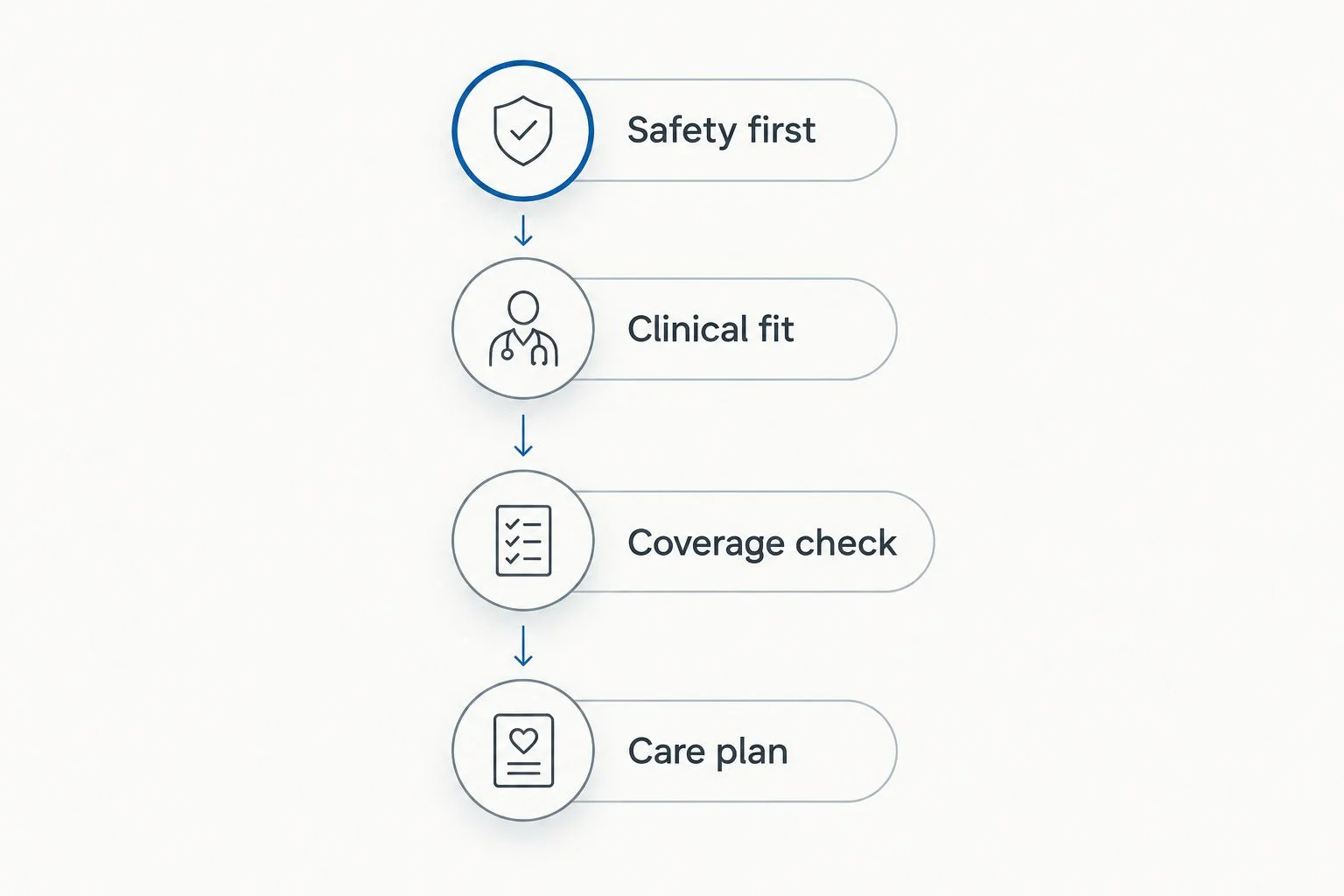
Choose the appropriate care setting before deciding how treatment will be delivered.
Bring the same questions to each provider. Ask who will assess you, which services address your concerns, whether telehealth is appropriate, and what happens if you need a higher level of care. These answers are more useful than a general promise of personalized treatment.
Explore outpatient care in Ohio
Review addiction treatment and mental health services, then ask about the care that fits your needs.
When continuing with Recovery.com may be useful
Recovery.com may remain useful while you are identifying and comparing providers. Another directory may broaden your options, but clinical and insurance questions still require direct follow-up.
If you already have a useful shortlist, contact those providers. You do not need to abandon a directory that helped you find options; you need to move from discovery to verification and assessment.
FAQ
Which Recovery.com alternative fits my next step in Ohio?
There is no single best option for everyone. A treatment locator can help you identify facilities, your insurer can explain network and benefit requirements, and a clinician can assess treatment needs. SOS Wellness is one Ohio care provider to consider; suitability depends on assessment, service eligibility and availability.
Is Recovery.com an addiction treatment provider?
Recovery.com is a treatment discovery and comparison directory, not the clinical team delivering your care. Contact the listed provider to discuss assessment, services, and treatment suitability.
Is FindTreatment.gov better than Recovery.com?
FindTreatment.gov offers a federal treatment search resource, while Recovery.com offers a treatment directory. Neither resource replaces an assessment, so use the one that helps you identify appropriate providers and then verify details directly.
Can I receive addiction treatment through telehealth?
Some addiction treatment services can be delivered through telehealth. Suitability depends on clinical needs, safety, privacy, connectivity, coverage and the provider's services. SOS patients must be physically in Ohio during visits. Remote visits cannot provide an on-site physical examination or emergency monitoring; ask a clinician whether withdrawal assessment or treatment requires in-person care.
How do I check whether my insurance covers treatment?
Ask your health plan and the treatment provider about the exact service being recommended. Confirm network participation and any authorization requirements before scheduling treatment.
Should I choose outpatient treatment or residential treatment?
A qualified clinician should assess withdrawal risk, medical and psychiatric stability, daily functioning, substance use and the home or recovery environment before recommending a level of care. Home safety alone does not determine suitability. Ask whether a program provides the services you need; not every residential program offers medical withdrawal care.
What should I do if I need addiction help urgently?
Call 911 for an immediate medical emergency. For a suicide or mental health crisis, call or text 988; do not wait for a treatment directory or routine appointment to resolve an urgent situation.
One last thing
A familiar substance can still carry withdrawal risks. Abruptly stopping after heavy alcohol use or benzodiazepine dependence can cause serious withdrawal, including seizures. Seek prompt medical assessment for a clinician-guided withdrawal plan rather than attempting withdrawal alone. Do not stop or change prescribed medication without prescriber guidance; call 911 for an immediate medical emergency.
When comparing care options, ask each provider to explain the recommended setting, its limits, coverage and follow-up arrangements. Choose based on assessed needs and practical fit, including a clear plan if a higher level of care becomes necessary.
Further reading
- SAMHSA: Substance use disorder treatment options
- SAMHSA: treatment locators
- Recovery.com: How the service works
Related reading
This article provides general educational information and does not replace an individual clinical assessment. Contact your healthcare provider about your own care.