

AddictionResource.com offers addiction education and treatment-finding resources, not direct treatment. Reading or searching for care is not the same as receiving an assessment. SOS Wellness offers outpatient addiction and mental health care in Ohio, while SAMHSA’s treatment locator helps people search for providers. This guide is published by SOS Wellness, which offers services discussed here. It is an unranked decision guide, not an independent endorsement or comparison of treatment outcomes.
At a glance
- For outpatient addiction and mental health care in Ohio, consider SOS Wellness as one provider option; an assessment and confirmation of service eligibility are needed to determine fit.
- Choose SAMHSA’s treatment locator to search for providers rather than receive care directly.
- Choose SAMHSA’s National Helpline for treatment referral information by phone.
- Use emergency services for immediate danger; a directory or outpatient appointment is not emergency care.
Why this matters
You do not need another long list if your actual question is where to get help. You need to distinguish information, referral support, and treatment before deciding what to do next.
An educational resource helps you understand addiction. A treatment locator helps you identify providers. A clinical service evaluates your needs and provides care within its scope. These are different jobs, not interchangeable versions of the same service.
For an Ohio family comparing options, the useful question is not which website has the most pages. It is which option gets you closer to the kind of help you need, without confusing outpatient treatment with emergency or hospital care.
The recommendations below are organized by purpose. They are not a ranking of clinical outcomes or a promise that one provider fits every person.
AddictionResource.com alternatives at a glance
| Option | Purpose | Service scope |
|---|---|---|
| AddictionResource.com | Addiction education and treatment-finding resources | Does not provide direct treatment |
| SOS Wellness | Outpatient addiction and mental health care in Ohio | Psychiatry, therapy, medication management and telehealth; assessment determines fit |
| SAMHSA treatment locator | Searching for mental health and substance use treatment | Government search resource; listings do not guarantee openings or coverage |
| SAMHSA National Helpline | Treatment referral information by phone | Free, confidential information and referrals, not counseling |
There is no single winner across every use case. Choose a provider when you need care, a locator when you need choices, and a referral line when you need help finding those choices.
Before choosing any clinical service, confirm that it treats your age group, your substance-related concerns, and the level of care a clinician recommends. A website’s general description does not replace that conversation.
SOS Wellness: outpatient care in Ohio
SOS Wellness offers addiction recovery services, psychiatry, therapy, medication management and Ohio telehealth options, including care for co-occurring mental health and substance use concerns. The practice serves children, teens and adults, but age eligibility varies by service; its intensive outpatient programs are for adults aged 18 and over. An assessment determines the appropriate care plan, and staff must confirm service availability.
That changes the purpose of your search. Instead of continuing to read about treatment, you can ask whether the provider’s services match your clinical needs and whether an assessment is the appropriate next step.
this option: service features
- Direct care: SOS provides outpatient services, not just information.
- Mental health services: Psychiatry and therapy can address co-occurring concerns following assessment.
- Medication management: Ask how medication options fit your care needs.
- Ohio telehealth: Patients must be physically in Ohio during SOS virtual visits. Ask whether remote care is appropriate for your needs.
this option: limits to confirm
- Outpatient scope: Outpatient care is not a substitute for emergency assessment, hospital treatment, or medically supervised withdrawal when those are needed.
- Not a multi-provider directory: A single provider does not serve the same purpose as a resource for comparing many treatment organizations.
- A personal assessment still matters: A service list cannot establish the right treatment intensity or medication for an individual.
Do not assume that offering medication management means a provider offers every medication used in addiction treatment. Ask specifically about your needs and let the clinical assessment guide the discussion.
Comparing direct care and treatment-finding resources
| Dimension | SOS Wellness | AddictionResource.com |
|---|---|---|
| Main purpose | Outpatient mental health and addiction care | Addiction education and treatment-finding resources |
| Clinical services | Psychiatry, therapy and medication management, subject to assessment | Does not provide direct treatment |
| Next step | Ask about assessment, eligibility and payment arrangements | Explore information and treatment-finding resources, then confirm details with a provider |
Potential fit: Ohio residents seeking an outpatient provider for addiction treatment and mental health services.
Before requesting care, describe the substances involved, any current mental health treatment, and whether you have experienced withdrawal symptoms. Ask how the provider determines the appropriate level of care and what happens if you need a different setting.
Next step: Ask whether SOS Wellness’s outpatient services match your assessed needs, age, scheduling requirements and insurance or payment arrangements. Outpatient care is not a substitute for an urgent medical evaluation.
SAMHSA treatment locator: an option for searching across providers
SAMHSA’s treatment locator is a government resource for finding mental health and substance use treatment across the United States and its territories. It supports provider searches rather than providing treatment directly.
Use it to develop a shortlist. Then contact the providers themselves, because finding a listing is only the beginning of deciding whether a service fits your needs.
the treatment locator: service features
- Provider search: It helps move your research from general addiction information toward treatment organizations.
- Multiple options: You can consider more than one provider instead of treating the first result as the only route.
- Substance use and mental health: Its search purpose covers both categories of treatment.
the treatment locator: limits to confirm
- No individual assessment: A search result cannot determine whether outpatient, residential, or hospital-based care is appropriate.
- Follow-up is necessary: You still need to confirm service scope, eligibility, and the practical details of receiving care.
- Listings are not personal recommendations: A provider appearing in a search does not establish that it is the right clinical match for you.
Comparing treatment-search resources
| Dimension | SAMHSA treatment locator | AddictionResource.com |
|---|---|---|
| Purpose | Government treatment-provider search | Addiction education and treatment-finding resources |
| Next action | Contact listed providers to confirm services, coverage and openings | Use resources to identify options and prepare provider questions |
| Clinical assessment | Requires a treating provider | Requires a treating provider |
Potential use: Identifying treatment organizations to contact before selecting a provider.
When you contact a listed service, ask what it actually provides. The word treatment can cover different settings and approaches, so your questions should address the care itself, not just the organization’s name.
Decision point: Consider the SAMHSA treatment locator when you need to find and compare providers; skip treating a listing as proof of clinical fit.
SAMHSA National Helpline: an option for referral information by phone
SAMHSA’s National Helpline is useful when you want treatment referral information through a phone conversation rather than another search page. SAMHSA describes it as a confidential information service for individuals and families facing mental health or substance use disorders.
The National Helpline is free and confidential, operating 24 hours a day, 7 days a week at 1-800-662-4357. It provides treatment referrals and information, not counseling or emergency medical care.
the National Helpline: service features
- Phone-based access: You can request referral information without building a shortlist entirely on your own.
- Family relevance: The service is intended for individuals and families, not only the person experiencing substance use concerns.
- Clear purpose: It offers information and referrals rather than presenting itself as treatment.
the National Helpline: limits to confirm
- Not counseling: A referral conversation is not a therapy session.
- Not medical assessment: The line does not determine whether withdrawal is medically safe to manage outside a clinical setting.
- Not an emergency service: Immediate danger requires a different response.
| Dimension | SAMHSA National Helpline | AddictionResource.com |
|---|---|---|
| Format | Phone-based information and referrals | Website-based education and treatment-finding resources |
| Possible next step | Request treatment referral information | Explore resources and contact providers about care |
| Direct treatment | Does not provide counseling or treatment | Does not provide direct treatment |
Potential fit: Individuals or family members who want treatment referral information by phone.
Decision point: Consider the National Helpline for referral support; skip using it as a replacement for treatment or emergency care.
Why choose an alternative to AddictionResource.com?
You may use different resources as your needs change. AddictionResource.com offers both education and treatment-finding resources; SAMHSA offers search and phone-referral routes. None replaces a provider’s individual assessment or ongoing treatment.
You need an assessment
If you want help understanding how substance use affects your health or functioning, seek a clinical assessment. An article cannot review your medical history, evaluate symptoms, or determine an appropriate care plan.
Bring a list of current medications and describe your substance use plainly. Include alcohol, prescribed medicines, and other substances rather than leaving out something because it feels uncomfortable to discuss.
You need to compare treatment settings
A provider search is more useful than another overview when you need to identify actual services. Ask a clinician about the appropriate level of care rather than deciding from a program name alone.
Withdrawal concerns warrant prompt medical assessment. Abruptly stopping after heavy alcohol use or benzodiazepine dependence can cause serious withdrawal, including seizures. Ask a clinician to plan safe withdrawal care rather than attempting it based on online information. Call 911 for a medical emergency.
You are helping someone else
A family member often needs referral information and a practical way to start a conversation. The National Helpline offers a referral route, while a provider can explain its process for assessing the person who needs care.
Ask what family involvement looks like and how consent and confidentiality apply. Do not assume that being a parent, partner, or caregiver gives you unrestricted access to another person’s treatment information.
Choose your next step, not just another website
Match the resource to the job you need it to do. For your search, use these categories before comparing names:
- Outpatient care: You need an assessment and ongoing services from a provider.
- Treatment search: You need to identify and compare treatment organizations.
- Referral support: You want treatment information through a phone conversation.
- Emergency care: You need immediate help for a medical emergency or immediate danger.
These categories are not a sequence everyone must follow. If safety is the issue, do not work through directories before seeking urgent help.
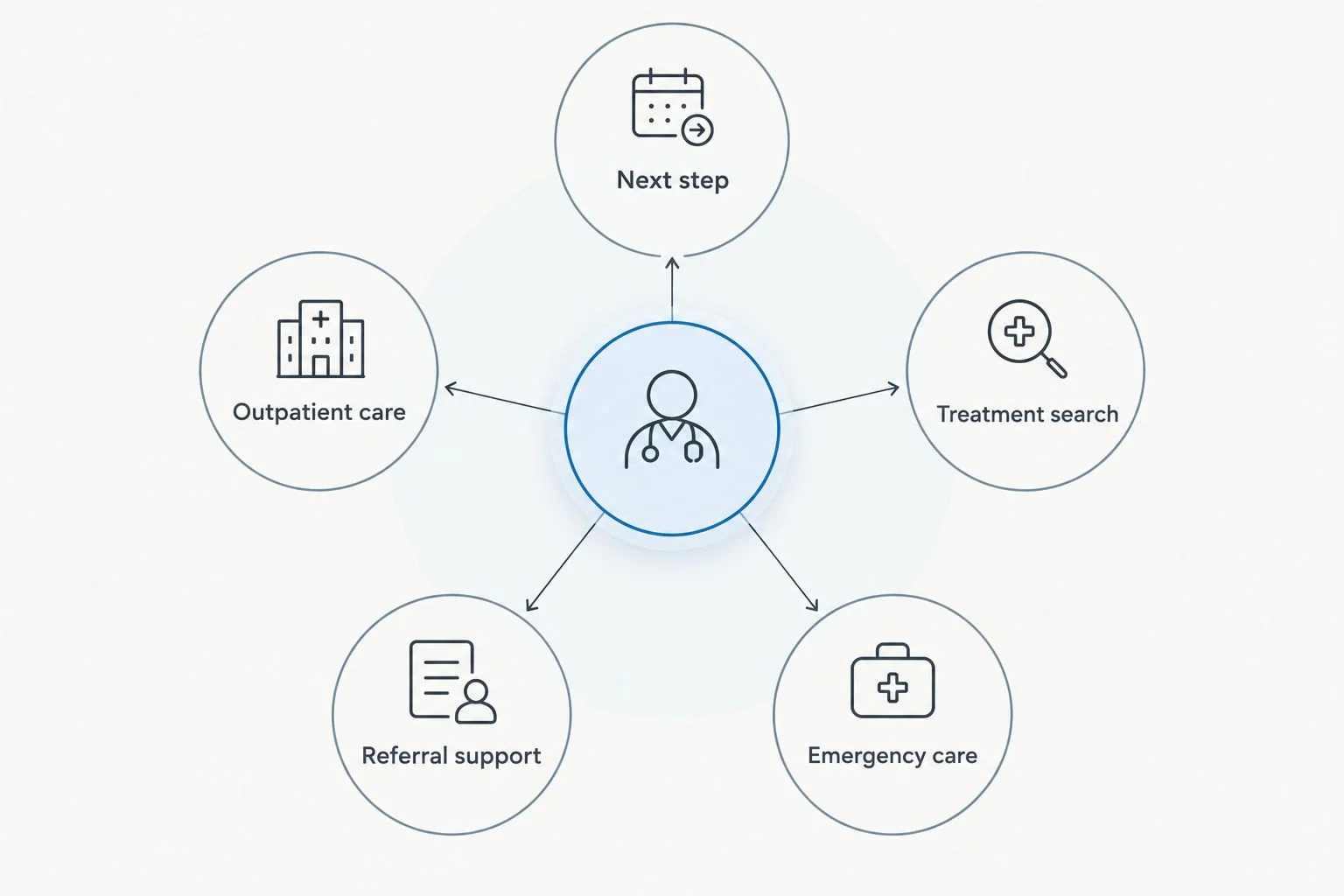
Choose the route that matches your immediate need rather than the website with the longest list.
Questions to ask before starting care
Use your first contact to clarify fit. A provider’s answers should help you understand the service, your next step, and what happens if your needs fall outside its scope.
- Which substance use concerns and age groups do you treat?
- How do you assess the appropriate level of care?
- Can treatment address both addiction and mental health needs?
- What does medication management include for my situation?
- Is telehealth appropriate for the service I need?
- How do you coordinate care when another clinician is involved?
- What should I do if symptoms become urgent before an appointment?
Do not stop or change prescribed medication based on a comparison article. Discuss changes with the prescribing clinician, especially when substance use, withdrawal, or psychiatric symptoms are involved.
Using educational and treatment-finding resources alongside care
Use educational material to understand terms, prepare questions or learn about treatment categories. Treatment-finding tools can help identify services to contact. You can continue using these resources while seeking professional care; neither provides an individual clinical assessment.
The boundary matters more than the website. Use information to prepare questions, not to diagnose yourself, choose medication, or decide whether withdrawal is safe without medical guidance.
You can combine resources: read for context, use a locator for choices, and speak with a provider about care. Research supports treatment decisions; it does not replace clinical assessment.
FAQ
What alternatives to AddictionResource.com can Ohio residents use?
The appropriate resource depends on the task. SOS Wellness is one outpatient addiction and mental health care option in Ohio, subject to assessment and service eligibility. SAMHSA’s treatment locator supports provider searches, while its National Helpline offers treatment referral information by phone. These options are not ranked and do not serve interchangeable roles.
Is an addiction information website the same as a treatment provider?
No. An information website explains addiction and treatment topics, while a treatment provider assesses individual needs and delivers services within its clinical scope.
Can I get help for addiction and mental health concerns together?
Ask for an assessment that addresses both concerns. Tell the provider about substance use, psychiatric symptoms, current medications, and existing treatment so it can evaluate the care you need.
Is telehealth always the right choice for addiction treatment?
No. Telehealth is a delivery format, not proof that outpatient care is appropriate. A clinician should assess your needs, withdrawal risk and other safety concerns, along with privacy and connectivity. SOS patients must be physically in Ohio during virtual visits.
Where can a family member get addiction treatment referral information?
SAMHSA’s National Helpline provides referral information for individuals and families at 1-800-662-4357. It operates 24 hours a day, 7 days a week, but does not provide counseling.
Can a treatment directory tell me whether I need inpatient care?
No. A directory helps you identify services, but an individual clinical assessment is needed to determine the appropriate level of care.
What should I do if someone is in immediate danger?
Call 911 for a medical emergency or immediate danger. In the United States, call or text 988 for suicide or mental health crisis support; do not wait for an outpatient appointment when urgent help is needed.
One last thing
Before your first appointment, write down what has changed in daily life: sleep, work, school, relationships, substance use, and medication use. Concrete examples give the clinician more useful information than trying to arrive with the right diagnosis.
You do not have to solve the whole care plan before asking for help. Choose the appropriate next step and let an assessment guide what follows.
Further reading
Related reading
This article provides general educational information and does not replace an individual clinical assessment. Contact your healthcare provider about your own care.