

Psychiatric care for Ohio teachers involves medical assessment and treatment of mental health symptoms to support functioning at school and at home. This guide explains how to choose care when classroom responsibilities, limited appointment windows, and concerns about workplace privacy complicate getting help.
At a glance
- Ohio teachers seeking psychiatric care should choose an assessment based on symptoms and daily functioning, not a burnout label alone.
- Therapy and medication management address different needs; a psychiatric assessment helps clarify your options.
- Ohio teachers using telehealth need a private setting and confirmation that the clinician can treat them where they are.
- Call or text the 988 Suicide & Crisis Lifeline for crisis support; call 911 for immediate danger.
Why psychiatric care matters for Ohio teachers
Work-related stress deserves attention, but burnout is not a complete explanation for every symptom. Persistent anxiety, low mood, sleep disruption, difficulty concentrating, or changes in substance use warrant a clinical conversation when they interfere with your life. An assessment helps distinguish overlapping problems without asking you to diagnose yourself.
A school schedule also affects how treatment fits. You need time for appointments, privacy for conversations, and a plan for follow-up during teaching weeks—not just during breaks. For your care plan, start with what is affecting your functioning rather than which appointment sounds easiest to arrange.
Understanding students’ symptoms is separate from assessing your own health. The child ADD and ADHD Ohio parents guide addresses a different audience; your assessment should focus on your history, symptoms, and needs as an adult.
How to arrange psychiatric care around teaching
Identify what has changed
Start with a written description of the problem before searching for a diagnosis. Describe what happens, when it started, and what it prevents you from doing. Feeling tense before parent meetings is different from anxiety that continues through evenings and weekends; both deserve an accurate description.
Spend 10 minutes preparing notes before contacting a clinician. If practical, record symptoms over 2 weeks to show patterns, but do not delay care to finish a diary. Include days away from school: that context helps the clinician understand whether symptoms change with your setting.
Bring concrete examples rather than conclusions. A note about repeatedly waking overnight is more useful than deciding that you definitely have a particular disorder.
- Describe changes in sleep, mood, concentration, appetite, or energy.
- Note when symptoms began and whether they occur outside school.
- Record effects on attendance, lesson preparation, relationships, or self-care.
- List current medicines, supplements, alcohol use, and other substances.
- Include past treatment and what helped or caused problems.
Choose the right first appointment
You do not need to know your diagnosis before seeking help. Choose a first appointment that can assess the problem and explain the next step. A psychiatric assessment is appropriate when you want medical evaluation of mental health symptoms, discussion of medication, or clarification of a complicated treatment history.
Therapy provides a setting to work on thoughts, emotions, behaviors, and coping skills. Primary care can also assess symptoms and consider physical health factors. These routes are not competing commitments: a clinician can recommend another service when your needs extend beyond the initial appointment.
Do not choose medication solely because you need a quick solution before the next school day. Treatment decisions require discussion of benefits, risks, alternatives, and your preferences.
- Request an assessment when symptoms or treatment needs are unclear.
- Consider therapy when you want structured work on coping and behavior.
- Tell the clinician about physical symptoms and relevant medical conditions.
- Explain any previous medication response or difficulty with treatment.
- Ask who will coordinate care if you see more than one clinician.
Check the provider’s fit before booking
A suitable provider must match your clinical needs, not simply your available lunch period. Ask whether the appointment is an initial assessment, therapy visit, or medication follow-up. Those visits serve different purposes, and knowing the distinction helps you prepare.
SOS Wellness provides outpatient psychiatric assessment and medication management for adults in Ohio. It also provides therapy, addiction recovery services, and Ohio telehealth options. This guide is published by SOS Wellness and describes its own services alongside general care options; it is not an independent provider ranking. An assessment helps determine appropriate care, and a visit does not guarantee a prescription. Outpatient treatment does not replace emergency care.
For appointments, verify current insurance participation and booking arrangements directly. A provider’s service list does not establish your plan’s coverage or guarantee a particular appointment time.
- Ask whether the clinician treats adults with your presenting concerns.
- Confirm the appointment type and whether it is virtual or in person.
- Check insurance participation with both the provider and your plan.
- Ask what records, forms, and medication information to bring.
- Clarify how to contact the practice between scheduled visits.
Protect your privacy and appointment time
A virtual appointment is still a healthcare appointment. Holding it in an empty classroom does not ensure privacy if colleagues can enter or students are nearby. Choose a location where you can speak openly without being overheard, and avoid joining while supervising students or driving.
Workplace privacy also requires specific questions. Healthcare confidentiality, insurance communications, school leave procedures, and requests for accommodations involve different processes. Ask what documentation a workplace request needs and who receives it; do not assume your employer needs your full clinical history.
For telehealth, tell the clinician where you will physically be during the visit. SOS Wellness requires you to be physically in Ohio for its video appointments. If you travel during school breaks, discuss arrangements with the practice before your visit; do not assume your appointment can proceed from another state.
- Reserve uninterrupted time rather than squeezing care between duties.
- Use a private location and headphones when appropriate.
- Ask what to do if the connection fails during a virtual visit.
- Check whether insurance messages or billing notices affect your privacy.
- Request clarification before authorizing release of clinical information.
Build a treatment plan around classroom demands
Tell your clinician what your work requires: sustained attention, speaking throughout the day, responding to students, commuting, and managing unpredictable situations. These details help you discuss treatment in practical terms without making your job the only measure of recovery.
If medication is recommended, ask about expected benefits, possible adverse effects, interactions, and monitoring. Explain any concern about alertness or concentration. Do not start, stop, or change psychiatric medication without instructions from your treating clinician.
Your treatment plan should also address life outside school. Being able to teach while remaining unable to sleep, connect with family, or manage basic tasks is not the whole treatment goal. Agree on changes that matter to you and how you will assess them.
- Ask which symptoms the treatment is intended to address.
- Discuss alertness, concentration, driving, and other safety-sensitive tasks.
- Review how and when to report adverse effects or worsening symptoms.
- Set goals for home life as well as classroom functioning.
- Confirm the follow-up plan and any required monitoring.
Arrange follow-up before the calendar fills
An initial appointment starts a process; it does not settle every treatment question. Ask when you should return, how progress will be reviewed, and what happens if a school obligation conflicts with the visit. Follow-up timing should reflect clinical need rather than the next convenient holiday.
Ask SOS Wellness about psychiatric care appointments and how therapy or medication management can fit your schedule. Telehealth removes the trip to an office, but it still requires protected time, privacy, and a clinically appropriate plan.
Prepare 3 questions for each follow-up visit: what has improved, what remains difficult, and what needs to change. Add any new safety concern immediately rather than saving it for a routine appointment. Bring your symptom notes and medication list so the discussion stays specific.
- Schedule the next visit according to the clinician’s recommendation.
- Ask how to handle cancellations and school-calendar conflicts.
- Track changes in the symptoms your treatment targets.
- Report new medicines or changes in alcohol and substance use.
- Confirm whom to contact for concerns between appointments.
Know when routine outpatient care is not enough
An outpatient appointment is not the right response to every situation. If you are in immediate danger, have a medical emergency, or cannot keep yourself safe, call 911 or go to the nearest emergency department. Do not wait for a portal reply or the end of the school day.
Call or text 988 for the Suicide & Crisis Lifeline when you need crisis support. You can also seek support when you are worried about someone else. Crisis services serve a different purpose from routine treatment and medication follow-up.
If symptoms are worsening without an immediate emergency, contact your treating clinician promptly. Ask whether you need an earlier assessment or a different level of care. Do not assume that a more intensive program is appropriate without evaluation.
- Use emergency services for immediate danger or medical emergencies.
- Contact the 988 Suicide & Crisis Lifeline for crisis support.
- Report worsening symptoms promptly to your treating clinician.
- Ask about an appropriate level of care when outpatient support is insufficient.
- Keep your crisis instructions somewhere you can access easily.
Compare care options for Ohio teachers
Choose the service that addresses your needs; choose the appointment format second. Therapy, psychiatric assessment, and medication management describe clinical services. Telehealth describes how a service is delivered, so it is not a substitute for deciding what treatment you need.
The options below are an unranked decision guide, not equivalent alternatives: they include clinical services, an appointment format, a provider, and a level of care. Confirm current services, insurance arrangements, and clinical suitability before booking. Combined care requires coordination, while a more intensive program requires its own assessment.
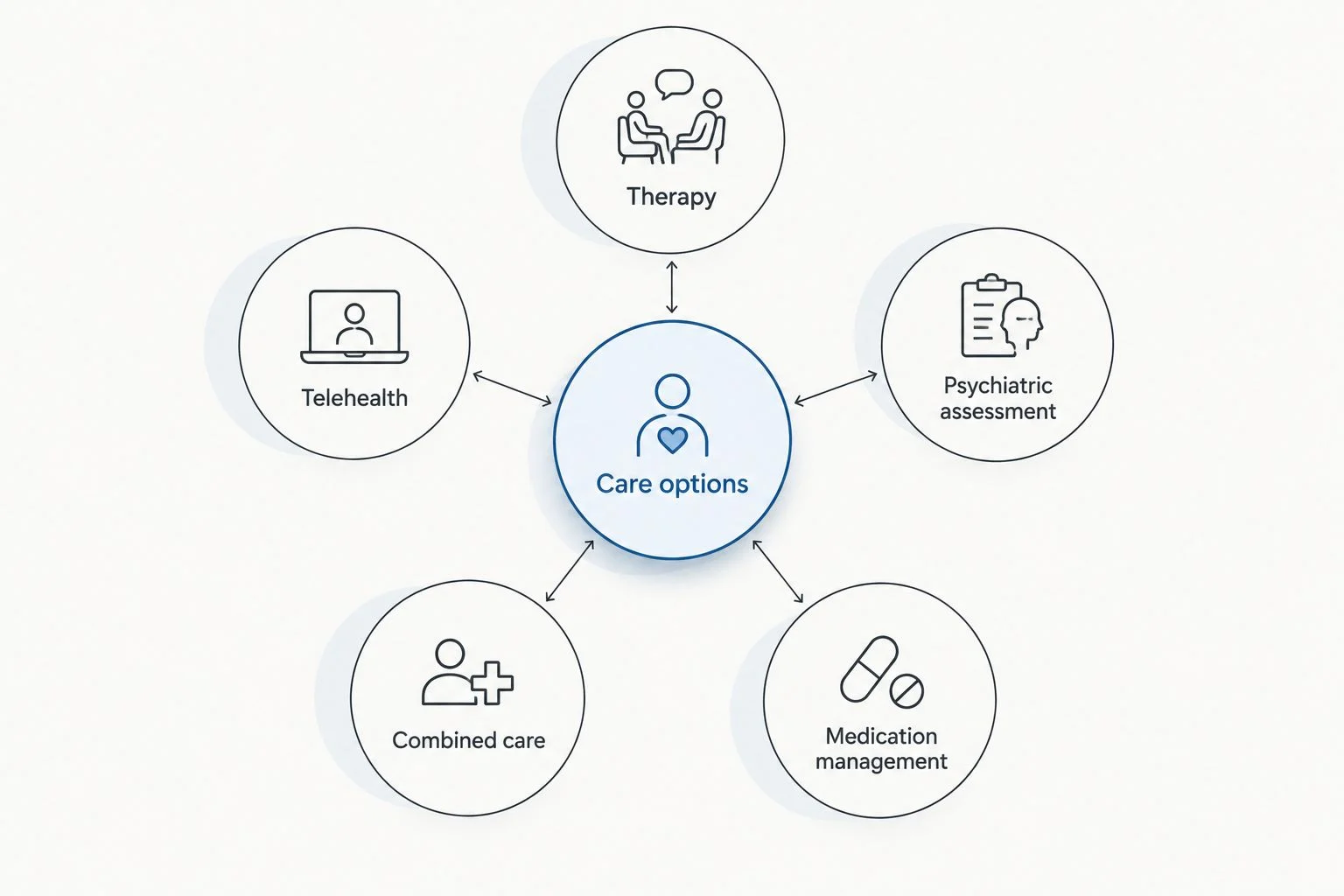
Telehealth is an appointment format, not a separate type of treatment.
| Option | When to consider it | Main benefit | Key limitation |
|---|---|---|---|
| Therapy | Teachers seeking help with coping, emotions, and behavior | Provides structured psychological treatment | Therapy alone does not provide medication prescribing. |
| Psychiatric assessment | Teachers needing diagnostic clarification or medical treatment planning | Reviews symptoms, history, and treatment options | An assessment is not a guarantee that medication will be recommended. |
| Medication management | Teachers whose treatment includes prescribed psychiatric medication | Reviews response, adverse effects, and treatment adjustments | Requires follow-up and does not replace therapy when therapy is indicated. |
| Combined care | Teachers whose assessed needs include therapy and medication | Addresses different parts of a treatment plan | Separate clinicians need clear coordination. |
| Telehealth | Teachers who need remote appointments and have a private setting | Removes travel to an office for the visit | Location rules, privacy, technology, and clinical suitability still apply. |
| SOS Wellness outpatient care | Ohio teachers seeking psychiatry, therapy, or medication management | Offers these services alongside addiction treatment and telehealth | Outpatient services do not replace emergency evaluation. |
| Intensive outpatient treatment | People assessed as needing more structured support than routine outpatient visits | Provides a more structured treatment setting | Participation involves a larger scheduling commitment and requires clinical assessment. |
Common mistakes Ohio teachers make when seeking care
Waiting for summer to address worsening symptoms
School breaks can make scheduling easier, but they should not determine whether you seek an assessment. If symptoms interfere with functioning now, contact a clinician now. Explain your teaching schedule and ask about suitable appointment arrangements.
Treating every concentration problem as ADHD
Sleep problems, anxiety, and depression can cause symptoms that resemble ADHD, as the CDC explains. Assessment considers the broader history rather than relying on one difficult semester or a symptom checklist. Bring examples from outside the classroom too.
Using student support strategies as personal treatment
Classroom routines and calming exercises can support daily functioning, but they do not establish your diagnosis or replace individualized care. Your professional familiarity with mental health language is useful context—not a reason to assess or treat yourself.
Assuming a virtual visit can happen anywhere
A hallway, shared office, or classroom during planning time can leave you unable to speak freely. Privacy affects the quality of the conversation, not just confidentiality. Arrange a setting where interruptions and overhearing are unlikely.
FAQ
What's the best first step for a teacher in Ohio who needs psychiatric care?
Arrange an assessment and describe how your symptoms affect work and home life. Bring your medication list, relevant treatment history, and specific examples rather than trying to settle on a diagnosis first.
Is psychiatric care better than therapy for teacher burnout?
Neither is automatically better; the right service depends on your symptoms and assessed needs. Therapy addresses psychological patterns and coping, while psychiatric care provides medical assessment and medication treatment when indicated.
Can Ohio teachers have psychiatric appointments through telehealth?
Telehealth is an option when the provider offers it and it is clinically appropriate. Confirm that the clinician can treat you where you will physically be, and arrange a private, uninterrupted setting.
Will my school automatically receive information about my treatment?
Do not assume that seeking care means your school receives your clinical record. Ask your provider about confidentiality and its exceptions, and clarify what documentation is required if you request leave or accommodations.
Does SOS Wellness provide mental health services for adults in Ohio?
SOS Wellness provides psychiatry, therapy, medication management, addiction treatment, and telehealth mental health services to adults in Ohio. Ask which service fits your concerns and confirm current appointment and insurance arrangements.
Do I have to take medication if I see a psychiatric clinician?
A psychiatric assessment does not automatically mean medication will be prescribed. The clinician reviews your needs and discusses appropriate treatment options, including benefits, risks, and alternatives.
What should a teacher do during a mental health crisis?
Call 911 or go to the nearest emergency department for immediate danger or a medical emergency. Call or text 988 for Suicide & Crisis Lifeline support, and do not wait for a routine appointment when urgent help is needed.
One last thing
Being able to finish the school day is not the same as feeling well. Tell your clinician what happens after dismissal: exhaustion, isolation, persistent worry, disrupted sleep, or difficulty managing home responsibilities. Those details belong in your assessment even when your classroom performance appears unchanged.
Use this guide to prepare for a clinical conversation, not to diagnose yourself or change treatment. Your next move is an appropriate appointment and a clear description of what needs help.
Further reading
Related reading
This article provides general educational information and does not replace an individual clinical assessment. Contact your healthcare provider about your own care.