

Instead of repeatedly calling about a prescription after your video visit, use a clear telehealth prescription to pharmacy pickup workflow: confirm the pharmacy, verify receipt, resolve any dispensing questions, and wait for pickup confirmation. A telehealth visit does not guarantee a prescription; your clinician first decides whether medication is appropriate.
At a glance
- For telehealth prescription to pharmacy pickup, confirm the pharmacy before your clinician sends the prescription.
- SOS Wellness provides telehealth mental health services and medication management for Ohio patients.
- Prescription receipt, insurance approval, and pickup readiness are separate checkpoints.
- Ask about refill requirements before your medication runs out; do not change doses yourself.
Why this matters
A prescription being sent is not the same as a medication being ready. The clinician sends the order, the pharmacy reviews it, and any insurance or prescribing questions need resolution before dispensing. Knowing which checkpoint is incomplete helps you contact the right person instead of repeating the whole story.
SOS Wellness offers outpatient mental health care in Ohio, not emergency response. SOS Wellness provides psychiatry, therapy, medication management, addiction treatment, and telehealth mental health services for children and adults. Scheduling hours are not emergency availability.
This guide explains how to coordinate the handoff between your clinician and pharmacy. It does not replace your prescription label, pharmacist's counseling, or personalized treatment plan.
Before you start
- Prepare your visit materials. Have your medication and allergy list, pharmacy name and exact location, insurance information if applicable, and access to your scheduled telehealth appointment. Include nonprescription medicines and supplements.
- Confirm who can communicate and collect medication. For a child or someone receiving caregiver support, ask about consent, identification, and pickup requirements. Do not assume access to an appointment also permits access to pharmacy records.
- Check the non-obvious barrier: prescribing eligibility. Some medications, especially controlled substances, have additional prescribing requirements. Before relying on a telehealth visit for a refill, ask whether your clinician can prescribe that medication under the rules applying to your care.
You do not need to establish a new pharmacy account simply because a visit happens online. Ask your chosen pharmacy what patient information and communication permissions it needs.
Visit preparation
Confirm the medication plan and destination
- State your physical location. You must be physically in Ohio for an SOS Wellness telehealth visit. Tell your clinician your location at the start, and contact staff before the appointment if you will be outside Ohio.
- Name the exact pharmacy. Give the pharmacy's name, street address, and city. A chain name alone does not identify the correct branch.
- Review the current medication list. Explain what you take, how you actually take it, and any side effects or missed doses. Include prescriptions from other clinicians.
- Repeat the treatment instructions. Confirm the medication name, strength, dose, schedule, and any instructions about starting, stopping, or changing treatment. Ask what to do if dispensing is delayed.
- Ask how to reach the care team. Establish the approved route for medication questions and refill requests. Do not assume a reply to an appointment reminder reaches the prescribing clinician.
Expected result: You know the agreed treatment plan, the intended pharmacy, and the route for follow-up questions. Your clinician has decided whether to prescribe; the pharmacy has not yet confirmed dispensing.
For your medication record, keep 1 current medication list rather than separate, conflicting versions. Update it whenever a clinician changes your treatment, and bring it to appointments with other prescribers.
Prescription handoff
Verify receipt without creating duplicate requests
- Ask whether the prescription was sent. Confirm the destination and whether the clinician has completed the order. A discussion about medication during a visit is not confirmation that an order was transmitted.
- Check with the receiving pharmacy. Ask whether the prescription appears in your patient record. Use the pharmacy's established contact method rather than assuming an app notification will appear.
- Identify the unresolved checkpoint. If the pharmacy received the prescription but cannot finish processing it, ask whether it needs clinician clarification, an insurance decision, or another action.
- Send a specific message to the responsible team. Include the medication name, pharmacy location, and the issue the pharmacist identified. Share sensitive details only through the communication method your care team recommends.
Expected result: You know whether the pharmacy received the order and who needs to act next. You have not asked multiple pharmacies or clinicians to create competing prescriptions.
Use 3 checkpoints to track progress: prescription receipt, dispensing review, and pickup confirmation. These describe a workflow, not a promised completion time.
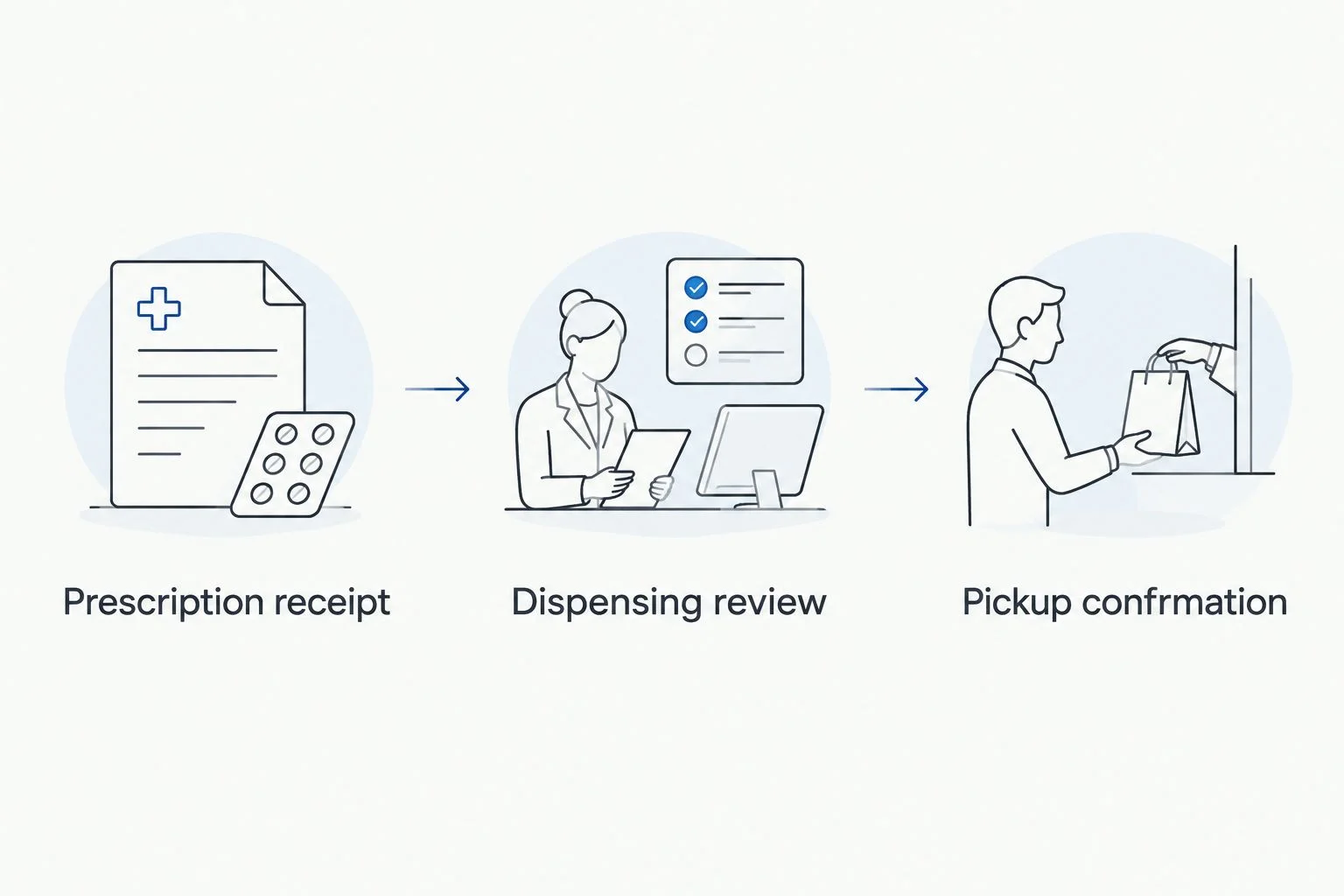
A sent prescription still needs pharmacy review before pickup confirmation.
Do not travel to the pharmacy based only on confirmation that the prescription was sent. Ask the pharmacy to confirm it is ready for collection. That distinction prevents an avoidable trip without assuming a particular pharmacy's processing schedule.
Pharmacy review
Resolve questions with the right team
- Separate insurance questions from prescribing questions. The pharmacy can identify a claim rejection or a request for more information. Your clinician decides whether a different treatment or revised prescription is medically appropriate.
- Clarify prior authorization requirements. If your insurer requires prior authorization, ask which office must submit the clinical information and how you will receive updates. Submission does not guarantee approval.
- Ask about prescription clarification. An unclear dose, missing instruction, or concern about an interaction can require communication between the pharmacist and prescriber. Do not interpret or rewrite the prescription yourself.
- Report a treatment interruption risk. Tell your clinician if you are close to running out or have already missed medication. Ask for individualized instructions rather than doubling a later dose or borrowing someone else's medication.
Expected result: Each unresolved issue has an identified owner. You understand whether the next step belongs to the pharmacy, prescribing office, insurer, or you.
Use the pharmacy's current instructions rather than an old screenshot or another person's experience. App menus, notification settings, and pickup procedures differ; there is no single button sequence that applies to every pharmacy.
Keep a brief record of the issue and the next action. Record only what you need, and protect medication details from shared devices or accounts that other people can access.
Pickup preparation
Confirm readiness and review the medication
- Wait for explicit pickup confirmation. Confirm the correct pharmacy branch and ask about identification or representative-pickup requirements before traveling.
- Use 2 patient identifiers. Be prepared to provide your name and date of birth so pharmacy staff can locate the correct record. Bring any identification the pharmacy requires.
- Check the label before leaving. Compare the patient name, medication name, strength, and directions with the plan you discussed. Ask the pharmacist about anything that differs.
- Request counseling. Ask how to take the medication, what to do after a missed dose, which side effects need a call, and which symptoms need urgent help. Instructions differ by medication.
- Document the next step. Note the follow-up plan and how to request the next refill. Taking the first dose does not replace ongoing monitoring.
Expected result: You leave with medication labeled for the correct person, understand the instructions, and know whom to contact with concerns.
If the medication looks different, ask the pharmacist before taking it. A different appearance can have an ordinary explanation, but appearance alone cannot confirm that you received the intended medicine.
Repeat prescriptions and medication changes
For ongoing medication, check whether the pharmacy has an authorized refill and follow your clinician's reassessment schedule. If no refills remain, contact the prescribing team to ask whether a visit or other review is needed before another prescription can be issued.
| Workflow | Potential fit | Main advantage | Limitation |
|---|---|---|---|
| New prescription | Starting a clinician-approved treatment | Establishes a specific medication plan | Requires initial prescribing and pharmacy review |
| Authorized refill | Continuing treatment as prescribed | Uses an existing refill authorization | Does not replace required follow-up or authorize dose changes |
| Changed prescription | Following a clinician-approved adjustment | Aligns the order with the revised plan | Requires clear instructions about the previous prescription |
When your clinician changes the dose
- Confirm when the new instructions begin and what happens to the previous prescription.
- Tell the pharmacist that your clinician changed the treatment plan.
- Ask the clinician or pharmacist how to handle medication already at home.
- Update your medication list so the old and new instructions are not confused.
A dose change is a new clinical instruction, not permission to improvise with remaining tablets. Splitting, combining, or stopping medication requires medication-specific advice.
For a repeat prescription, follow the same receipt, review, and pickup checkpoints. An earlier successful pickup does not confirm that the next prescription has been authorized or processed.
Troubleshooting
The pharmacy cannot find the prescription
Confirm the exact branch with the prescribing office, then ask the pharmacy to check your identifying information. If the order went elsewhere or transmission failed, the prescribing office needs to address it. Avoid asking for another prescription without explaining what happened to the first.
The pharmacy says it needs authorization
Ask whether it means an insurance prior authorization or a new prescription from the clinician. Those are different problems. Relay the pharmacy's exact explanation so the care team can address the correct issue.
You are running out before the issue is resolved
Contact the prescribing team and explain your medication supply and any missed doses. Some medications cause withdrawal symptoms or other problems when stopped abruptly; ask for a safe, individualized plan. Do not ration, stop, or change doses without guidance.
You need a different pharmacy
Ask the receiving pharmacy and prescribing office how to proceed before requesting a replacement order. Transfer rules depend on the medication and applicable requirements. Controlled substances can involve additional restrictions, so do not assume every prescription can be moved the same way.
You missed the notification
Contact the pharmacy directly and verify the phone number and notification permissions on your record. A missing text message does not establish whether the prescription was received or prepared. Ask about the prescription itself, not just the notification.
Customize your workflow
Build your routine around the person who needs the medication. For a child, clarify which caregiver manages appointment information, pharmacy communication, and medication administration. For an adult receiving support, establish consent before sharing health information with relatives.
Choose one place to record medication changes, follow-up appointments, and unresolved pharmacy questions. Avoid storing passwords alongside health information, and ask how to protect sensitive messages on a shared phone.
SOS Wellness provides medication management alongside its other outpatient mental health services. Medication questions belong within your ongoing care plan, especially when symptoms change or side effects interfere with daily life.
FAQ
How does telehealth prescription to pharmacy pickup work?
After a clinician decides to prescribe, the prescription goes to the chosen pharmacy for review and dispensing. Confirm receipt, resolve any questions, and wait for pickup confirmation before traveling.
Does a telehealth appointment guarantee a prescription?
No. The clinician assesses whether medication is appropriate and whether prescribing requirements are met. The visit can lead to a different treatment recommendation instead.
Can SOS Wellness help with psychiatric medication management in Ohio?
Yes. SOS Wellness provides psychiatry, medication management, and telehealth mental health services in Ohio. Ask the care team how those services apply to your treatment needs.
How long after a telehealth visit can I collect medication?
There is no single pickup time that applies to every prescription. Pharmacy review, clinician clarification, and insurance requirements can affect the process; get readiness confirmation directly from the pharmacy.
Can a family member pick up my prescription?
Ask the pharmacy about its requirements before sending someone else. Identification, patient authorization, and medication-specific rules can affect collection.
Can I get controlled medication through a telehealth appointment?
Certain controlled medications may be prescribed through telemedicine under federal temporary rules extended through December 31, 2026, subject to federal and state requirements. Your clinician must assess whether prescribing is clinically appropriate and legally permitted. This does not establish that SOS Wellness will prescribe a particular medication, and a visit does not guarantee a prescription.
What should I do if I run out before pickup?
Contact your prescribing team for medication-specific instructions. Do not double doses, borrow medication, or make your own stopping plan.
One last thing
Ask who handles the next refill before you need it. Knowing whether to contact the pharmacy or prescribing office removes a common point of confusion, especially after a dose change.
For a life-threatening emergency, call 911. For suicidal thoughts or a mental health crisis, call or text 988; do not wait for a prescription message or routine appointment response.
Further reading
Related reading
This article provides general educational information and does not replace an individual clinical assessment. Contact your healthcare provider about your own care.