

A primary care referral to psychiatric care involves more than sending an order: identify the clinical need, send a clear handoff, confirm scheduling, and document who manages care while you wait. This guide explains each step for Ohio patients, families, and referring teams.
At a glance
- A primary care referral to psychiatric care needs a clinical question, a safety assessment, and confirmed follow-up.
- SOS Wellness provides Ohio psychiatry, therapy, medication management, addiction treatment, and telehealth mental health services.
- Coordination tip: keep the referral open until the receiving team confirms the next step.
- Routine psychiatric referrals do not replace emergency evaluation when someone faces immediate danger.
Why this matters
A referral order records an intention. It does not establish that the patient reached psychiatric care, understood the plan, or knows whom to contact about worsening symptoms.
SOS Wellness is an option for Ohio children and adults seeking outpatient psychiatric care. You can review SOS Wellness while discussing an appropriate destination with the referring clinician. Confirm the receiving service’s requirements before sending records; this guide describes coordination practices, not a provider-specific intake process.
Assign responsibility at every transition. The patient should not have to guess whether primary care or psychiatry is handling the next step.
Before you start
- Gather access and materials. The referring team needs the clinical record, current medication list, patient contact details, and an approved method for sending health information. Patients should bring medication bottles or an accurate list and their main concerns.
- Confirm the destination. Check the receiving service’s patient-age criteria, clinical scope, referral requirements, coverage process, and visit format. Do not assume a submitted referral means an appointment is scheduled.
- Resolve the easily missed consent issue. Before transferring records, check applicable privacy rules and organizational procedures, especially for minors and certain substance use treatment records. Confirm permission for family participation rather than assuming it.
Use the equivalent fields in your organization’s referral system. Field names and buttons differ, so the instructions below describe the information to enter rather than prescribing software labels.
Clinical need and urgency
Establish the reason for referral
- State the clinical question. Explain what psychiatric assessment should clarify: diagnostic uncertainty, medication concerns, persistent symptoms, or another specific issue. Avoid an unexplained request to evaluate and treat.
- Describe symptoms and functioning. Include the main symptoms, their course, and effects on sleep, relationships, school, work, or daily activities. Distinguish the patient’s report from the clinician’s observations.
- Document relevant treatment. Record current medications, previous treatment, response, adverse effects, and relevant medical or substance use history. Include screening results when available, but do not treat a screening score as a diagnosis.
- Assess urgency. The clinician should evaluate safety concerns and choose routine, urgent, or emergency assessment based on the clinical situation and local procedures.
Expected result: The receiving clinician can understand why psychiatric input is needed and what decision the referral should support.
A routine referral is not the right route for an immediate emergency. If someone is in immediate danger or has a medical emergency, call 911. In the United States, call or text 988 for suicide or mental health crisis support; emergency evaluation remains necessary when the situation requires it.
Referral destination and handoff
Match the service to the clinical question
Psychiatry, therapy, and addiction treatment address different needs and can be used together. The referring clinician should match the request to the assessment rather than asking the patient to choose from service names alone.
| Care option | Potential fit | What it contributes | Limitation to address |
|---|---|---|---|
| Psychiatric assessment and medication management | Diagnostic clarification and medication decisions | Evaluation of symptoms, treatment history, and medication options | Do not assume ongoing psychotherapy is included |
| Therapy | Work on coping, behavior, relationships, and emotional difficulties | Structured psychological treatment | A therapy appointment does not automatically include prescribing |
| Addiction treatment | Assessment and treatment of substance-related concerns | Care focused on substance use and associated needs | General mental health intake does not necessarily provide the required treatment scope |
| Coordinated care | Mental health needs involving several clinicians | A shared plan across relevant services | Roles must be explicit to avoid conflicting instructions |
SOS Wellness provides these mental health services in Ohio. That service range does not establish which pathway fits an individual patient; confirm the appropriate intake route directly.
Prepare and send the handoff
- Verify identity and contact details. Check the patient’s full name, date of birth, preferred contact method, and permission to leave messages. Ask about language or accessibility needs.
- Confirm referral instructions. Establish whether the receiving team requires a clinician referral, patient-initiated intake, supporting records, or another administrative step. Verify coverage requirements separately from clinical acceptance.
- Send a focused clinical summary. Include the referral question, urgency, relevant history, medication details, allergies, and available assessment findings. Use the approved secure channel and confirm the destination before transmitting.
- Name the interim care owner. Document who handles medication questions, symptom changes, and follow-up before the psychiatric visit. Do not imply that the receiving team has assumed responsibility merely because records were sent.
Expected result: The receiving service has enough information to review the request, and the patient knows whom to contact during the transition.
Scheduling and interim care
Confirm receipt and the next action
- Check receipt. Use the receiving service’s approved process to establish whether the referral arrived and whether anything is missing. A successful transmission alone does not confirm clinical review.
- Assign the scheduling task. Tell the patient whether they must contact intake or should expect contact. Record which person or team checks progress if scheduling does not occur.
- Identify practical barriers. Ask about transportation, privacy, internet access for telehealth, interpretation, and caregiver involvement. Address the barrier before it becomes a missed appointment.
- Agree on an interim plan. The treating clinician should explain follow-up, medication questions, and what symptom changes require earlier assessment. Patients should not stop or change prescribed medication on their own while waiting.
Expected result: There is a documented next action with an owner—not simply an instruction to wait.
A referral tracker can separate Sent, Received, Scheduled, and Reviewed, with a clear definition for each status. These are suggested tracking categories, not claims about any provider’s software. Keeping them separate can help distinguish a transmitted document from completed care.
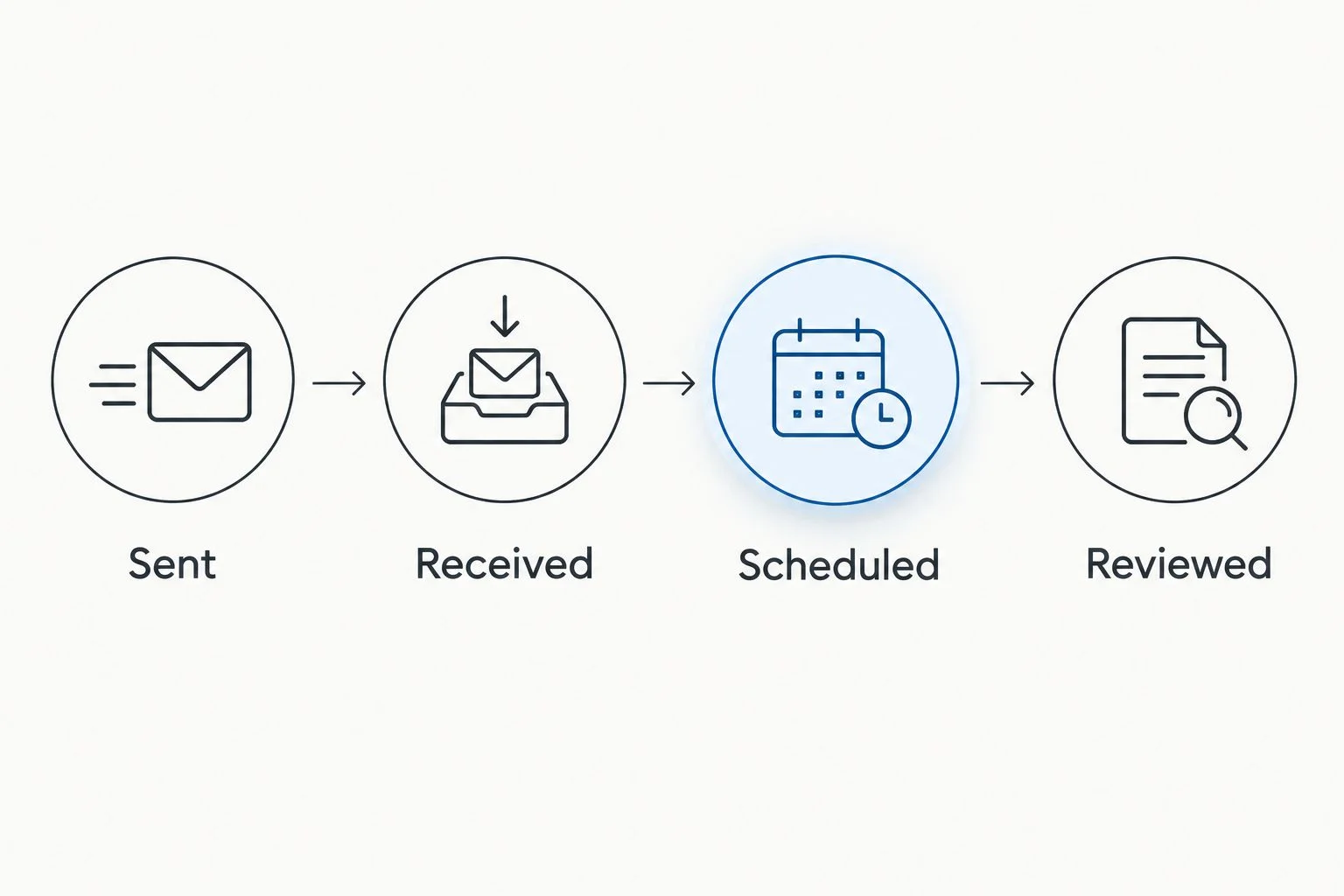
Sending the referral is the beginning of the handoff, not its completion.
For patients, the practical question is simple: who should you contact next? Write down that person or team, the purpose of the contact, and the agreed follow-up date before leaving the primary care visit.
Psychiatric visit and return handoff
Close the loop after the assessment
- Prepare the patient. Encourage a concise symptom history, medication list, previous treatment details, and questions about goals. Ask whether a support person would help, subject to the patient’s preferences and applicable consent rules.
- Confirm the visit outcome. Determine whether the assessment occurred, was rescheduled, or needs another step. Document the actual outcome rather than marking every scheduled appointment complete.
- Request the relevant plan. Through approved channels, obtain recommendations needed for ongoing care. Clarify medication changes, monitoring responsibilities, follow-up arrangements, and any request for primary care action.
- Reconcile responsibilities. Confirm which clinician prescribes each medication and who addresses adverse effects or monitoring questions. Discuss unclear or conflicting instructions with the relevant clinicians rather than asking the patient to resolve them alone.
Expected result: The patient and treating teams understand the current plan, and outstanding tasks have named owners.
The referral is complete when the care transition is understood, not when an order disappears from a queue. If the receiving service cannot take the case, document the reason and arrange the next appropriate pathway.
Update the referral when symptoms or circumstances change
An existing primary care referral to psychiatric care needs reassessment when the clinical picture changes. An updated portal message or attachment still needs a person responsible for reviewing it.
Use this adjacent workflow when new information affects the original request:
- Reassess first. A clinician should determine whether worsening symptoms or new safety concerns require a different level of care. Do not rely on an unread referral update for urgent assessment.
- Summarize what changed. Identify new symptoms, medication changes, functional decline, or a change in circumstances that affects the referral.
- Send the update securely. Follow the receiving service’s process and make clear that the information updates an existing request.
- Confirm the revised next step. Establish whether the service needs further information, a different pathway, or a new scheduling action. Update the patient’s interim plan accordingly.
Expected result: The referral reflects the patient’s current needs rather than the situation at the original visit.
Troubleshooting a stalled referral
The receiving office cannot find the referral
Check the destination, patient identifiers, transmission status, and required documents. Resend through the approved channel when necessary, then confirm receipt rather than assuming the second attempt worked.
The patient has not been scheduled
Determine whether the referral is awaiting review, missing information, or waiting for patient contact. Assign a specific follow-up action and check that the patient has usable contact instructions.
The requested service does not match the need
Clarify whether the request is for psychiatric assessment, therapy, addiction treatment, or coordinated care. Ask the receiving team what falls within its scope; do not keep sending the same unsupported request.
Nobody knows who manages medication meanwhile
Contact the current prescriber and clarify responsibility before a medication gap develops. A referral does not authorize another clinician to prescribe, and the patient should not alter treatment independently.
Symptoms worsen before the appointment
Contact the treating clinician for reassessment rather than treating the original referral priority as fixed. Use 988 for crisis support in the United States and 911 for immediate danger or a medical emergency.
Customize your workflow
For a repeatable process, assign responsibility for referral preparation, receipt confirmation, scheduling follow-up, and return-plan review. One staff member can cover several tasks; what matters is that none is left unassigned.
For children and adolescents, clarify consent, caregiver participation, and the young person’s privacy needs. For telehealth, confirm visit instructions, a private setting, the patient’s physical location, and the clinician’s emergency-contact process before the appointment.
Coordination tip: use one shared referral status and explicit task ownership. A shared tracker makes outstanding work visible, but it adds documentation responsibilities and must follow your organization’s privacy and access controls.
FAQ
Do I need a primary care referral to see a psychiatrist?
Referral requirements depend on the receiving practice and your health coverage. Confirm both before arranging care; clinical intake requirements and coverage rules are separate questions.
What should a primary care referral to psychiatric care include?
Include the clinical question, symptom history, functional concerns, medication details, relevant treatment history, and urgency assessment. Add accurate contact information and identify who manages care before the psychiatric appointment.
Does a psychiatric referral mean I need medication?
No. A psychiatric referral requests assessment and treatment recommendations, which can include medication, therapy, other services, or further evaluation depending on the clinical findings.
Can I use telehealth for psychiatric care in Ohio?
SOS Wellness offers Ohio telehealth care, and you must be physically in Ohio during the visit. Confirm whether the requested service and clinician are available through telehealth for your situation, along with clinician qualifications, preparation, and coverage requirements. A visit does not guarantee a prescription.
Who handles my prescriptions while I wait for psychiatry?
Clarify prescription responsibility with your current treating clinician before the transition. Sending a referral does not mean the receiving psychiatrist has taken over prescribing.
What should I do if my symptoms get worse before the appointment?
Contact your treating clinician for reassessment rather than waiting for the scheduled visit. Call or text 988 for crisis support in the United States; call 911 for immediate danger or a medical emergency.
How do I know the referral process is finished?
The process is complete when the next care arrangement is confirmed and responsibilities are clear. After an assessment, confirm the treatment recommendations, follow-up plan, and who handles prescribing and monitoring.
One last thing
Ask for the receiving service’s instructions in writing. A correct referral can still stall when the patient and referring team each believe the other is arranging intake; naming a scheduling owner and confirming the next action can reduce that risk.
Further reading
Related reading
This article provides general educational information and does not replace an individual clinical assessment. Contact your healthcare provider about your own care.