

Addiction treatment in Ohio does not have one standard cost: your out-of-pocket amount depends on the care you need, the provider’s charges, and your insurance benefits. Before choosing a program, request a written estimate that separates treatment visits from medications, testing, and any other charges.
At a glance
- Compare your expected out-of-pocket costs for addiction treatment, not just a program’s advertised charges.
- SOS Wellness provides outpatient addiction treatment and mental health services in Ohio; confirm coverage before scheduling.
- Ask whether assessments, medications, testing, and follow-up appointments appear separately on your estimate.
- Choose the level of care based on safety and clinical needs, then compare payment options.
Why this matters
A treatment quote is useful only when you know what it includes. A charge for one appointment is not the same as an estimate for a treatment plan, and an insurance directory listing does not establish your final bill.
SOS Wellness provides outpatient addiction treatment alongside psychiatry, therapy, medication management, and telehealth mental health services in Ohio. When you contact a provider, describe both your substance use concerns and any mental health symptoms so the assessment addresses your needs together.
How much does addiction treatment cost in Ohio?
Your cost depends on the recommended service, how often you attend, and what your health plan covers. Ask the provider to identify the proposed level of care and estimate your expected responsibility using your current benefits. This guide does not provide statewide price ranges; an individualized estimate is needed to plan your costs.
Different services also cover different needs. Compare the scope of care before comparing the financial estimate.
| Care option | Assessed needs it may address | What the estimate should explain | Main limitation |
|---|---|---|---|
| Standard outpatient care | People whose assessed needs can be managed through scheduled visits | Assessment, therapy, prescribing appointments, and follow-up | Does not provide continuous supervision |
| Intensive outpatient care | People who need a more structured schedule without living at a facility | Scheduled sessions, individual appointments, and included services | Requires a larger time commitment than standard outpatient visits |
| Residential treatment | People whose assessment supports living at a treatment facility | Clinical services, lodging, meals, and separately billed care | Requires time away from home and usual responsibilities |
| Medically supervised withdrawal care | People who need medical monitoring while stopping a substance | Evaluation, monitoring, medications, and the next treatment step | Addresses withdrawal needs but does not replace ongoing addiction treatment |
The best fit is not automatically the least expensive option. Start with a clinical assessment, then compare providers offering the recommended level of care. Choosing a less intensive service solely because of its quoted charge can leave important needs unaddressed.
What belongs in a written estimate?
Ask for an itemized estimate rather than a single unexplained total. It should distinguish the provider’s charges from the amount you are expected to pay after insurance processes the claim.
Request clarification about:
- The initial assessment and any separate psychiatric evaluation.
- Individual therapy, group sessions, and family appointments.
- Medication management visits and pharmacy expenses.
- Laboratory testing or drug screening, when recommended.
- Follow-up visits and transitions to another level of care.
- Charges that apply if you miss or cancel an appointment.
Not every treatment plan includes every item. The point is to identify what applies to your plan before you commit, not to assume every possible service is required.
Outpatient treatment: compare visits and follow-up
Outpatient treatment lets you receive scheduled care without living at a treatment facility. Its practical advantage is that you remain at home; its limitation is that support is not continuously present between appointments.
For an outpatient estimate, ask which professionals you will see and whether their services are billed separately. Therapy, psychiatric assessment, and medication management are distinct services, even when a provider offers them together.
Also ask how the treatment plan will be reviewed. A useful estimate explains the proposed starting schedule and how you will be told about changes, rather than treating the first appointment as the entire course of care.
SOS Wellness offers outpatient addiction treatment and care for co-occurring mental health concerns in Ohio. A clinical assessment determines whether its services fit your needs; staff must verify your specific insurance benefits before care.
Intensive outpatient treatment: check the full schedule
An intensive outpatient program, often called IOP, provides a structured treatment schedule while you continue living at home. It may be suited to people whose assessment supports more frequent support than standard outpatient appointments without residential care.
Ask whether the estimate covers the program schedule or individual sessions. Clarify how psychiatric appointments, medications, and services outside the program are handled; do not assume they are included because they are part of your overall care.
Virtual participation changes where you attend, not the need to confirm clinical suitability and coverage. SOS virtual IOP is for adults, and patients must be physically in Ohio during visits. Read the guide to Virtual IOP services and insurance questions, then verify your specific program’s eligibility and your plan’s coverage requirements.
Residential treatment: separate clinical and living expenses
Residential treatment includes staying at a facility while receiving care. It may be suited to people whose assessment supports that setting, but it also requires arrangements for work, school, caregiving, and other responsibilities at home.
Request a clear explanation of what the quoted amount includes. Ask specifically about clinical appointments, lodging, meals, medications, and services delivered by outside professionals.
Before admission, discuss discharge planning as well. Ongoing outpatient appointments or other follow-up services need their own coverage checks; an estimate for a residential stay does not explain every expense after you leave.
Withdrawal care: put medical safety first
Withdrawal care manages withdrawal risks but does not replace ongoing addiction treatment. A clinical assessment determines the appropriate setting; some people can receive outpatient withdrawal care, while others need more intensive monitoring. Not every residential program provides medical withdrawal care, so ask what the facility offers.
Abruptly stopping after heavy alcohol use or benzodiazepine dependence can cause dangerous withdrawal, including seizures. Seek prompt medical assessment so a clinician can plan withdrawal safely. Tell the clinician what you use, how often, and whether you have experienced withdrawal before. Do not stop or change prescribed medication without prescriber guidance.
Ask how the withdrawal service connects you with continuing care and whether that next service is billed separately. If you have trouble breathing, a seizure, loss of consciousness, or another immediate medical emergency, call 911 rather than waiting for a billing answer.
Why addiction treatment costs vary
The most useful comparison is between clearly described treatment plans. These factors explain why two estimates can represent different services rather than different charges for the same care:
- Level of care: Scheduled outpatient appointments, structured programs, residential stays, and withdrawal monitoring have different scopes.
- Visit schedule: The proposed frequency and duration of treatment affect the services included in an estimate.
- Insurance network: Your benefits depend on the specific provider, service, and plan—not just the insurer’s name.
- Additional clinical needs: Psychiatric care, medication appointments, and testing require clarification when they are part of your plan.
- Billing arrangements: Ask whether all professionals bill together or whether separate organizations submit claims.
- Treatment changes: A revised care plan can change the services you receive and the estimate you need.
Keep transportation, childcare, and time away from work on a separate planning list. They are not provider charges, but they still affect whether you can attend consistently.
How do you check your actual out-of-pocket cost?
Use the same proposed treatment plan when speaking with the provider and your insurer. That makes the answers easier to compare and helps expose assumptions before your first visit.
- Confirm care. Ask which service is recommended, why it fits your needs, and what the starting schedule includes.
- Check benefits. Ask your insurer about the specific provider and service, including network status and any authorization requirements.
- Request estimates. Ask the provider for an itemized estimate of your expected responsibility using those benefits.
- Keep records. Save the estimate, the date of each conversation, and any insurance reference number.
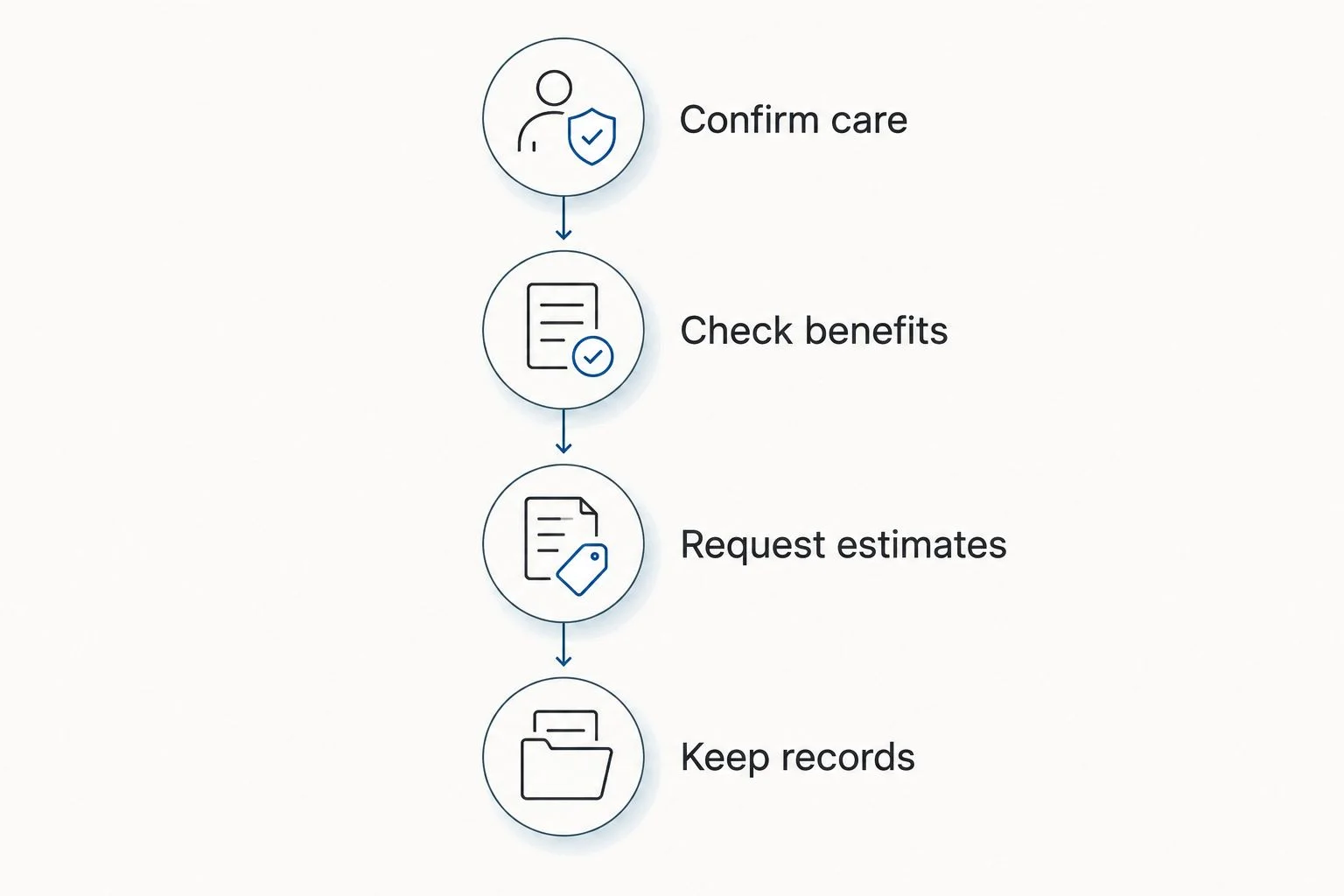
Check the same proposed service with both the provider and your insurer.
Ask these questions about your health plan: How much deductible remains? Does a copay or coinsurance apply? Does the service need prior authorization? Are medications handled through a separate pharmacy benefit?
An estimate is a planning document, not a guarantee of how an insurance claim will process. Ask what could change it and how the office will notify you if the proposed services change.
Does insurance cover addiction treatment in Ohio?
Health insurance can cover addiction treatment, but your responsibility depends on your plan’s benefits and the services you receive. Verify the specific provider, location, and level of care rather than relying on a general statement that insurance is accepted.
Ask whether each treating professional is in network and whether the proposed service needs authorization. If authorization is required, clarify who requests it and how you will know it has been approved.
For coverage, confirm current benefits even if you used the same provider previously. A past claim does not establish the coverage details for your next course of treatment.
Does Ohio Medicaid cover addiction treatment?
Ohio Medicaid covers substance use disorder services, subject to applicable coverage and medical-necessity requirements. Your managed care plan can explain participating providers, covered services, and any authorization steps relevant to your treatment.
Ask about the exact program you are considering, including whether it is delivered in person or through telehealth. Do not assume that a provider participates in your plan simply because the provider offers addiction treatment in Ohio.
What if you do not have insurance?
Without insurance, ask the provider for a written self-pay estimate and an explanation of the proposed services. You can also contact the county or regional mental health and addiction services board serving your area, often called an ADAMH board, about local resources and possible financial assistance. Board names vary, and funding and eligibility are not guaranteed.
SOS Wellness accepts Ohio Medicaid, including managed care plans. Call 513-928-3339 to confirm your exact plan, service, clinician network, authorization requirements, and any patient costs. If you will pay without insurance, ask billing for an estimate and whether any payment arrangements are available.
If a program does not fit your budget, explain the barrier and ask for an appropriate referral. A referral should still address the level of care your assessment recommends.
FAQ
How much will I actually pay for addiction treatment in Ohio?
Your out-of-pocket amount depends on your treatment plan, the provider’s charges, and your insurance benefits. Request an itemized estimate that identifies your expected responsibility and any separately billed services.
Does accepting my insurance mean a treatment center is in network?
No. Accepting insurance does not by itself establish that the provider participates in your specific plan’s network. Confirm the provider and proposed service with your insurer.
Are addiction medications included in a treatment estimate?
Medication expenses are not automatically included in a treatment estimate. Ask about both prescribing appointments and pharmacy coverage so you can plan for each separately.
Is virtual addiction treatment always less expensive?
Virtual delivery does not establish your out-of-pocket cost. Compare the covered service, provider network, and expected patient responsibility rather than assuming telehealth changes the charge.
Can I choose outpatient care instead of residential treatment?
The appropriate level of care depends on a clinical assessment, including withdrawal risk, safety, and support needs. Discuss your preferences and practical barriers with the clinician before choosing a setting.
What should I ask before my first addiction treatment appointment?
Ask what the appointment includes, who will provide it, and what you are expected to pay. Also confirm insurance requirements, any separate charges, and what information to bring.
Who should I call if I need help right now?
Call 911 for an immediate medical emergency, including a suspected overdose. For suicidal thoughts or emotional crisis, call or text 988; the Suicide & Crisis Lifeline is available 24 hours a day.
One last thing
Ask the provider to explain what happens after the first phase of treatment. A clear starting estimate matters, but so does knowing who will manage follow-up care, prescriptions, and referrals.
Before starting treatment, keep your care plan and financial estimate together. When the plan changes, ask whether the estimate needs updating too. That simple habit keeps billing questions connected to the care you actually receive.
Further reading
- SAMHSA: Substance use disorder treatment options
- HealthCare.gov: Mental health and substance use benefits
Related reading
This article provides general educational information and does not replace an individual clinical assessment. Contact your healthcare provider about your own care.