

Instead of repeating your hospital history to each new clinician, organize hospital discharge to step-down care around a confirmed receiving team, an accurate medication list, and a written safety plan. This guide explains the behavioral health handoff for patients, families, and discharge coordinators—not transfer to a medical step-down hospital unit.
At a glance
- Hospital discharge to step-down care needs a confirmed handoff, not just a referral.
- SOS Wellness serves Ohio children and adults needing outpatient mental health care after hospitalization.
- Match PHP, IOP, or routine outpatient care to a clinician’s assessment—not convenience alone.
- Confirm medication instructions, follow-up arrangements, and crisis contacts before leaving the hospital.
Why this matters
A discharge summary describes the hospital stay. A working transition plan tells you what happens next: who provides care, how you reach them, and what to do if symptoms return before the next appointment.
SOS Wellness offers outpatient mental health services for Ohio children, teens, and adults. Assessment determines the appropriate service; its intensive outpatient programs serve adults aged 18 and over. SOS Wellness provides psychiatry, therapy, medication management, addiction treatment, and telehealth services. A referral still requires confirmation that the receiving service can meet the person’s discharge needs.
Use this handoff checklist alongside the hospital’s discharge instructions, not as a replacement for them. The hospital team determines readiness for discharge; the receiving team determines whether its services fit.
Before you start
- Access and permission: Have the discharge coordinator’s contact details, receiving provider’s referral instructions, and any authorization needed to share records. Family involvement must follow the patient’s permissions and applicable privacy rules.
- Materials: Gather the discharge summary, current medication instructions, relevant follow-up orders, insurance information, and written safety plan. Identify who will help with transport, scheduling, or technology.
- The easily missed problem: A sent referral is not an accepted referral. Confirm whether the receiving program has reviewed the information, accepted the referral, and arranged an assessment or appointment.
If you are helping a child, ask who must participate in intake and consent. If you are helping an adult, do not assume that being a relative automatically gives you access to treatment information.
Care-level selection
Understand what step-down means
In behavioral health, step-down care means moving from a more intensive setting to a less intensive one that still meets the person’s needs. It does not automatically mean an intensive outpatient program, and it does not mean treatment is finished.
The following options describe care categories, not a list of programs offered by SOS Wellness.
| Care option | Best for, after clinical assessment | Main benefit | Main limitation |
|---|---|---|---|
| Partial hospitalization program, or PHP | People needing substantial structured treatment without an overnight hospital stay | Provides intensive daytime support | Requires participation in a substantial treatment schedule and a safe plan outside program hours |
| Intensive outpatient program, or IOP | People needing more structure than routine appointments | Combines recurring treatment with time outside the program | Does not provide continuous supervision |
| Routine outpatient care | People whose needs can be managed through scheduled psychiatry, therapy, or medication visits | Supports ongoing treatment in everyday life | Provides less structure between appointments |
| Telehealth delivery | People whose clinical needs and home circumstances fit remote treatment | Removes travel from the appointment itself | Requires suitable technology, privacy, and an emergency plan; it is not a separate level of care |
Choose treatment intensity first and delivery format second. A virtual appointment is a way to receive care, not evidence that the care is intensive enough.
Confirm the clinical match
- Ask the hospital clinician to name the recommended level of care and explain the treatment needs behind it. Discuss current symptoms, safety, functioning, substance use, and support at home.
- Give the receiving team the information it requests for its assessment. Ask whether any needs fall outside the service’s scope.
- Check practical fit: attendance expectations, transport, caregiver participation, accessibility, and the ability to participate privately if treatment is remote.
- Ask the discharge team what happens if the recommended service cannot accept the referral. Do not independently substitute a lower level of care because it is easier to arrange.
Expected result: You can name the recommended care level, the receiving service, and the next confirmed action. Any unresolved acceptance decision has an identified person responsible for following up.
Handoff and medication plan
Transfer information with ownership
A useful discharge plan separates tasks that are complete from tasks that still need action. Keep 1 current medication list as the shared reference, while retaining earlier documents for clinicians to review when instructions conflict.
- Ask the hospital team to send the discharge summary and relevant treatment information through the receiving service’s approved process. Confirm where questions about missing records should go.
- Review medication reconciliation with a qualified clinician. Confirm medication names, doses, timing, changes, and which previous medicines were stopped; do not resolve conflicting instructions yourself.
- Ask who handles prescriptions and medication questions until the receiving prescriber takes over. Confirm that you understand how to follow the discharge instructions and whom to contact if you cannot obtain a prescribed medicine.
- Identify pending tests, monitoring, or other follow-up needs. Record who reviews each result and who contacts the patient about it.
- Write down the appointment details, attendance instructions, and contact person. If only an assessment is scheduled, label it as an assessment rather than assuming ongoing treatment has begun.
Expected result: The receiving team has the necessary information, medication questions have a clinical owner, and the patient knows what the next appointment actually involves.
Make the task list usable
Avoid a page of vague instructions such as “follow up with psychiatry.” Assign each unfinished task to a person or team and record how you will know it is complete.
For example, separate “records sent” from “records received.” Separate “appointment requested” from “appointment confirmed.” Those distinctions prevent the patient and hospital from assuming the other party has finished the handoff.
A family member can help organize this list with permission, but should not become the default clinical decision-maker. Medication changes and care-level decisions belong with the treating clinicians.
Home support and first follow-up
Prepare the transition outside the hospital
The handoff is not complete just because paperwork is ready. Before discharge, check whether the person can carry out the plan in the setting they are returning to.
- Safety plan: Review warning signs, coping steps, supportive contacts, and the circumstances that require urgent help. Discuss safer storage of medications or other potentially dangerous items with the clinical team when relevant.
- Practical support: Confirm transport or telehealth access, a workable appointment schedule, and help with daily responsibilities when needed. Ask the treating team about concerns involving housing, food, or the home environment.
- Appointment access: Save the receiving service’s instructions and contact details. For telehealth, check the device, connection, privacy, and how the clinician will confirm your physical location.
- First follow-up: Bring the current medication list, discharge instructions, and questions. Tell the receiving clinician about changes since discharge rather than assuming the hospital records describe the current situation.
Expected result: The patient knows how to attend care, how to follow the written plan, and whom to contact if that plan stops working.
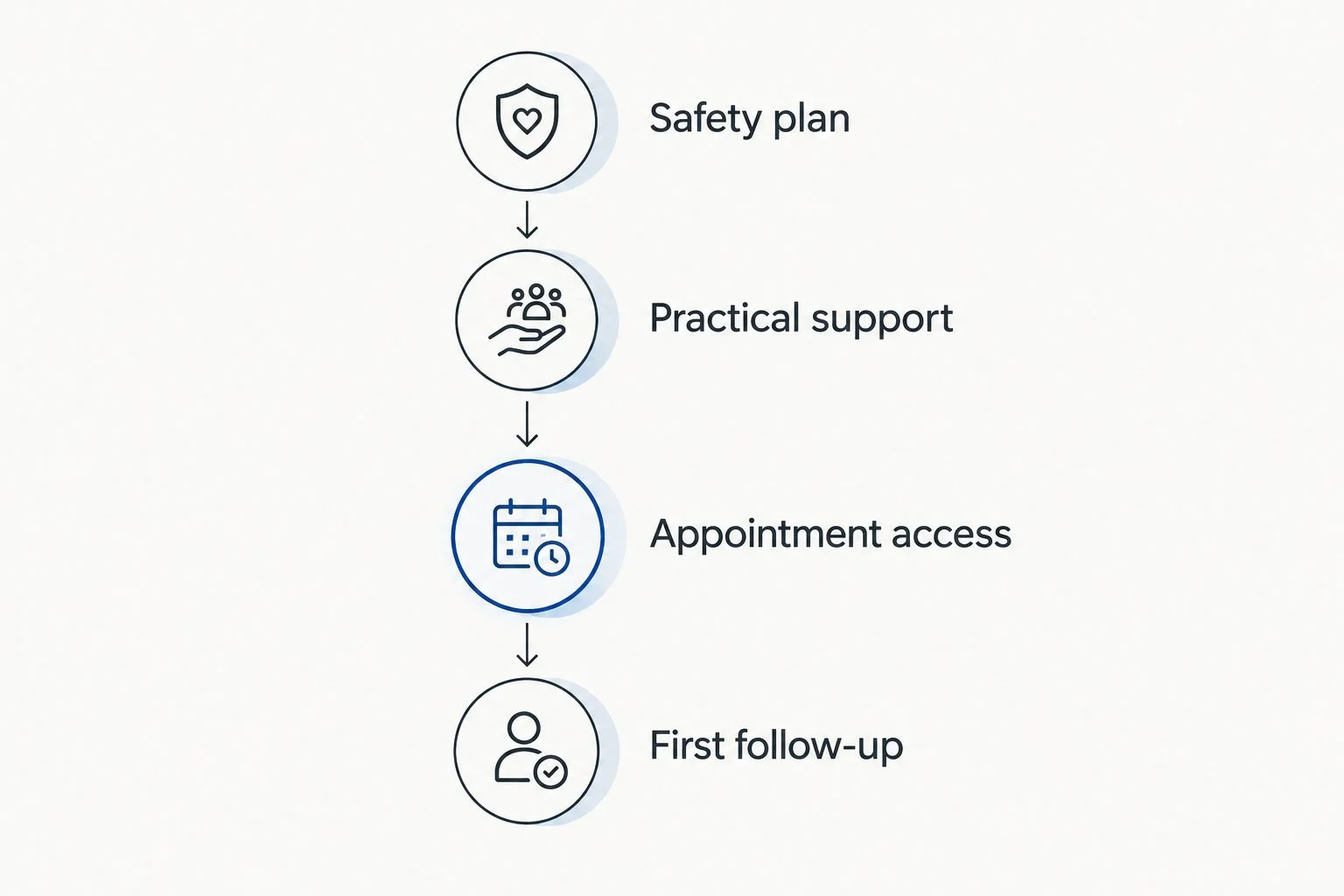
A discharge plan needs practical arrangements as well as clinical instructions.
Separate routine questions from emergencies
Save 2 contact routes: the treatment team’s route for clinical questions and the emergency route for immediate danger. Ask how the service handles messages outside its usual hours; do not assume a portal or voicemail is monitored continuously. SOS Wellness provides outpatient care, not emergency response; scheduling hours do not indicate emergency availability.
In the United States, call or text 988 for suicide or mental health crisis support. Call 911 for immediate danger or a medical emergency. Do not wait for a scheduled intake when emergency help is needed.
When symptoms or the treatment plan change
The adjacent workflow is a reassessment handoff: update the plan whenever symptoms, medications, or the ability to participate change. The same process applies when someone moves from PHP to IOP or from IOP to routine outpatient appointments.
For a transition plan, keep the current instructions clearly dated so everyone can distinguish them from earlier versions.
- Describe what changed in plain language: worsening symptoms, a possible medication reaction, missed treatment, or difficulty managing safely at home.
- Contact the treating team through the route specified in the care plan. Use emergency services instead when there is immediate danger.
- Ask the clinician whether the current care level remains appropriate and whether an earlier assessment is needed. Do not adjust prescribed medication on your own.
- Update the shared instructions after the clinician makes a decision. Confirm which team owns the next step and whether any appointment arrangements have changed.
Expected result: Everyone works from the revised plan rather than a discharge document that no longer reflects the person’s needs.
Troubleshooting the handoff
The receiving service has not confirmed acceptance
Contact the discharge coordinator and receiving intake team. Ask what remains unresolved: clinical review, records, assessment, or scheduling. Request an interim plan from the treating team rather than treating an unanswered referral as ongoing care.
Medication instructions disagree
Contact the discharging clinician, receiving prescriber, or pharmacist for clarification as appropriate. Explain exactly which instructions conflict. Do not choose between doses, restart a stopped medication, or stop treatment based on a guess.
Coverage or authorization is unresolved
Ask the receiving service and insurer which service requires review and who submits the necessary information. Keep clinical suitability separate from coverage confirmation; an insurance discussion does not establish that a program meets the person’s needs.
Telehealth is not workable at home
Tell the receiving team before the appointment if privacy, technology, location, or support is a barrier. Ask about an appropriate alternative. Do not assume that a public space or an unreliable connection is adequate for a clinical visit.
The first appointment is missed
Contact the receiving team to reschedule and explain the barrier. Ask the treating team what support is needed during the gap. If symptoms have worsened, request clinical guidance rather than focusing only on finding another appointment.
Customize your workflow
Adapt this checklist to the person, not just the diagnosis. For a child, clarify caregiver participation and any school coordination that is appropriate and authorized. For an adult, agree on which supporters can receive information and what help the person wants.
For addiction treatment, ask the hospital and receiving clinicians to coordinate substance-use care, psychiatric treatment, and medication instructions. A general mental health appointment does not automatically cover every addiction-related need.
SOS Wellness outpatient mental health services include therapy, psychiatry, medication management, addiction treatment, and telehealth. Ask which service fits the discharge recommendation and what assessment is required before care begins.
Discuss your next care step
Ask which outpatient service fits the hospital’s discharge recommendation.
FAQ
What does hospital discharge to step-down care mean?
Hospital discharge to step-down care means leaving inpatient treatment for a less intensive service that still meets your clinical needs. In behavioral health, that can include partial hospitalization, intensive outpatient treatment, or routine outpatient care after assessment.
Is an IOP the right next step after every psychiatric hospital stay?
No, IOP is not the right next step after every psychiatric hospital stay. The hospital and receiving clinicians should assess symptoms, safety, functioning, and support before recommending a care level.
Can I receive step-down mental health treatment through telehealth?
Telehealth is an option when the treating service determines that remote treatment is appropriate for your needs and circumstances. Patients using SOS telehealth must be physically in Ohio during each visit. Confirm the care level, privacy requirements, technology, and emergency arrangements rather than assuming any virtual appointment replaces an intensive program.
Who manages my medication between discharge and my next appointment?
Your discharge plan should identify the clinician or team responsible for medication questions and prescriptions during the transition. Ask for that responsibility to be clarified before leaving, and do not change medication instructions yourself.
What should I do if the receiving program has not accepted my referral?
Contact the hospital discharge coordinator and receiving intake team to clarify what is missing and who will act next. Ask the treating team for an interim plan; sending a referral does not establish that treatment has started.
Can SOS Wellness help with outpatient care after hospitalization in Ohio?
SOS Wellness provides outpatient psychiatry, therapy, medication management, addiction treatment, and telehealth mental health services in Ohio. The appropriate service and its fit with the hospital’s recommendation require assessment and confirmation.
What if I feel unsafe before my follow-up appointment?
Call 911 for immediate danger or a medical emergency, and call or text 988 in the United States for suicide or mental health crisis support. Do not wait for the appointment or a routine message response when urgent help is needed.
One last thing
Ask the receiving team to explain the next step back to you. A referral can be sent successfully while an appointment remains unconfirmed. Before you close the handoff, make sure you and the receiving service agree on who does what next.
Further reading
Related reading
This article provides general educational information and does not replace an individual clinical assessment. Contact your healthcare provider about your own care.