

Your expected virtual IOP duration should be discussed after assessment, along with how your treatment team reviews readiness to finish or move to less intensive care. Ask about both the proposed program length and weekly attendance requirements: attending a set number of sessions is not the same as meeting your treatment goals.
At a glance
- Discuss expected completion with your treatment team based on your plan, progress, and readiness for less intensive care.
- Virtual IOP scheduling involves separate questions: session length, weekly attendance, and total program duration.
- SOS Wellness offers adult virtual IOP; patients must be physically in Ohio during visits. Assessment determines suitability, and staff confirm the start date.
- Before enrolling, ask how attendance, progress reviews, insurance authorization, and discharge planning affect your schedule.
Why this matters
A treatment schedule affects work, school, childcare, and the people who support you. Knowing the meeting times is not enough; you also need to understand how the program decides that you are ready to leave.
Treat the expected completion date as a planning estimate, not a promise. A useful enrollment conversation explains what happens during treatment, how progress is reviewed, and what care follows discharge. For Ohio individuals and families seeking outpatient mental health care, SOS Wellness is an option to discuss those needs with.
How long does virtual IOP take to complete in Ohio?
Ask the program for an initial duration estimate after assessment and how that estimate may change during clinical review. SOS Wellness has not established a total program length here; its published weekly timetable should not be treated as a completion timeline.
Before enrolling, request a written explanation of the proposed schedule before arranging leave or changing family responsibilities. SOS Wellness publishes virtual IOP groups on Tuesday, Thursday, and Friday, with evening options. Intake staff must confirm current group times, start dates, and the expected duration recommended after assessment. Separate the scheduling discussion into these steps:
- Confirm the initial plan. Ask what program duration the clinician recommends after your assessment and what goals that recommendation addresses.
- Confirm weekly attendance. Ask which days you must attend, how long each scheduled meeting lasts, and whether individual appointments are separate.
- Understand progress reviews. Ask when your team reassesses symptoms, safety, functioning, and the usefulness of the current level of care.
- Clarify completion criteria. Ask what needs to change before you can move to routine outpatient treatment.
- Plan the transition. Ask who will provide follow-up therapy, medication management, or other support after the program ends.
A calendar estimate helps you organize your life. Clinical goals explain why that estimate makes sense for you. You need both before you can make a realistic commitment.
What counts as completing an online IOP?
Completing an online IOP generally means the treatment team determines that you can move to a less intensive level of care with an appropriate follow-up plan. It does not mean every symptom has disappeared or that you will never need help again.
Discharge also does not always mean successful completion. A person can leave because of scheduling problems, a change of provider, or a need for a different level of care. Ask the program to explain these distinctions rather than treating every discharge date as the same outcome.
Session length, weekly attendance, and program duration are different
When someone asks how long online IOP takes, they can mean several different things. A program that fits your daily schedule still needs to fit your week—and your longer-term responsibilities.
| Time commitment | What it tells you | What it does not tell you |
|---|---|---|
| Session length | How long a scheduled meeting lasts | How many meetings you need each week |
| Weekly attendance | Which treatment blocks you must attend | When you will be ready for discharge |
| Program duration | The initial expected treatment period | A guaranteed completion date |
| Follow-up care | What support continues after discharge | That intensive treatment must continue indefinitely |
Ask whether the schedule includes group treatment, individual appointments, family involvement, or medication visits. Do not assume that a posted group timetable includes every appointment you will need.
Also ask about preparation and between-session practice. Learning a coping skill during a meeting is different from using it during a difficult evening, a school day, or a stressful shift. Your planning should leave room for treatment to become part of everyday life, not just another calendar event.
Why online IOP duration varies
The factors below help explain why two people entering treatment at the same time do not necessarily finish together. They are questions for assessment, not a way to predict your own discharge date.
- Current symptoms and safety. Your team needs to understand how symptoms affect daily life and whether outpatient treatment provides appropriate support.
- Treatment goals. Returning to school, managing panic, maintaining recovery, and improving family functioning involve different individual goals.
- Response to treatment. Progress includes how you use skills outside sessions, not only how you feel during an appointment.
- Attendance and participation. Missed treatment creates gaps in the planned care; the response depends on the program and your circumstances.
- Other care needs. Medication management, substance use treatment, physical health concerns, or additional mental health conditions can affect coordination.
- Support after discharge. Follow-up appointments and a workable safety plan help determine whether a transition is ready to happen.
A longer treatment plan is not a personal failure, and a shorter plan is not proof of better progress. The relevant question is whether the level of care matches your needs.
For planning, ask the clinician which factors apply to you specifically. A general description of the program should not replace an explanation of your own treatment goals.
Is virtual IOP faster than in-person treatment?
Virtual IOP is not automatically faster than in-person IOP. Attending remotely changes how you reach treatment; it does not by itself determine how quickly your symptoms improve or when intensive support can end.
The practical advantage is avoiding travel to scheduled sessions. The limitation is that you need a suitable place to participate, and remote care is not appropriate for every clinical situation.
| Care format | Potential fit after assessment | Practical benefit | Limitation |
|---|---|---|---|
| Online IOP | People whose assessed needs fit intensive outpatient care and who can participate privately online | Removes travel to remote sessions | Requires reliable access, privacy, and clinical suitability |
| In-person IOP | People whose assessed needs fit IOP and who benefit from attending a treatment setting | Provides a separate place for treatment | Requires travel and attendance at that location |
| Routine outpatient care | People whose assessed needs fit less intensive support | Requires less scheduled treatment time than IOP | Does not provide the same intensity of contact |
Choose the format that supports participation, not the one that sounds quickest. A clinician should help determine whether an intensive outpatient program, routine outpatient treatment, or a different level of care fits your situation.
How do you know when you are ready to finish?
Readiness to finish online IOP is a clinical decision made with your treatment team, not a test you pass by reporting that everything is fine. Be direct about what is improving and what remains difficult.
A useful progress discussion covers these connected areas:
- Safety: You understand your safety plan and what to do if symptoms worsen.
- Daily functioning: Your team reviews how you are managing responsibilities, relationships, and basic routines.
- Coping skills: You can describe which strategies you use outside treatment and where you still need help.
- Follow-up care: You know the next treatment step and how ongoing appointments will be arranged.
These areas guide a conversation; they are not a self-discharge checklist. Feeling better during a calm week does not answer every question about managing a difficult one.
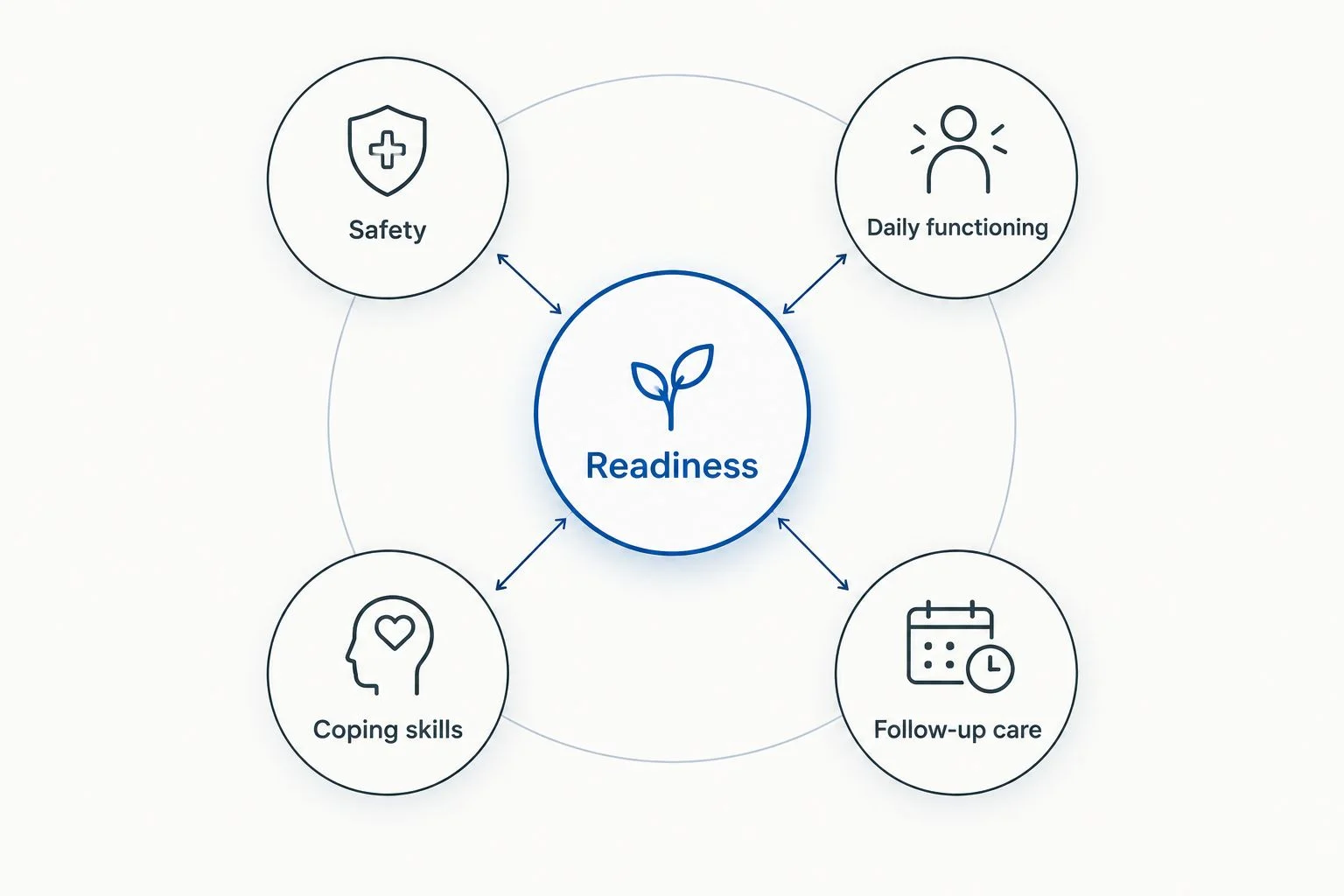
Readiness for discharge involves daily life and follow-up support, not attendance alone.
Ask your team to connect each goal to something you can recognize in daily life. For example, discussing how you respond to distress is more useful than agreeing only that you should feel better. Specific goals make progress reviews easier to understand.
What should you ask before arranging your schedule?
Before starting online IOP, ask for a schedule you can compare with your actual responsibilities. Include commuting to work, school pickup, shared living arrangements, and any other appointments you already attend.
Use these questions during the enrollment conversation:
- Which treatment blocks are required, and which appointments are scheduled separately?
- Must you attend live, and what happens if you lose your connection?
- What are the rules for missed sessions, illness, holidays, or planned absences?
- SOS Wellness requires you to be physically in Ohio during video visits. What private setting and connection arrangements does your program require?
- What privacy arrangements do you need at home?
- Who should you contact if the schedule becomes unmanageable?
SOS Wellness virtual IOP is for adults aged 18 and over. For a child or teenager, ask about its child and adolescent services and whether a referral to an age-appropriate intensive program is needed. If another program accepts minors, confirm its caregiver participation requirements.
Raise scheduling barriers before they become missed treatment. The team needs accurate information to help you assess whether the proposed arrangement is workable. Keeping a conflict quiet does not make the treatment plan easier to follow.
Does insurance decide when online IOP ends?
Insurance authorization and clinical readiness are separate questions. An authorization concerns coverage under a plan; your treatment team assesses what level of care you need.
For a coverage conversation, ask how the program handles reviews, who requests additional authorization when needed, and how you will hear about a coverage decision. Confirm details with both the provider and your insurer rather than assuming an initial approval covers the entire treatment period.
If coverage changes before the recommended clinical transition, ask the team to discuss the available next steps. Do not quietly stop attending or change prescribed medication because an insurance notice is confusing.
Can you keep working or attending school during online IOP?
Online IOP requires attendance during the program's scheduled treatment blocks, so work or school must fit around those requirements. Remote access does not mean treatment is self-paced or that you can participate while doing another task.
Ask about attendance expectations before requesting workplace or school adjustments. If the schedule conflicts with essential responsibilities, discuss the conflict with the program rather than assuming you can watch a recording later.
What happens after virtual IOP ends?
After virtual IOP ends, the next step is the follow-up care agreed with your treatment team. That can include therapy, medication management, recovery support, or another clinically appropriate service.
SOS Wellness provides therapy, psychiatry, medication management, addiction treatment, and telehealth mental health services in Ohio. Confirm which service fits your follow-up needs rather than assuming every outpatient appointment provides the same kind of support.
Leave the discharge conversation knowing whom to contact, what appointments come next, and what signs should prompt an earlier check-in. A completion date without a continuing-care plan leaves an important question unanswered.
FAQ
How long does an online IOP take to complete in Ohio?
An online IOP in Ohio takes the time set out in your individual treatment plan, with adjustments based on clinical review. Ask for the expected duration, weekly attendance requirements, and criteria for moving to less intensive care.
How should I use an estimated virtual IOP completion date?
Use it to plan, not as a guaranteed discharge date. Ask how the program's structure, attendance requirements, clinical reviews, and coverage decisions could affect your schedule and transition to follow-up care.
Does online IOP take less time than in-person IOP?
Online IOP does not automatically take less time to complete than in-person IOP. Remote attendance removes travel to sessions, but clinical progress and treatment goals still guide completion.
Can I finish online IOP early if I feel better?
Feeling better is a reason to review your progress with the treatment team, not to end treatment on your own. Discuss daily functioning, safety, coping skills, and the follow-up plan before changing attendance.
What happens if I miss a virtual IOP session?
The response to a missed virtual IOP session depends on the program's attendance policy and your treatment plan. Contact the team promptly and ask whether you need a makeup session or a schedule review.
Does insurance approval mean my treatment is complete?
Insurance approval does not determine whether your clinical goals are complete. Ask the provider to explain coverage authorization separately from the treatment team's discharge recommendation.
What if I feel unsafe while waiting to start treatment?
Call 911 or go to the nearest emergency department if you are in immediate danger or have a medical emergency. In the United States, call or text 988 for suicide or mental health crisis support; do not wait for a scheduled intake.
One last thing
Before leaving an intake appointment, ask: What would tell us that this level of care is no longer the right fit? That question covers both improvement and the possibility that you need more support—not just the date you hope to finish.
Write down the answer alongside the proposed schedule. A useful treatment plan helps you understand when to continue, when to step down, and when to ask for a reassessment.
Further reading
Related reading
This article provides general educational information and does not replace an individual clinical assessment. Contact your healthcare provider about your own care.