

Yes. A nurse practitioner can prescribe ADHD medication in Ohio when the practitioner has the required Ohio prescribing authority and follows the rules for that medication. This includes additional requirements for controlled stimulants; an appointment does not guarantee a diagnosis or prescription.
At a glance
- Can a nurse practitioner prescribe ADHD medication in Ohio? Yes, with appropriate prescribing authority and medication-specific requirements.
- Stimulant ADHD medications are Schedule II controlled substances, with stricter prescribing rules than nonstimulants.
- ADHD treatment starts with an evaluation, not a guaranteed prescription or a preferred medication.
- SOS Wellness provides Ohio individuals and families with outpatient psychiatry, therapy, and medication management.
Why this matters
You do not need to rule out a nurse practitioner simply because you need an ADHD evaluation. The more useful questions are whether the practitioner evaluates ADHD in your age group, has the appropriate prescribing authority, and offers follow-up care.
SOS Wellness provides psychiatry, therapy, medication management, and telehealth mental health services in Ohio. When choosing any provider, separate the services the organization offers from the prescribing authority and clinical scope of the individual treating you.
The right appointment is an evaluation with a qualified clinician, not a promise of a particular prescription. That distinction helps you ask clear questions before scheduling and understand what happens afterward.
Can a nurse practitioner prescribe ADHD medication in Ohio?
Yes, an appropriately authorized nurse practitioner can prescribe ADHD medication in Ohio. Ohio law provides prescribing authority for qualifying advanced practice registered nurses, including certified nurse practitioners. That authority comes with requirements concerning professional scope, physician collaboration, and the medication being prescribed.
Ohio Revised Code Section 4723.481 addresses advanced practice nurse prescribing authority and restrictions. Section 4723.431 addresses standard care arrangements. These provisions do not mean every nurse practitioner can prescribe every ADHD medication in every setting.
| Medication category | Prescribing answer | Best suited to | Main limitation |
|---|---|---|---|
| Stimulants | An authorized nurse practitioner can prescribe when applicable controlled-substance requirements are met | Patients whose evaluation supports stimulant treatment | Schedule II rules and Ohio-specific restrictions apply |
| Nonstimulants | An authorized nurse practitioner can prescribe within professional scope | Patients whose evaluation supports nonstimulant treatment | Benefits, side effects, and suitability differ by medication |
| Either category | Treatment requires an individualized clinical decision | Patients receiving evaluation and ongoing monitoring | Legal authority does not establish medical appropriateness |
Neither category is automatically the better choice. Your symptoms, health history, previous treatment, and safety considerations guide the decision.
Does a nurse practitioner need physician collaboration?
Ohio nurse practitioners practice under a standard care arrangement with a collaborating physician, subject to applicable requirements. Collaboration does not necessarily mean the physician attends your appointment or personally writes each prescription.
Ask the practice how it handles consultation, medication questions, and referrals. Those details matter when your symptoms are complicated or treatment needs to change.
Stimulant ADHD medication: additional prescribing requirements
Stimulants used for ADHD are Schedule II controlled substances. A nurse practitioner prescribing them needs the appropriate state authority and federal controlled-substance registration, and must follow applicable Ohio restrictions.
Ohio's Schedule II prescribing rules include conditions and setting-specific provisions. A clinic's ability to prescribe therefore depends on more than whether it employs a nurse practitioner. Ask about the individual prescriber and the practice setting rather than assuming all Ohio clinics operate identically.
Stimulants can help appropriately selected patients manage ADHD symptoms. They also require attention to appetite, sleep, blood pressure, heart rate, misuse risk, and other individual safety concerns.
Under federal controlled-substance rules, Schedule II prescriptions cannot be refilled. Continued treatment requires a new prescription, which is different from using a refill remaining on an existing prescription. Ask how the practice handles prescription requests and follow-up appointments before your medication runs low.
Do not interpret prescribing authority as an obligation to prescribe. A clinician can recommend further assessment, a different medication, or another level of care when that is the safer choice.
Nonstimulant ADHD medication: another treatment option
Nonstimulant ADHD medications offer another treatment path. They are not simply substitutes that every clinician should choose when stimulant prescribing is inconvenient.
Nonstimulants may be appropriate when an individualized evaluation supports their use. Previous treatment response, side effects, health considerations, and each medication's benefits and risks help guide the choice.
Nonstimulants also have limitations. Some take time to show their full benefit, and each medication has its own side effects, precautions, and monitoring needs. A noncontrolled medication is not automatically risk-free.
Ask your prescriber what improvement to look for, which adverse effects to report, and how you will decide whether treatment is working. Do not switch, stop, or adjust medication without discussing the plan with your clinician.
What happens before an ADHD prescription?
An ADHD evaluation looks beyond whether you struggle to concentrate. Sleep problems, anxiety, depression, substance use, and other health conditions can affect attention, so your clinician needs a fuller picture.
Established diagnostic criteria include symptoms lasting at least 6 months, several symptoms present before age 12, symptoms across 2 or more settings, and meaningful interference with functioning. The symptom threshold is five in the relevant symptom category for ages 17 and older and six for younger children. A full assessment considers whether another condition better explains the symptoms; no single test or online questionnaire establishes ADHD. A prior childhood diagnosis or available school records is not required to ask for an assessment.
A practical evaluation generally includes these steps:
- Review symptoms. Describe the difficulties you experience and how they affect daily responsibilities, relationships, or safety.
- Review history. Discuss childhood patterns, health conditions, sleep, medications, substance use, and previous treatment.
- Consider alternatives. Assess whether another condition explains the symptoms or exists alongside ADHD.
- Plan treatment. Discuss medication, therapy, practical supports, or a combination based on the findings.
- Monitor progress. Track benefits, side effects, and functioning after treatment begins.
Bring specific examples rather than only saying that you cannot focus. Missing deadlines despite reminders, repeatedly losing essential items, or struggling to complete schoolwork gives the clinician something concrete to explore.
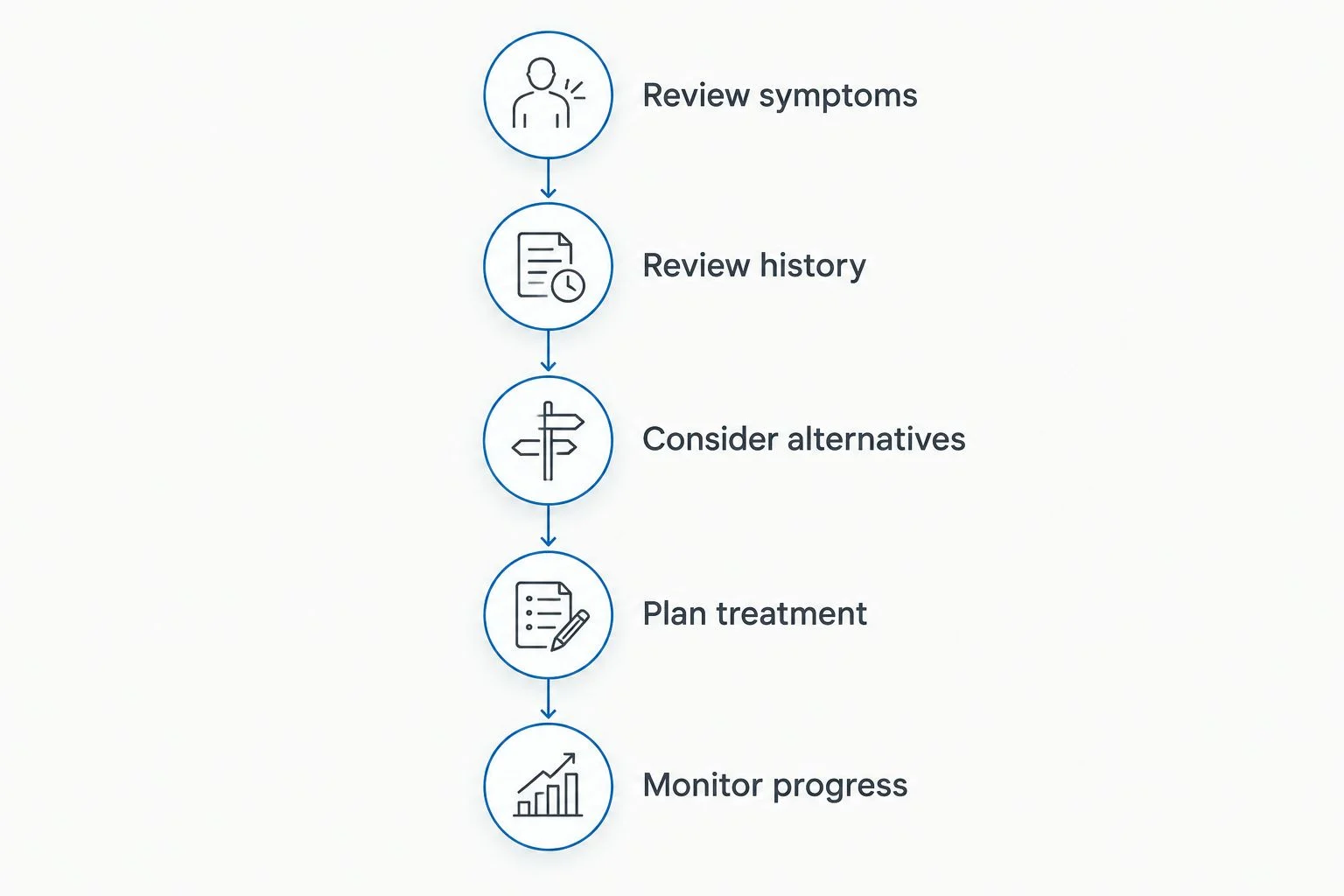
An ADHD prescription follows an assessment and a plan for monitoring treatment.
Questionnaires can support the evaluation, but they do not replace clinical judgment. School records, prior evaluations, or information from someone who knows you well can help when available; ask the practice what to bring.
Why prescribing decisions vary
Two people with attention difficulties do not necessarily need the same treatment. These factors explain why an Ohio nurse practitioner might prescribe medication for one patient and recommend another approach for another:
- Prescribing authority and setting. The practitioner's authorization and applicable Ohio rules determine what the practitioner can prescribe.
- Age and professional scope. Experience treating adults does not establish that a clinician evaluates children, or the reverse.
- Diagnostic findings. ADHD treatment depends on whether the assessment supports ADHD and identifies other relevant conditions.
- Medical history. Cardiovascular concerns, sleep difficulties, and other health issues affect medication selection and monitoring.
- Current medications and substance use. Interactions and safety risks influence the treatment plan.
- Previous response. Benefits, adverse effects, and difficulties with earlier treatment help guide the next decision.
A different prescribing decision is not automatically a lower standard of care. Ask the clinician to explain the reasoning and what would need to change before another option becomes appropriate.
What should you ask before booking an appointment?
For an ADHD appointment, confirm the practice's clinical scope before sharing lengthy records or arranging time away from work. A receptionist can clarify services, while medication decisions belong to the treating clinician.
Useful questions include:
- Does this clinician evaluate ADHD in someone my age?
- Does the appointment include diagnostic assessment, ongoing medication management, or both?
- Can this clinician prescribe controlled ADHD medication when clinically appropriate and legally permitted?
- What records should I bring from previous treatment?
- How does the practice arrange follow-up and handle prescription questions?
- If this clinician cannot provide the recommended treatment, how are referrals handled?
Avoid asking only whether the practice prescribes a specific stimulant. That answer does not tell you whether the clinician can assess your symptoms thoroughly or provide continuing care.
SOS Wellness serves Ohio individuals and families seeking outpatient mental health care. Ask about the treating clinician's scope and the evaluation process rather than assuming that an organization's general service list answers every prescribing question.
Can an Ohio nurse practitioner prescribe ADHD medication online?
An online appointment does not automatically permit an ADHD prescription. The nurse practitioner must meet the requirements for treating a patient in the patient's location, and the prescription must satisfy the applicable state and federal rules.
For controlled stimulants, federal telemedicine requirements also matter. The DEA's Fourth Temporary Extension permits specified remote controlled-medication prescribing through December 31, 2026, subject to federal and state requirements. This temporary pathway requires real-time audio-video visits for Schedule II stimulants; the distinct audio-only exception for certain opioid-use-disorder medicines does not apply to them. It does not guarantee a prescription or establish SOS's prescribing policy. Ask which rules apply on your visit date, particularly for visits after the extension ends.
Telehealth can make appointments easier to attend, but it has limits. A clinician can require an in-person assessment, physical measurements, medical records, or other information before making a safe treatment decision.
Tell the practice where you will physically be during the appointment, especially if you travel between states. For SOS Wellness telehealth visits, you must be physically in Ohio. Ask how required monitoring will be completed and what happens if an in-person visit becomes necessary.
Can a nurse practitioner prescribe ADHD medication for a child?
A properly authorized nurse practitioner can prescribe ADHD medication for a child when the treatment falls within the practitioner's professional scope and meets applicable requirements. Not every nurse practitioner treats pediatric ADHD.
For children, an assessment often includes information from parents or caregivers and school. The clinician needs to understand how symptoms affect development, learning, relationships, and daily activities—not just whether a child is restless.
Ask how the practice evaluates concerns across settings and monitors treatment. For children taking medication, follow-up includes attention to appetite, sleep, growth, and other medication-specific safety considerations.
Choose a clinician who treats your child's age group and explains the plan clearly. Parents can also use the Ohio parents' guide to child ADD and ADHD to prepare questions about symptoms and support.
Can you transfer an existing ADHD prescription to a new provider?
You can ask a new provider to take over ADHD treatment, but the new clinician must make an independent prescribing decision. An existing diagnosis or medication history does not require the clinician to continue the same prescription.
Request your previous evaluation, medication list, and relevant treatment records before your first appointment. Explain what helped, what caused problems, and when your current medication will run out.
Do not wait until the last dose to arrange care. For Schedule II medication, the absence of refills means ongoing treatment requires new prescriptions and coordination with your prescriber.
What should you monitor after treatment starts?
A useful follow-up visit addresses daily functioning as well as symptoms. Tell your clinician whether you are completing tasks more consistently, managing responsibilities better, or experiencing changes that concern you.
Keep notes about sleep, appetite, mood, and medication timing. Follow the monitoring instructions for your particular medication, and tell the clinician about new prescriptions, supplements, or substance use.
Do not take another person's ADHD medication or change your dose to meet a demanding workday. Contact your prescriber about side effects or an inadequate response instead.
For immediate danger or a medical emergency, call 911. For suicidal thoughts or an emotional crisis in the United States, call or text 988. Routine appointment messages are not an emergency response service.
FAQ
Can a nurse practitioner prescribe ADHD medication in Ohio?
Yes, an appropriately authorized nurse practitioner can prescribe ADHD medication in Ohio, subject to professional scope and medication-specific requirements. Controlled stimulants have additional state and federal restrictions.
Can an Ohio nurse practitioner prescribe stimulant ADHD medication?
Yes, when the nurse practitioner has the required authority and meets applicable controlled-substance requirements. Ohio Schedule II restrictions and the practice setting also matter.
Do I need a psychiatrist to get ADHD medication in Ohio?
A psychiatrist is not the only clinician who can prescribe ADHD medication in Ohio. An appropriately authorized nurse practitioner can also prescribe within professional scope, although some patients need specialist evaluation or consultation.
Can I get ADHD medication at my first appointment?
A first appointment does not guarantee an ADHD prescription. The clinician must assess your symptoms, history, safety considerations, and any need for additional information before deciding on treatment.
Can a nurse practitioner refill a stimulant prescription?
Schedule II stimulant prescriptions cannot be refilled under federal controlled-substance rules. Continued treatment requires a new prescription from an authorized prescriber, with appropriate follow-up.
Can I get ADHD treatment through telehealth in Ohio?
Telehealth can be part of ADHD care when the clinician and visit meet applicable requirements. Ask specifically about controlled-medication rules, your physical location during the visit, and any in-person assessment needs.
Does SOS Wellness provide medication management in Ohio?
SOS Wellness provides medication management, psychiatry, therapy, and telehealth mental health services in Ohio. Ask the practice about ADHD evaluations, the treating clinician's scope, and the appropriate appointment for your needs.
One last thing
Bring a description of the problem you want treatment to solve, not just the medication you hope to receive. A concrete goal—such as finishing essential tasks without repeatedly losing track—gives you and your clinician a clearer way to judge progress.
For your appointment, prepare your medication list, previous records, and questions about follow-up. The most useful answer is not simply that a nurse practitioner can prescribe; it is whether that clinician can provide the assessment and continuing care you need.
Further reading
- NIMH: ADHD in adults
- CDC: Diagnosing ADHD
- DEA: Telemedicine prescribing extension through December 2026
- Ohio law: APRN prescribing authority
Related reading
This article provides general educational information and does not replace an individual clinical assessment. Contact your healthcare provider about your own care.