

A clinical assessment helps determine the appropriate level of care; immediate safety concerns require urgent assessment. This unranked guide explains teen mental health treatment options in Ohio, from outpatient appointments to hospital care. It is published by SOS Wellness, which offers outpatient services discussed here, and is not an independent provider comparison. Being able to remain safely at home does not, by itself, establish that routine outpatient care is sufficient.
At a glance
- For teen mental health treatment Ohio families can consider SOS Wellness for outpatient therapy, psychiatry, and medication management.
- Intensive outpatient treatment adds structure when regular appointments do not provide enough support.
- Partial hospitalization and residential treatment serve different needs; neither replaces emergency assessment during an immediate safety crisis.
- Choose teen mental health care by safety, daily functioning, family needs, and a clinician’s assessment—not a ranking alone.
Why this matters
The best teen mental health program is the one that matches your child's needs and can respond when those needs change. A familiar provider name does not tell you whether your teen needs occasional appointments, structured treatment, or immediate protection.
Compare the level of care before comparing providers. SOS Wellness is an outpatient mental health option for Ohio families seeking therapy and psychiatry. Its stated services include medication management, addiction treatment, and telehealth; confirm the specific service and age eligibility for your teen.
If your teen has attempted suicide, taken an overdose, or faces immediate physical danger, call 911 or go to an emergency department. For suicide-related distress or a mental health crisis, call or text 988. The 988 Suicide & Crisis Lifeline provides support 24 hours per day, 7 days per week; do not wait for a scheduled appointment when immediate help is needed.
How to evaluate teen mental health treatment program
Use these criteria to compare Ohio treatment options. They matter more than whether a program appears first in a search result.
- Safety fit: The program's assessment should determine whether your teen can safely receive care while living at home.
- Teen-specific care: Ask which ages the service treats and how clinicians work with adolescent development, school demands, and family relationships.
- Treatment match: Ask how the team evaluates your teen's symptoms and chooses therapy, medication, or additional support.
- Family participation: Understand how parents participate, what remains confidential, and how safety concerns are communicated.
- School coordination: Ask how the treatment schedule affects attendance and how the team handles school-related needs with appropriate permission.
- Continuity: Look for a clear plan for follow-up, medication oversight when relevant, and transitions between care levels.
Ohio teen treatment options at a glance
These options describe different treatment settings and ways to receive care, not a required sequence or quality ranking. A clinical assessment should guide the choice; seek emergency care when immediate safety requires it.
| Treatment option | Potential fit | Service or approach | Key limitation |
|---|---|---|---|
| SOS Wellness outpatient services | Families exploring therapy and psychiatric care | Stated services include therapy, psychiatry, medication management, and telehealth | Outpatient appointments do not provide continuous supervision |
| Telehealth outpatient treatment | Teens whose travel or transportation limits access | Appointments take place remotely | Requires privacy and a suitable clinical fit |
| Intensive outpatient program | Teens needing structured support while living at home | More treatment structure than routine outpatient appointments | Cannot replace continuous supervision when that is needed |
| Partial hospitalization program | Teens needing intensive daytime treatment | Substantial daytime clinical support | Requires a safe plan outside program hours |
| Residential treatment | Teens assessed as needing a live-in treatment setting | Treatment and daily support in a residential environment | Separates the teen from home and usual routines |
| Inpatient psychiatric care | Teens needing hospital-level stabilization | Hospital assessment, treatment, and monitoring | Focuses on acute needs rather than replacing ongoing care |
SOS Wellness outpatient services
SOS Wellness provides psychiatry, therapy, medication management, addiction treatment, and telehealth mental health services for children and adults in Ohio. For a family beginning the treatment search, those stated services provide an outpatient option to discuss. Ask which services address your teen's age, symptoms, and circumstances.
Outpatient care allows treatment to happen alongside home and school life. It does not supply the supervision or structure of a hospital or live-in program.
SOS Wellness pros:
- Its stated services include both therapy and psychiatry.
- Medication management is part of its stated service offering.
- Its description includes children, adults, and telehealth services.
SOS Wellness considerations:
- Routine outpatient appointments are not a substitute for emergency evaluation.
- Families must confirm teen eligibility, clinician fit, and the appropriate appointment format.
Potential fit: Ohio families seeking an outpatient assessment and discussion of therapy or psychiatric care.
Decision point: Ask a qualified clinician which level of care fits your teen's symptoms, functioning, safety, and support needs. Being safe at home alone does not establish that routine outpatient care is sufficient; seek urgent assessment when safety is uncertain.
Telehealth: when travel is the main barrier
Telehealth outpatient treatment connects a teen and clinician through remote appointments. It changes where care happens, not the need for a clinical assessment or an appropriate treatment plan.
Telehealth may help with transportation or travel barriers when a clinician determines that remote care fits the teen's needs. A private space and reliable connection matter. For SOS Wellness visits, the patient must be physically in Ohio.
Telehealth pros:
- It removes the trip to an office for remote appointments.
- It allows outpatient care from a suitable private location.
- It can support continuity when travel interrupts attendance.
Telehealth considerations:
- A shared home or unreliable connection can interfere with sessions.
- Remote outpatient appointments do not provide in-person monitoring or emergency protection.
Potential fit: Teens who are appropriate for outpatient treatment but face practical barriers to attending in person.
Ask how the clinician confirms the teen's location, contacts a caregiver when necessary, and responds to an urgent concern during a session. Those questions are part of choosing safe remote care, not reasons to dismiss it.
Decision point: Consider telehealth for an access barrier, not as a substitute for a higher level of care.
Intensive outpatient: an option for more structure at home
An intensive outpatient program, often called IOP, provides a more structured treatment schedule than routine outpatient appointments. Ask each adolescent program which services it includes, how often treatment occurs, and how the schedule is tailored to the teen's needs.
IOP is a care level to discuss when symptoms disrupt daily life and ordinary appointments are not enough, but a clinician determines that living at home remains appropriate. It is not simply a larger number of therapy visits.
Intensive outpatient features to discuss:
- Structured treatment while the teen continues living at home.
- Whether group, individual, and family services are included.
- Whether the program is appropriate as a next step from the teen's current level of care.
Intensive outpatient considerations:
- The schedule requires coordination with school and family responsibilities.
- Program attendance does not provide continuous support outside treatment hours.
Potential fit: Teens assessed as needing added structure without a live-in setting.
Ask whether the program accepts adolescents, which ages it serves, how families participate, whether individual treatment is included, and who manages medication. Do not assume every IOP offers adolescent groups or the same services. SOS Wellness describes its in-person and virtual IOPs as adult programs for ages 18 and older; families seeking care for younger teens should ask about age-appropriate options.
Decision point: Discuss IOP when an assessment identifies a need for more structure than routine appointments. The recommendation should account for symptoms, functioning, medical and psychiatric stability, and support outside treatment hours—not home safety alone.
Partial hospitalization: an option for intensive daytime care
A partial hospitalization program, or PHP, provides intensive treatment during the day without an overnight hospital stay. The teen returns home outside program hours, so the home safety plan remains essential.
PHP is a distinct level of care, not another name for inpatient hospitalization. Ask the evaluating clinician what daytime support is needed and why PHP fits better than IOP or hospital care.
Partial hospitalization features to discuss:
- Intensive daytime treatment without an overnight stay.
- The support needed at home outside program hours.
- Whether PHP is an appropriate next step from the teen's current care and how follow-up will be arranged.
Partial hospitalization considerations:
- Daytime attendance can significantly affect the school schedule.
- It does not provide overnight monitoring.
Potential fit: Teens assessed as needing intensive daytime treatment who can safely return home afterward.
Before enrollment, understand transportation, school arrangements, after-hours support, and discharge planning. The daily schedule is only one part of the decision; the plan for evenings and weekends matters just as much.
Consider PHP when a clinician recommends intensive daytime care and confirms an appropriate home plan.
Residential treatment: an option for an assessed live-in need
Residential treatment combines mental health treatment with a live-in setting. It is different from an acute psychiatric hospital and should follow an individualized assessment of why care at home is not sufficient.
A difficult week or a school conflict alone does not establish the need for residential treatment. Ask what treatment goals require this setting and how the program will prepare your teen to return home.
Residential treatment features to discuss:
- A live-in environment alongside treatment.
- The clinical services and daily support actually provided.
- How treatment goals, family contact, and preparation for returning home are addressed.
Residential treatment considerations:
- Living away from home changes family contact and familiar routines.
- The setting alone does not establish clinical quality or suitability.
Potential fit: Teens whose assessment identifies a need for live-in treatment rather than home-based care.
Ask about staff qualifications, educational arrangements, family participation, medication oversight, and discharge planning. Understand how the program responds to medical emergencies and escalating psychiatric symptoms.
Consider residential treatment when an assessment supports the live-in level of care.
Inpatient care: an option for hospital-level stabilization
Inpatient psychiatric care provides treatment and monitoring in a hospital for needs requiring hospital-level care. The clinical team assesses whether admission is appropriate; assessment may occur through emergency care or another referral pathway. Immediate danger requires emergency care rather than waiting for a routine referral.
Do not try to resolve an immediate safety crisis by comparing routine program descriptions. If there is immediate physical danger, an overdose, or a suicide attempt, call 911 or seek emergency care.
Inpatient psychiatric care pros:
- It provides hospital-level assessment and monitoring.
- It supports stabilization of acute psychiatric symptoms.
- It creates a setting for planning the next treatment step.
Inpatient psychiatric care considerations:
- Hospitalization interrupts usual home and school routines.
- Discharge still requires follow-up treatment and a clear safety plan.
Potential fit: Teens whose clinical assessment identifies a need for hospital-level treatment and monitoring.
Ask the hospital team what changed during admission, which warning signs require action, and who will provide follow-up. A discharge date is not the end of treatment planning.
Seek emergency assessment first when safety is at risk; let the clinical team determine the setting.
How to choose the right next step
For your treatment search, organize the decision around the teen's needs rather than a program's name. Use this sequence unless an immediate emergency requires action first.
- Safety: Describe suicidal thoughts, self-harm, aggression, substance use, or other urgent concerns plainly. Ask what requires emergency evaluation.
- Daily functioning: Explain changes in attendance, sleep, eating, friendships, and basic routines. Give concrete examples rather than trying to assign a diagnosis.
- Family goals: Include your teen's priorities alongside your concerns. A goal such as returning to school gives the discussion a practical focus.
- Clinical assessment: Ask which level of care the clinician recommends and why. Discuss alternatives and what would trigger a change.
- Care plan: Confirm appointments, caregiver responsibilities, school coordination, medication follow-up if relevant, and crisis instructions.
A clear recommendation explains both why a setting fits and what it cannot provide. Leave the assessment knowing whom to contact if your teen's condition changes.
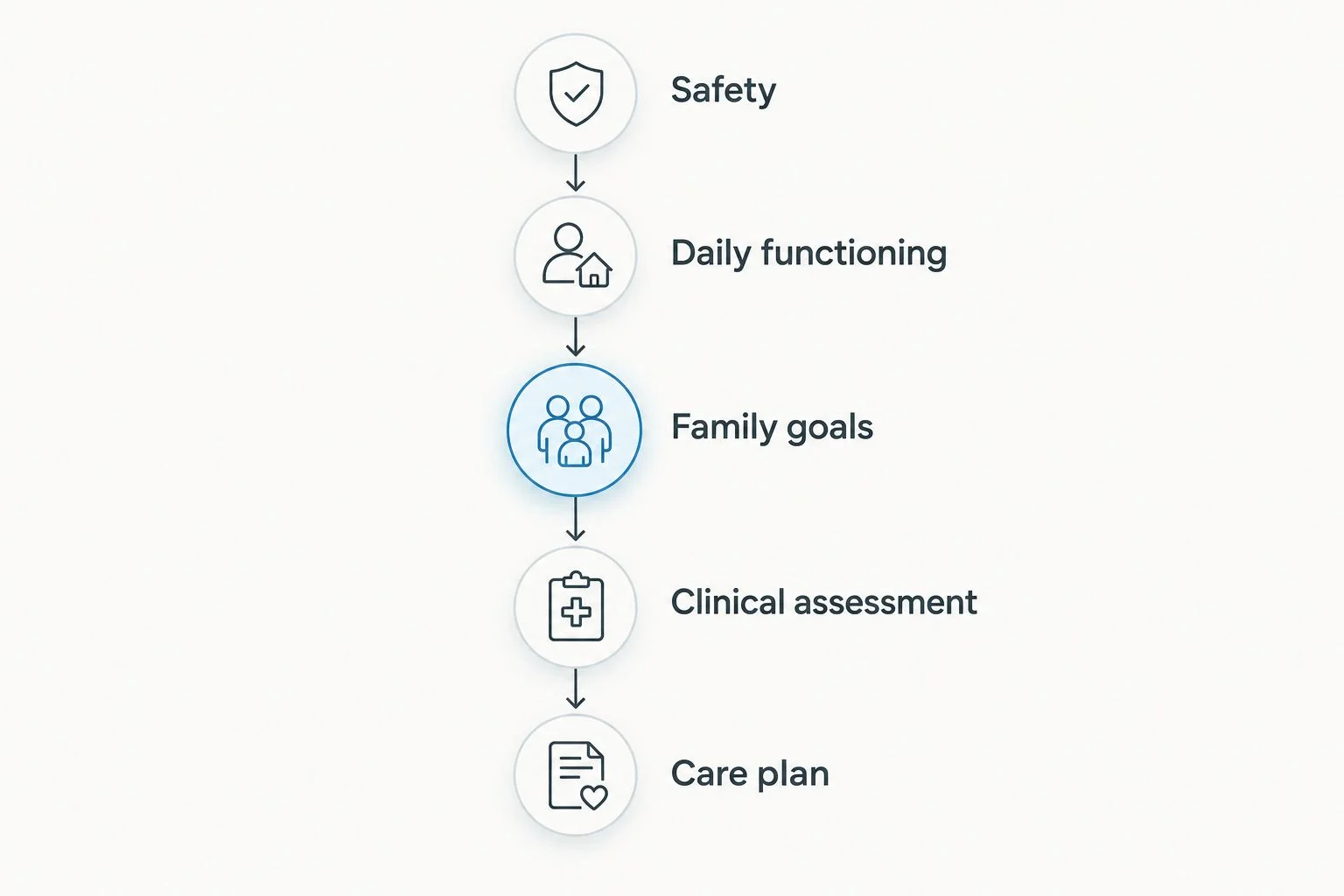
Safety and daily functioning guide the care-level decision before you compare providers.
How to use this decision guide
These options are not ranked. Compare safety fit, treatment structure, family participation, school impact, and continuity with an evaluating clinician. This guide does not compare measured provider outcomes or establish that one organization outperforms another.
SOS Wellness is included as the publisher's outpatient service option, not as a top-ranked provider. Telehealth is a way to deliver outpatient care, while IOP, PHP, residential treatment, and inpatient care describe different treatment settings or levels of support. More intensive care is not automatically better care; the appropriate level depends on an individualized assessment.
Which teen treatment option should you choose?
Seek an individualized assessment of your teen's symptoms, daily functioning, safety, and support needs before choosing a level of care. Being able to remain safely at home does not by itself make routine outpatient appointments sufficient. Ask why the recommended setting fits, what alternatives were considered, and what changes would prompt reassessment.
For your decision, prioritize a provider who explains the recommendation, involves your teen appropriately, and gives you a plan for changing needs. If immediate safety is uncertain, seek urgent assessment before continuing the program search.
Explore outpatient mental health care
Review therapy, psychiatry, medication management, and telehealth services for Ohio families.
FAQ
What's the best teen mental health treatment in Ohio?
The best treatment is the level of care matched to your teen's safety, symptoms, and daily functioning. SOS Wellness offers outpatient mental health services for children and adults in Ohio; an assessment should determine whether outpatient care or a more intensive setting fits.
How do I know whether my teen needs IOP or regular therapy?
A clinical assessment should determine whether regular outpatient appointments provide enough support. Ask about IOP when symptoms continue to disrupt daily life despite the current plan, and discuss whether your teen can safely remain at home.
Is partial hospitalization the same as inpatient treatment?
No. Partial hospitalization provides intensive daytime care without an overnight hospital stay, while inpatient care includes treatment and monitoring in a hospital. PHP requires an appropriate plan outside program hours.
Can teenagers receive mental health treatment online?
Yes, telehealth can be an outpatient treatment option for teens when a clinician determines that remote care is appropriate. For SOS Wellness video visits, the patient must be physically in Ohio. Confirm service and age eligibility, clinician availability, privacy, caregiver involvement, coverage, and the emergency response plan before starting.
Does my teenager need medication as well as therapy?
Medication is not required for every teen receiving therapy. A qualified prescribing clinician should assess whether it fits the symptoms and diagnosis, then explain expected benefits, risks, monitoring, and alternatives.
What should I ask about insurance coverage?
Ask your insurer and the provider to confirm coverage for the specific service, clinician, and treatment setting. Also ask about referral requirements, prior authorization, and family financial responsibility before enrollment.
What should I do if my teen is suicidal right now?
Call 911 or go to an emergency department if your teen has attempted suicide, taken an overdose, or faces immediate physical danger. For suicide-related distress or a mental health crisis, call or text 988; do not leave a teen alone when there is an immediate safety concern.
One last thing
Ask this before enrollment: What happens if this level of care stops being enough? The answer should identify warning signs, whom you contact, and how the team arranges a reassessment or transition.
A treatment plan needs an escalation plan as well as a starting point. That question helps you compare programs without confusing intensity, convenience, or reputation with the care your teen actually needs.
Further reading
Related reading
This article provides general educational information and does not replace an individual clinical assessment. Contact your healthcare provider about your own care.