

For Ohio families seeking outpatient psychiatry and therapy, SOS Wellness is a starting point to consider. A child and adolescent psychiatrist can provide specialist psychiatric assessment; telehealth is a care format to consider when travel makes appointments difficult. Published by SOS Wellness, this guide includes the practice's own services alongside general care pathways. It is an unranked decision guide, not an independent comparison of providers.
At a glance
- For a child psychiatrist Ohio search, compare training, age eligibility, clinical fit, and follow-up arrangements before booking.
- SOS Wellness provides Ohio families with psychiatry, therapy, medication management, and telehealth mental health services.
- Choose child and adolescent psychiatry for specialist assessment; confirm the clinician's credentials and experience with your child's needs.
- Telehealth reduces travel, but privacy, safety, and the need for in-person assessment still determine fit.
Why this matters
A useful child psychiatrist Ohio search starts with your child's needs, not a provider's position on a list. Trouble sleeping, school refusal, persistent sadness, attention difficulties, and changes in behavior can have different explanations. An assessment helps clarify those explanations before treatment decisions.
The best fit is the clinician whose training, assessment process, and follow-up match your child's situation. For your shortlist, separate three questions: Does this clinician treat your child's age group? Do they evaluate the concerns you are seeing? Can your family participate in the recommended care?
If your child is in immediate danger or has a medical emergency, call 911. For suicide-related distress or a mental health crisis, call or text 988. Do not wait for a routine appointment when immediate safety is at risk.
How to evaluate child psychiatry fit
Use these criteria before comparing care settings:
- Relevant training: Verify whether the clinician is a psychiatrist, a child and adolescent psychiatrist, or another mental health professional. Titles are not interchangeable.
- Age eligibility: Confirm the clinician treats your child's age, rather than assuming a practice treats every pediatric age group.
- Assessment depth: Ask how the clinician considers development, medical history, school functioning, family observations, and the child's perspective.
- Treatment choices: Look for clear explanations of therapy, medication, family support, and referrals when appropriate.
- Family participation: Ask how caregivers contribute and how the clinician handles age-appropriate privacy.
- Follow-up and safety: Confirm who handles questions, medication concerns, and worsening symptoms between appointments.
A reassuring conversation matters. So does a clear answer about what happens after the first visit.
Ohio child mental health care at a glance
These options overlap: a specialist can work in an outpatient practice, a multidisciplinary clinic, or through telehealth. The table is unranked and includes one named practice alongside clinician types, care settings, and treatment approaches; these are not equivalent categories or competing providers.
| Care option | May suit | Services or approach | What to confirm |
|---|---|---|---|
| SOS Wellness | Families exploring outpatient mental health services in Ohio | Psychiatry, therapy, medication management, and telehealth services | Confirm the individual clinician's pediatric scope and credentials |
| Child and adolescent psychiatrist | Complex psychiatric assessment | Medical training with additional child and adolescent psychiatry training | Other therapy or school supports can still be needed |
| Multidisciplinary pediatric clinic | Concerns involving several areas of development or health | Access to different disciplines within a care setting | Ask how assessments and recommendations are coordinated |
| Telehealth mental health care | Families facing travel barriers | Appointments conducted remotely | Not a substitute for emergency care or every in-person assessment |
| Therapy-first care | Families seeking skills-based support when clinically appropriate | Work on coping, behavior, relationships, and family responses | Does not replace psychiatric or medical assessment when indicated |
SOS Wellness: outpatient care for Ohio families
SOS Wellness provides psychiatry, therapy, medication management, addiction treatment, and telehealth mental health services to individuals, families, children, and adults in Ohio. For parents, that makes the organization an option to explore when looking for outpatient mental health care rather than emergency treatment.
Potential fit: Families who want to discuss outpatient psychiatry and therapy needs with an Ohio provider.
Before booking, describe your child's age, your main concerns, and any current treatment. Ask which clinician would conduct the assessment and whether that clinician has child and adolescent psychiatry training. An organization's service list does not establish every individual clinician's specialty.
SOS Wellness pros:
- Provides both psychiatry and therapy services.
- Offers medication management as part of its stated services.
- Serves children, adults, individuals, and families in Ohio.
- Includes telehealth mental health services.
SOS Wellness considerations:
- Confirm age eligibility and clinical fit for the specific appointment.
- Ask how psychiatric care and therapy are coordinated for your child.
- Routine outpatient appointments are not emergency care.
Questions to ask when scheduling: Who will assess your child, which ages do they treat, and what will the assessment cover? If symptoms are worsening, ask about appropriate next steps rather than delaying assessment while comparing options.
Child and adolescent psychiatrist: complex assessment
A child and adolescent psychiatrist is a physician with specialty training in psychiatric care for children and adolescents. This pathway fits questions that need psychiatric expertise, including diagnostic uncertainty, significant impairment, or a careful review of medication treatment.
Potential fit: Children and teenagers who need specialist psychiatric assessment or medication review.
Bring the concerns you want explained, not just a diagnosis you want confirmed. Attention problems, for example, deserve a broader discussion of sleep, anxiety, learning, development, and medical history. The assessment should explain how the clinician reached a conclusion and what remains uncertain.
Child and adolescent psychiatrist pros:
- Brings medical and psychiatric training to assessment.
- Can evaluate psychiatric diagnoses and medication options.
- Considers symptoms in the context of development.
- Can recommend additional assessment or treatment when needed.
Child and adolescent psychiatrist considerations:
- A specialist appointment does not automatically include ongoing psychotherapy.
- Medication is not the only possible treatment recommendation.
- You still need to confirm the clinician's experience with your child's concerns.
For a provider comparison, verify credentials through the relevant licensing and certification records. Ask what specialist training the clinician completed; do not treat a directory category as proof of that training.
Questions to ask when scheduling: What specialty training has the clinician completed, and do they assess your child's concerns and age group? Your child's existing clinician can help guide a referral for specialist psychiatric assessment.
Multidisciplinary pediatric clinic: overlapping concerns
A multidisciplinary pediatric clinic brings different professional disciplines into a shared care setting. Depending on the clinic, those disciplines can include psychiatry, psychology, developmental care, or other pediatric specialties. Confirm the actual team rather than assuming every clinic includes every service.
Potential fit: Families whose concerns span mental health, learning, development, or physical health.
This pathway is useful when the referral question crosses professional boundaries. A child with emotional distress and learning difficulties needs a plan that distinguishes those concerns and explains how they interact. Ask who coordinates the findings so your family receives a usable plan rather than disconnected recommendations.
Multidisciplinary pediatric clinic pros:
- Can bring different clinical perspectives to an assessment.
- Supports evaluation of overlapping concerns.
- Can help identify which discipline should lead treatment.
Multidisciplinary pediatric clinic considerations:
- Services differ between clinics.
- Multiple assessments do not guarantee coordinated follow-up.
- Diagnostic evaluation and ongoing treatment can be separate services.
Ask whether the clinic shares findings with your child's existing clinicians, with your permission. Also ask who explains the final recommendations to your family.
Questions to ask the clinic: Who coordinates the assessment, explains the findings, and arranges follow-up? For overlapping concerns, ask which disciplines your child may need rather than assuming a larger team is necessarily better.
Telehealth mental health care: travel barriers
Telehealth describes how an appointment happens, not the clinician's specialty. Psychiatry and therapy can both be delivered remotely, but you still need to verify the professional's qualifications and whether the format fits your child.
Potential fit: Families whose travel or location makes participation in appropriate outpatient care difficult.
A remote appointment needs a private setting, working technology, and a clear plan for caregiver involvement. Ask whether your child will speak with the clinician separately for part of the visit and how the clinician handles safety concerns during a remote session.
Telehealth mental health care pros:
- Removes travel from the appointment itself.
- Allows care discussions from a suitable private space.
- Can support follow-up when the clinician considers remote care appropriate.
Telehealth mental health care considerations:
- Limited privacy can interfere with an honest conversation.
- Technical problems can interrupt assessment.
- Some concerns require an in-person examination or a different care setting.
When comparing telehealth options, ask whether the clinician is authorized to treat your child in the state where your child will physically be during the visit. For SOS Wellness telehealth, your child must be physically in Ohio. Confirm age eligibility, service availability, and suitability with the team before scheduling.
Questions to ask about telehealth: Can your child participate privately and safely, and is any in-person assessment needed? If remote care cannot meet those needs, ask the clinician about an appropriate alternative.
Therapy-first care: practical skills and family support
Therapy-first care begins with a qualified therapist when the child's needs and clinical assessment support that approach. Therapy can focus on emotional coping, behavior, relationships, or caregiver responses. It is a treatment pathway, not a substitute for every psychiatric evaluation.
Potential fit: Families seeking skills-based treatment when medication assessment is not the immediate clinical question.
Ask how the therapist chooses an approach, involves caregivers, and checks progress. A useful plan connects treatment to daily life: getting to school, handling distress, participating in relationships, or managing routines. Goals should reflect what your child needs, not just what adults want to stop seeing.
Therapy-first care pros:
- Focuses on skills and patterns your child can practice.
- Can include caregiver guidance when appropriate.
- Provides a setting to discuss emotional and relationship concerns.
Therapy-first care considerations:
- A therapist's scope does not necessarily include prescribing medication.
- Medical or psychiatric assessment can still be necessary.
- Fit depends on the treatment approach and your child's needs.
Ask what would prompt a referral to psychiatry or another specialist. That answer helps you understand the limits of the treatment plan.
Questions to ask the therapist: What approach and goals do you recommend, how will progress be reviewed, and when would you involve psychiatry or another specialist? Therapy and medication assessment can be complementary when clinically appropriate.
How to compare these pathways
The numbered sections organize different options; they do not indicate rank, recommended treatment order, or provider quality. Compare training, age eligibility, assessment depth, treatment choices, family participation, and follow-up against your child's assessed needs.
A care setting does not establish an individual clinician's qualifications. More than one pathway may be part of the same care plan.
Which care option should you choose?
Start with the question you need answered. If you are unsure what is happening, ask for an assessment rather than requesting a specific medication or treatment format. Your child's pediatrician can also help evaluate medical concerns and guide referrals.
Use this sequence to organize your decision:
- Clarify concerns: Describe symptoms and their effect on everyday life.
- Check safety: Separate routine care needs from urgent or emergency needs.
- Verify fit: Confirm age eligibility, credentials, and relevant experience.
- Plan follow-up: Establish who reviews progress and handles concerns.
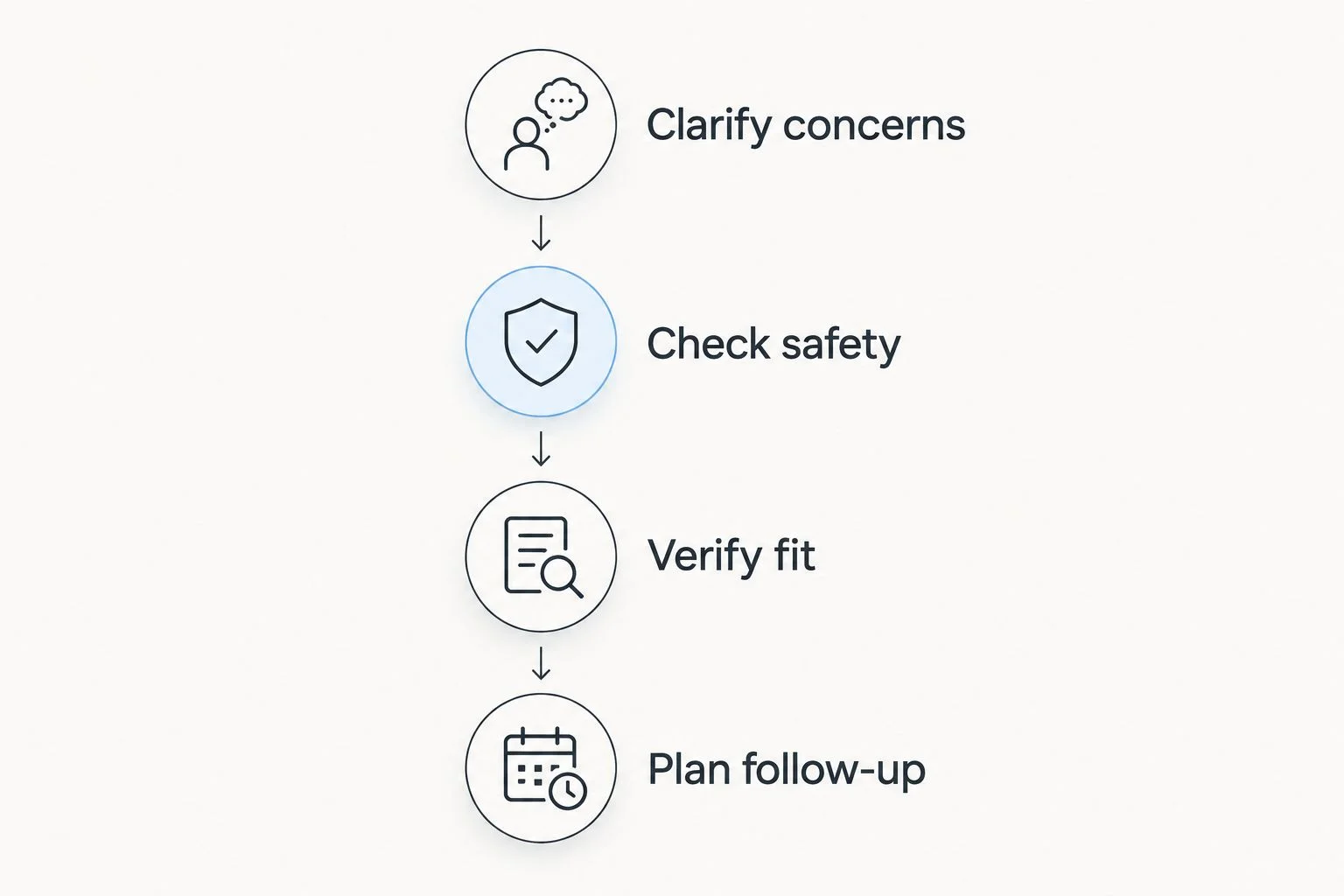
Choose the care pathway after checking safety and clinical fit.
If you are unsure where to start, ask your child's pediatrician or a qualified mental health clinician which assessment fits the concerns. SOS Wellness is one outpatient option; confirm the assigned clinician's pediatric scope and specialty training, as you would with any practice. A care setting and specialist expertise can overlap.
Explore outpatient mental health care
Review psychiatry, therapy, medication management, and telehealth services for Ohio families.
What to bring to the first appointment
Prepare a 1-page summary of your concerns, your child's strengths, current treatment, and the questions you want answered. Include medications and supplements, previous assessments, relevant medical history, and school observations when available.
If it is safe to wait for a scheduled appointment, notes covering 2 weeks can help you describe patterns in sleep, mood, attention, and daily functioning. This is an organizational suggestion, not a requirement or a reason to delay care.
Write down 3 goals in everyday language, such as returning to school, sleeping more consistently, or handling distress without withdrawing from family activities. Let your child contribute goals in their own words.
Before leaving the appointment, ask what the clinician thinks is happening, what treatment options fit, and when progress will be reviewed. For a treatment plan, keep the current medication list and follow-up instructions together so caregivers use the same information.
FAQ
What's the best child psychiatrist in Ohio for my child?
The best fit is a qualified clinician whose training and experience match your child's age and needs. Compare assessment methods, treatment options, caregiver involvement, and follow-up rather than relying on a ranking alone.
Does SOS Wellness provide mental health care for children?
SOS Wellness provides mental health services to children and families in Ohio, including psychiatry, therapy, medication management, and telehealth services. Confirm the individual clinician's age eligibility and pediatric scope before booking.
Is a child psychiatrist different from a therapist?
Yes. A psychiatrist is a physician who can assess psychiatric conditions and prescribe medication; therapists provide psychotherapy within their professional scope. Some children need both types of care.
Can my child see a psychiatrist through telehealth in Ohio?
Telehealth can be appropriate for outpatient psychiatric care when the clinician determines that the format fits the child's needs. Verify authorization to treat a child located in Ohio, privacy arrangements, and the plan for concerns that require in-person care.
Does seeing a child psychiatrist mean my child will take medication?
No. A psychiatric assessment can lead to recommendations for therapy, family support, further evaluation, medication, or a combination. Ask why each option is recommended and how benefits and risks will be reviewed.
What should I ask before booking a child psychiatry appointment?
Ask who will assess your child, what specialty training they have, and whether they treat your child's age and concerns. Also ask about caregiver participation, follow-up, and how to handle worsening symptoms between visits.
What should I do if my child is in a mental health crisis?
Call 911 for immediate danger or a medical emergency. Call or text 988 for suicide-related distress or a mental health crisis; do not wait for a routine outpatient appointment when immediate safety is at risk.
One last thing
Ask who owns the follow-up. An assessment is only one part of care; your family also needs to know who reviews symptoms, responds to medication concerns, and adjusts the plan. Before accepting a recommendation, make sure that responsibility is clear.
Further reading
Related reading
This article provides general educational information and does not replace an individual clinical assessment. Contact your healthcare provider about your own care.