

Young adult addiction treatment is care for harmful substance use with the aim of helping you stay safe, regain daily functioning, and build a workable recovery plan. In Ohio, choosing care means matching treatment to withdrawal risk, mental health needs, and the demands of school, work, housing, and family relationships.
At a glance
- SOS Wellness provides outpatient addiction treatment and mental health services in Ohio; ask whether its services match your assessed needs.
- For addiction treatment for young adults Ohio residents can access, start with a safety assessment, not a program label.
- Outpatient care, intensive outpatient programs, and residential treatment serve different needs; withdrawal risk requires a separate assessment.
- Treat substance use and co-occurring anxiety, depression, or ADHD together rather than building disconnected care plans.
Why addiction treatment matters for young adults
Substance use becomes a treatment concern when it affects your safety, health, relationships, or ability to meet daily responsibilities. You do not need to lose a job, leave school, or experience an overdose before asking for help. An assessment can clarify what is happening without assuming that every person needs the same program.
Young adulthood brings practical treatment decisions: whether you can keep working, attend classes, travel to appointments, or involve family without giving up privacy. The right care level comes before the most convenient schedule. A program that fits your calendar still needs to address your clinical needs.
SOS Wellness provides psychiatry, therapy, medication management, addiction treatment, and telehealth mental health services in Ohio. SOS Wellness offers outpatient addiction and mental health care; an assessment determines whether its services fit your needs. This guide is published by SOS Wellness, a treatment provider, and is an unranked decision guide rather than an independent provider comparison. Its stated outpatient services do not establish that it provides medical withdrawal management or residential care; ask directly when either is needed.
This guide explains how to assess urgency, compare care settings, prepare for an appointment, and keep treatment connected to your everyday life.
Choose addiction treatment in six practical steps
Start with immediate safety
Before comparing programs, decide whether you need emergency help. Call 911 if someone cannot be awakened, has slowed or stopped breathing, has a seizure, or is in immediate danger. For a suspected opioid overdose, call 911, give available naloxone according to its instructions, and follow dispatcher advice. Stay with the person; emergency care is still needed even if they improve.
Abruptly stopping after heavy alcohol use or benzodiazepine dependence can cause serious withdrawal, including seizures. If dependence is possible, seek prompt medical assessment so a clinician can plan withdrawal care. Do not stop or change prescribed medicines without prescriber guidance.
For suicidal thoughts or a mental health crisis, call or text 988, the Suicide & Crisis Lifeline. Call 911 for immediate danger. Neither a routine intake form nor a future appointment is a substitute for urgent care.
- Describe the substance used, last use, and current symptoms to the clinician or emergency responder.
- Mention alcohol, sedatives, opioids, and combinations rather than reporting only your main substance.
- Tell the clinician about previous withdrawal symptoms, seizures, or overdoses.
- Keep naloxone accessible when opioid exposure is possible, and learn how to use it.
- Arrange a safe ride; do not drive while intoxicated or significantly impaired.
Prepare a clear picture of your substance use
Start with a paper note or a private document. You do not need an app, a diagnosis, or a perfectly organized history. Write down what you use, how it affects you, and what you want to change. An honest account helps a clinician choose care; it is not a test you pass or fail.
Use a 7-day timeline as an appointment-preparation exercise, then add longer-term patterns that the week does not capture. Include missed classes, arguments, sleep changes, cravings, and attempts to cut back. Note prescribed medicines and supplements too.
An appointment with SOS Wellness can be a place to discuss addiction treatment and mental health needs together. Ask which service provides the assessment and whether another provider is needed for withdrawal or a higher level of care.
- Record substances, approximate amounts, frequency, and last use as accurately as you can.
- List prescriptions, nonprescription medicines, and supplements without stopping them independently.
- Note previous treatment, what helped, and what made participation difficult.
- Write down 2 treatment goals, such as returning to class and reducing substance-related conflict.
- Bring questions about privacy, family involvement, transportation, and appointment format.
Match the care level to your needs
Ask a qualified clinician to assess substance use, withdrawal risk, mental health symptoms, physical health, and your living situation. Program names alone cannot answer whether you need routine outpatient appointments, a more structured outpatient schedule, residential support, or medically supervised withdrawal care.
The practical distinction is the amount and type of support you need between appointments. If your home is unsafe, symptoms are difficult to manage, or previous treatment has not met your needs, say so directly. These details belong in the placement decision.
For your treatment search, ask each provider to explain why its setting fits your assessment and what would trigger a referral elsewhere. A clear referral plan is a strength, not a reason to reject a provider.
- Ask whether withdrawal assessment happens before regular treatment begins.
- Request a plain-language explanation of the recommended care level.
- Explain whether you have stable housing and a safe place to recover.
- Describe work, classes, caregiving, and transportation constraints.
- Ask how the team responds if symptoms worsen between visits.
- Confirm how referrals work when the current setting is not enough.
Address mental health and medication together
Anxiety, depression, ADHD symptoms, trauma-related symptoms, and substance use can overlap. Sleep disruption and intoxication can also affect mood and concentration. You need an assessment that considers these connections rather than separate plans that never communicate.
Medication is part of evidence-based treatment for some substance use disorders. FDA-approved medications for opioid use disorder include buprenorphine, methadone, and naltrexone. Methadone for opioid use disorder generally requires care through a certified opioid treatment program, with limited hospital and emergency exceptions. A clinician must assess suitability and plan initiation, including withdrawal risks with buprenorphine or naltrexone. Supportive care is individualized; lack of counseling access should not block buprenorphine treatment.
SOS Wellness provides addiction treatment, psychiatry, therapy, and medication management. Its advertised medication-assisted treatment options include buprenorphine/Suboxone, naltrexone/Vivitrol, and acamprosate. An assessment determines appropriateness; ask which services fit your needs and whether a referral is necessary.
- Tell every treating clinician about substance use and current prescriptions.
- Ask how the team evaluates symptoms that occur during intoxication or withdrawal.
- Discuss medication options for your diagnosed condition without starting or stopping medicines independently.
- Request coordination between your therapist, prescriber, and addiction treatment provider.
- Ask how medication side effects, missed doses, and ongoing substance use are handled.
Build treatment around your actual week
Sketch your weekly commitments before an intake call. Include shifts, classes, travel, caregiving, and the times when cravings or substance use are hardest to manage. A realistic schedule helps you participate consistently; it should not be used to rule out clinically necessary care.
Telehealth reduces the need to travel, but it still requires privacy, a reliable connection, and a plan for emergencies. For SOS Wellness video visits, you must be physically in Ohio; staff must confirm whether the service and clinician are available for your situation. In-person care avoids some technology barriers but adds travel demands. Neither format is automatically better for every young adult.
Confirm insurance participation and coverage directly with both the provider and your insurer before scheduling. Ask about the specific service, clinician, appointment format, and any authorization requirements. A provider accepting an insurance plan does not establish coverage for every service.
- Identify appointment windows you can attend without repeatedly missing essential commitments.
- Check whether you have a private place for telehealth conversations.
- Arrange transportation before an in-person appointment.
- Ask what happens if your work or class schedule changes.
- Confirm coverage for the recommended service rather than the provider name alone.
- Discuss alternatives with the treatment team if the proposed schedule is unworkable.
Make a plan for support and follow-up
Treatment needs a plan for the hours outside appointments. Start by choosing 1 trusted person, if you have someone safe to involve, and decide what help you want. That might mean transportation, encouragement, or support contacting your care team—not monitoring every conversation.
As an adult, you can ask your provider how consent and information sharing work. Family participation should have a defined purpose and boundaries. If involving family would make you less safe, tell the clinician privately.
Write your follow-up plan before leaving the appointment. A return to substance use is a reason to reassess safety and treatment, not to disappear from care. After reduced use or abstinence, lowered tolerance can increase overdose risk if opioid use resumes.
- Identify people and places that support your treatment goals.
- Decide what information you authorize the provider to share and with whom.
- Write down who to contact for cravings, worsening symptoms, and urgent concerns.
- Schedule the next recommended appointment before leaving.
- Review naloxone access and overdose response when opioid exposure is possible.
- Ask when the team will reassess whether your care level remains appropriate.
Compare treatment options for young adults in Ohio
Choose a setting based on assessed need, then compare how you will attend it. Outpatient, intensive outpatient, residential, and withdrawal services are not interchangeable. Telehealth is a delivery format, not a separate measure of treatment intensity.
| Option | Who may be considered after assessment | Main benefit | Key limitation |
|---|---|---|---|
| Outpatient care | Young adults assessed as able to receive care while living at home | Allows treatment alongside daily responsibilities | Does not provide continuous on-site support |
| Intensive outpatient program | Young adults needing a more structured outpatient schedule | Adds organized treatment contact without residential living | Requires regular attendance and a safe environment outside sessions |
| Residential treatment | Young adults whose assessed needs call for a live-in treatment setting | Provides a structured treatment environment | Separates you from your usual home and routine; medical capabilities vary |
| Medical withdrawal management | People whose withdrawal risk requires clinical monitoring or treatment | Addresses withdrawal safety | Does not replace ongoing addiction treatment |
| Telehealth appointments | Young adults whose needs can be met remotely | Removes travel for the remote appointment | Requires privacy, connectivity, and an appropriate clinical fit |
The distinction to remember is setting versus format. A video appointment describes how you meet a clinician; it does not tell you how much support the treatment plan provides.
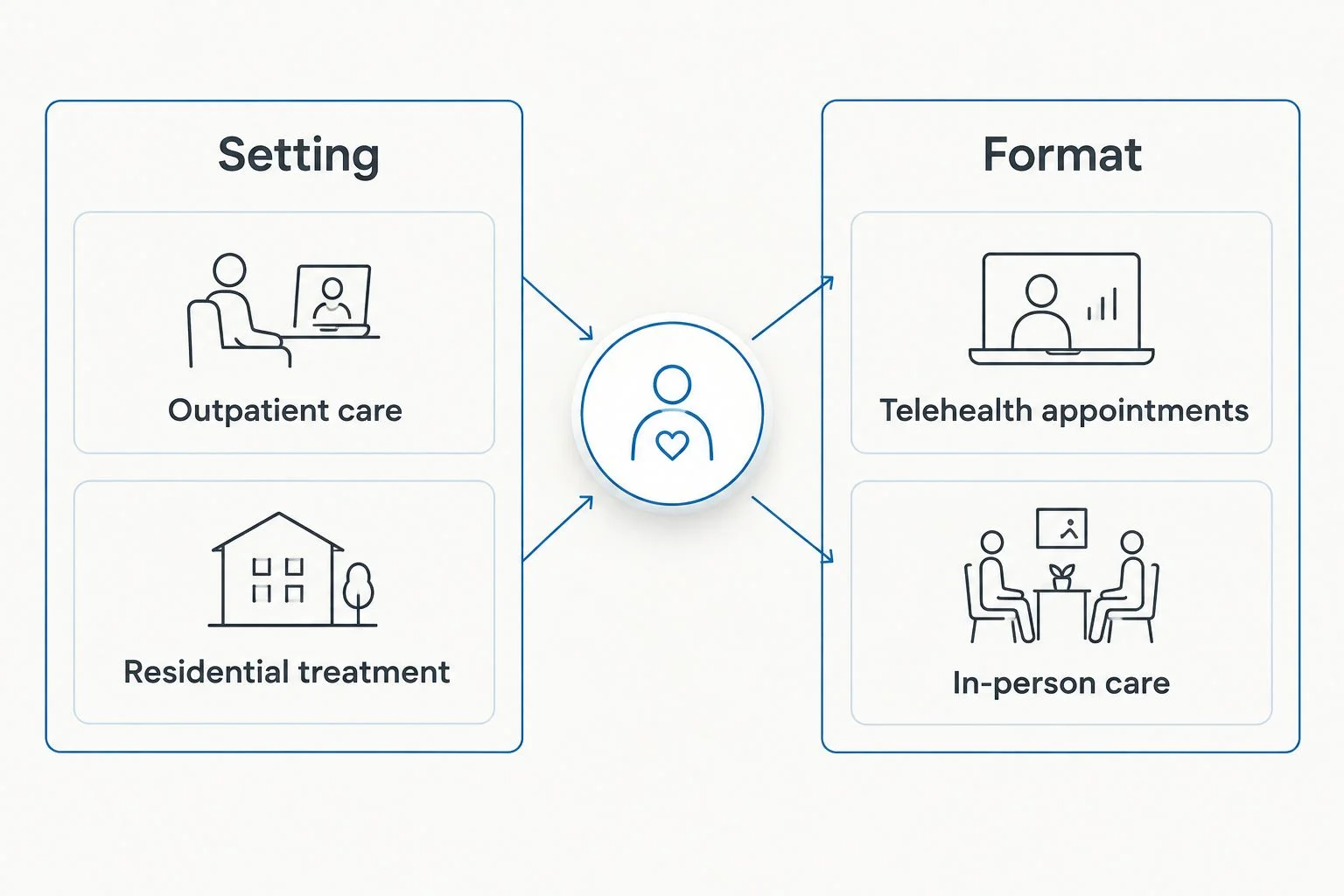
Choose the care setting before deciding whether remote appointments fit your needs.
Ask providers about eligibility, group composition, family participation, and coordination with other clinicians. A service described as adult treatment does not automatically include a dedicated young-adult group. For any option you consider, verify those details rather than relying on a label.
Common mistakes young adults make when choosing treatment
Choosing convenience before safety
An online appointment can be convenient, but it cannot replace emergency care or medically necessary withdrawal monitoring. Start with assessment, then ask how the recommended treatment can fit your schedule.
Hiding use to protect school or work
Leaving out a substance, a prescription, or a previous overdose gives the clinician an incomplete safety picture. Ask about confidentiality first, then share the information needed to plan care. You can discuss academic or employment concerns without minimizing symptoms.
Treating family involvement as all or nothing
Family support does not necessarily require unrestricted access to treatment information. Ask what specific permissions and boundaries are possible, including legal exceptions and potential insurance communications. A supportive relative may help with appointments without receiving therapy details, depending on your consent and applicable rules.
Choosing a program only because friends attend
Shared experiences can help you feel less alone, but your friend's care level is not your assessment. Compare withdrawal risk, mental health needs, home safety, and treatment goals—not just the program name.
Leaving after a difficult week
Missed appointments or renewed substance use need a conversation, not silent withdrawal from care. Contact the treatment team, describe what happened, and ask whether your support or care level needs to change.
FAQ
What's the best addiction treatment for a young adult in Ohio?
The best addiction treatment matches the young adult's assessed withdrawal risk, substance use, mental health needs, and living situation. Start with a clinical assessment rather than choosing a program solely by schedule or reputation.
Can I keep going to college while receiving addiction treatment?
Some outpatient treatment plans allow you to continue college while receiving care. Your clinician should first determine whether outpatient treatment provides enough support, then help you address scheduling and academic needs.
Is online addiction treatment as appropriate as in-person care?
Online care is appropriate when the service can safely meet your assessed needs remotely. It is not a substitute for emergency care, and withdrawal risk or a need for more intensive support requires a separate clinical decision.
Does SOS Wellness provide addiction treatment and mental health care?
SOS Wellness provides addiction treatment, psychiatry, therapy, medication management, and telehealth mental health services in Ohio. Ask which services fit your substance use and mental health assessment and whether referrals are needed.
Will my parents know that I am getting treatment?
Ask the provider to explain confidentiality and consent before treatment begins. For adult patients, family involvement generally depends on permission, but legal exceptions and insurance communications can affect privacy.
Does Medicaid cover addiction treatment in Ohio?
Ohio Medicaid covers eligible substance use disorder services, including intensive outpatient treatment. SOS Wellness accepts Ohio Medicaid, including managed plans. Confirm your exact plan, recommended service, clinician network, authorization requirements, and any patient costs; coverage is not automatic for every program or person.
What should I do if I use substances again during treatment?
Contact your treatment team and discuss safety, triggers, and whether the plan needs to change. Call 911 for suspected overdose or immediate danger, and remember that reduced opioid tolerance increases overdose risk if use resumes.
One last thing
You do not need to know your diagnosis before asking for an assessment. Bring a description of what is happening and what you want to change. A useful first appointment ends with a next step, a safety plan, and a clear explanation of who is responsible for follow-up.
Further reading
Related reading
This article provides general educational information and does not replace an individual clinical assessment. Contact your healthcare provider about your own care.