
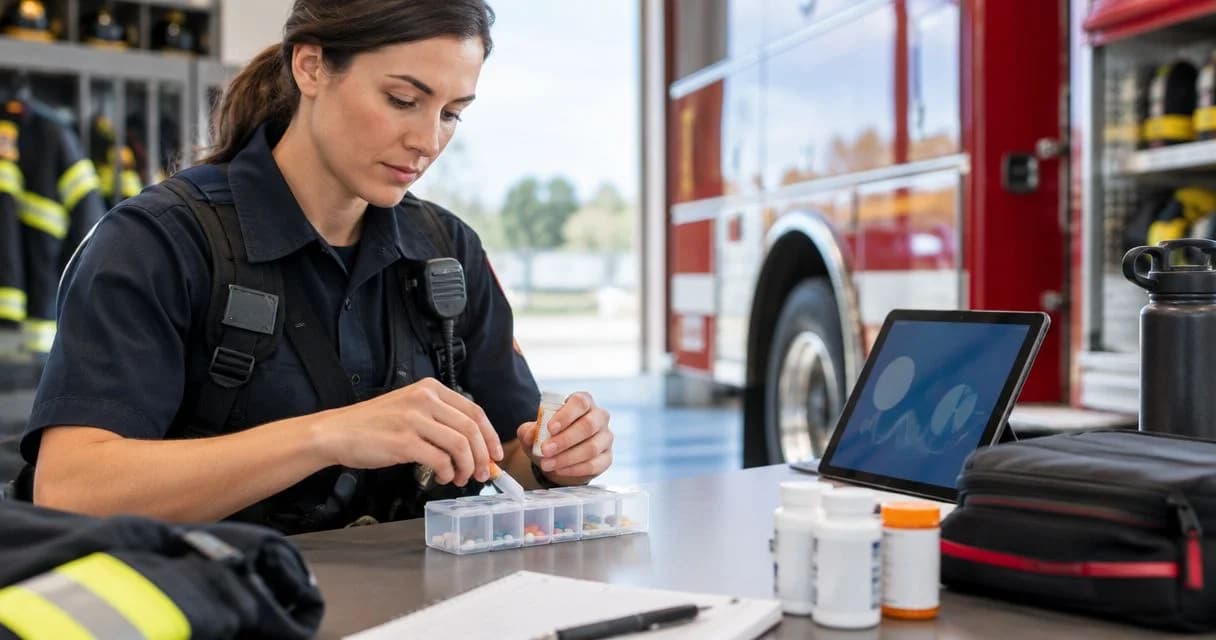
Medication management for first responders includes psychiatric assessment, prescribing when appropriate, and monitoring benefits and side effects. An appointment does not guarantee a prescription or establish fitness for duty. This Ohio guide explains how to plan care around rotating shifts, interrupted sleep, driving, and other safety-sensitive responsibilities.
At a glance
- Medication management for first responders in Ohio starts with symptoms, shift patterns, current medicines, and safety-sensitive duties.
- SOS Wellness offers Ohio medication management and therapy; ask how appointments and monitoring fit your work schedule.
- Discuss alertness and medication changes before returning to driving, emergency response, or other safety-sensitive tasks.
- Never change psychiatric medication on your own; agree on follow-up and urgent-contact instructions with your prescriber.
Why medication management matters for first responders
First responders need treatment plans that account for what happens between appointments. A firefighter working overnight, a paramedic driving an ambulance, and a police officer handling a weapon each need to discuss alertness, judgment, sleep, and medication effects with a prescriber. Your actual duties matter more than your job title alone.
Medication management is more than receiving a prescription. It includes assessing symptoms, reviewing other medicines, discussing treatment choices, and checking whether benefits outweigh side effects. Treatment can address conditions such as depression, anxiety, and ADHD, but the diagnosis and medication decision belong to a qualified clinician.
SOS Wellness offers outpatient medication management and therapy in Ohio. This guide is published by SOS Wellness; it is not an independent provider ranking. Confirm whether its services fit your needs and whether care will involve more than one clinician. SOS Wellness provides psychiatry, medication management, therapy, addiction treatment, and telehealth mental health services in Ohio. Ask how those services fit your clinical needs rather than assuming the practice provides occupational clearance or first-responder-specific evaluations.
For your care plan, separate two questions: whether treatment helps your symptoms and whether you can perform your current duties safely. Feeling better does not automatically answer the second question. Your prescriber and any required occupational health process address different responsibilities.
Do not wait for an outpatient appointment during an emergency. Call 911 for immediate danger or a medical emergency. In the United States, call or text 988 for suicide or mental health crisis support.
Build a medication plan around your actual duties
Start with information you can gather yourself: a symptom record, a medication list, and a description of your work. Then choose clinical care and agree on a monitoring plan. These steps help you prepare for a useful appointment; they do not replace an assessment.
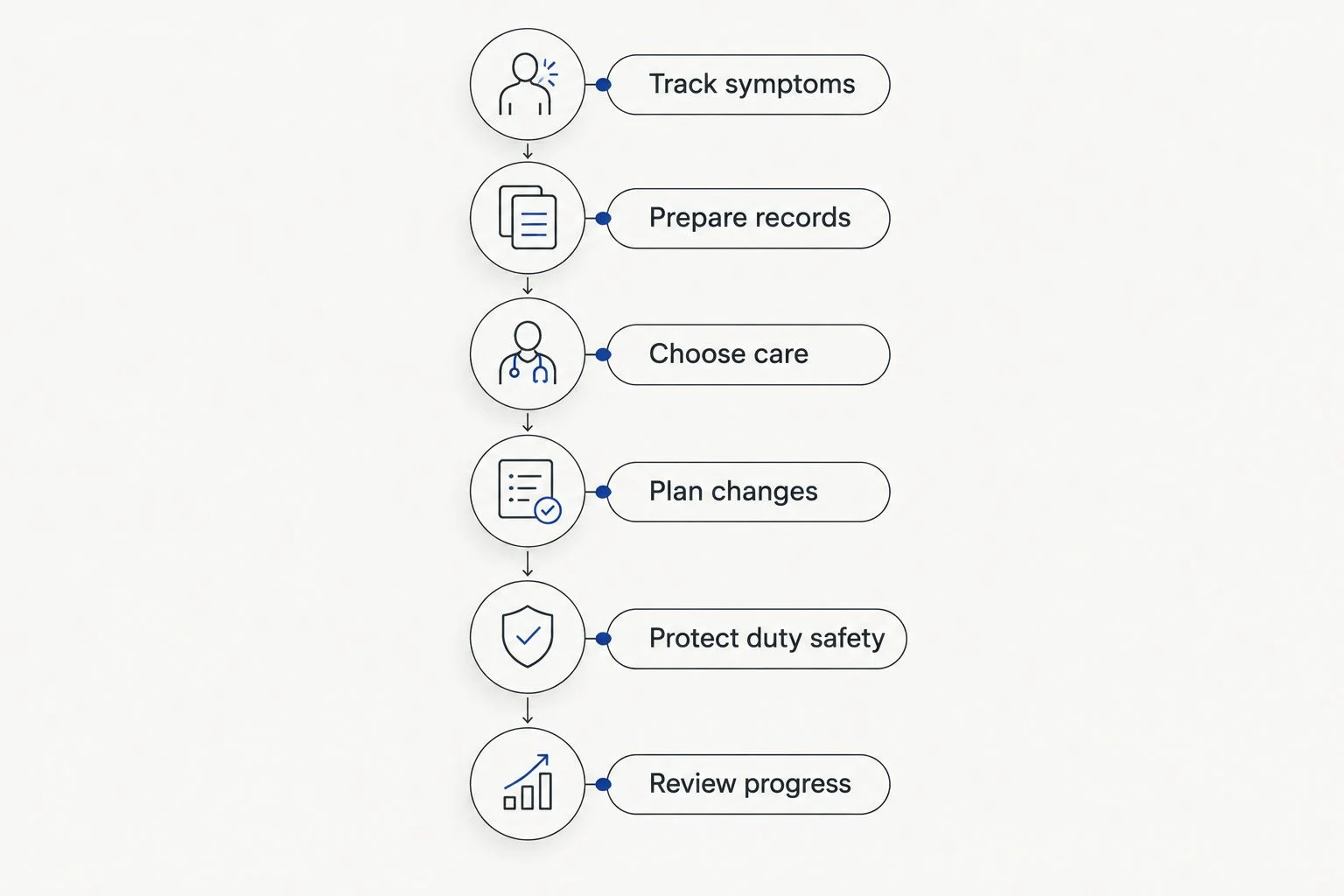
Work duties and follow-up belong in the treatment plan, not just the initial prescription.
Track symptoms
Before your appointment, keep a brief record of what is happening and when. A 7-day log is a practical starting point, not a diagnostic requirement. If you need help sooner, book the appointment rather than waiting to complete the log.
Write observations instead of trying to diagnose yourself. Record difficulty falling asleep, intrusive memories, irritability, trouble concentrating, or low mood in your own words. Note whether symptoms occur during shifts, after difficult calls, on days off, or across all settings.
Add how symptoms affect your life. Missing family activities, avoiding work conversations, or struggling to finish documentation gives your clinician useful context. Include changes noticed by someone you trust, if you want that perspective considered.
- Record symptoms, including when they start and what interrupts them.
- Note sleep timing and whether sleep feels restorative.
- Describe effects on work, relationships, and daily tasks.
- Record alcohol, cannabis, caffeine, and other substance use honestly.
- Flag worsening symptoms or immediate safety concerns when requesting care.
Prepare records
Bring one current medication list rather than relying on memory during the visit. Include prescriptions, over-the-counter medicines, supplements, and medications prescribed by other clinicians. Add what you actually take, including missed doses or changes you made yourself.
Your medication record should also include previous psychiatric treatments. A medicine that caused an unwanted effect, failed to help, or was stopped early is relevant. Explain what happened without labeling the treatment a failure before your clinician reviews it.
Describe your shift schedule clearly. Include rotating start times, overnight duties, overtime, and the tasks that require sustained attention. If your schedule changes frequently, explain that pattern instead of presenting a typical day that rarely exists.
You can prepare these records on paper or in a secure personal note. The useful part is accuracy, not the format.
- Bring a medication list with names, doses, and usual timing.
- Summarize previous treatment benefits and unwanted effects.
- Describe your shift schedule and sleep opportunities.
- Write down safety questions about driving, equipment, or other duties.
- Bring relevant records you already have and ask what else is needed.
Choose care
Start by identifying the kind of assessment you need. A prescribing clinician evaluates whether medication is appropriate; a therapist provides psychological treatment. Some people need both. A referral from an existing clinician or a direct appointment request can begin that process.
SOS Wellness offers medication management, psychiatry, therapy, and telehealth in Ohio. You must be physically in Ohio during SOS telehealth visits. Ask about appointment scheduling, how follow-up works, and which concerns require in-person assessment. Telehealth is an appointment format, not a guarantee that every clinical need can be handled remotely.
For medication decisions, seek a qualified prescribing clinician who assesses your symptoms and actual work demands. Familiarity with first-responder work is useful to ask about, but do not assume it from a provider's general service description.
Confirm the purpose of the visit before booking. An outpatient treatment appointment is not automatically an employer-requested fitness-for-duty evaluation, and the records or permissions involved can differ.
- Ask who performs the prescribing assessment and follow-up.
- Explain your occupation and safety-sensitive responsibilities.
- Confirm whether telehealth or in-person care fits the assessment.
- Ask how you contact the practice between appointments.
- Clarify whether you need treatment, occupational evaluation, or both.
Plan changes
A useful prescribing conversation covers the proposed medicine, the symptom it targets, likely side effects, and how progress will be judged. Ask about alternatives, including therapy, before agreeing to a plan. Medication is a treatment choice, not a prerequisite for receiving help.
For your treatment plan, choose 2 functional goals with your clinician. Examples include concentrating during documentation and participating in family activities without withdrawing. Goals should reflect your life; symptom improvement alone does not describe every meaningful benefit.
Discuss how rotating shifts affect medication timing. Do not assume a bedtime instruction means the same clock time every day, or change a dose to accommodate a shift without asking. Your prescriber can explain the instructions for your specific medicine.
Some psychiatric medications can cause problems if stopped abruptly. Do not start, stop, increase, or reduce a prescribed medicine without clinical guidance. Ask for instructions you can review after the appointment.
- Identify the symptoms and functional goals the treatment targets.
- Ask about common side effects and symptoms requiring urgent help.
- Confirm dosing instructions for your actual shift pattern.
- Discuss interactions with other medicines, alcohol, and substances.
- Get clear instructions for missed doses and follow-up.
Protect duty safety
Ask directly whether the proposed treatment can affect alertness, coordination, judgment, or sleep. The answer depends on the medicine, your response, other substances, and your health history. A medication being prescribed does not mean every work activity is immediately safe.
Tell your prescriber before a medication change if your duties include emergency driving, firearms, patient care, climbing, or heavy equipment. Ask how to assess your response and whether temporary work changes need consideration. Do not decide that an off-duty first dose proves you are ready for every task.
If you feel impaired, stop the safety-sensitive activity and follow your workplace's safety process. Contact your clinician for medication advice. Severe symptoms or immediate danger require urgent or emergency help rather than a routine message.
Keep treatment privacy and workplace safety as separate questions. Ask what information is confidential, what exceptions apply, and what documentation an employer-requested process requires.
- Identify tasks where reduced alertness creates a safety risk.
- Ask what to do if drowsiness, dizziness, or agitation occurs.
- Confirm whom to contact before the next appointment.
- Review relevant workplace policies and occupational health requirements.
- Avoid alcohol or other substances that conflict with your treatment instructions.
Review progress
Medication management continues after the first prescription. Keep notes on benefits, side effects, sleep, and missed doses so follow-up appointments address what actually changed. Do not report only the best day or only the hardest shift.
Use the goals agreed with your clinician. Better concentration with persistent dizziness is a mixed result that needs discussion, not a reason to hide the dizziness. Likewise, an unchanged symptom does not give you permission to increase the dose yourself.
Agree on the next appointment before leaving and clarify what warrants earlier contact. Follow-up timing depends on your condition, the treatment, and your response; there is no single schedule that fits every first responder.
If several clinicians prescribe medicines, tell each about the others. Ask who coordinates psychiatric medication decisions so you do not receive conflicting instructions.
- Compare current functioning with your agreed treatment goals.
- Record unwanted effects even when the medication helps.
- Report missed doses and barriers to taking medication consistently.
- Confirm the next review and reasons to contact the practice sooner.
- Update your medication list whenever another clinician changes treatment.
Compare care options
These options are an unranked decision guide, not a comparison of provider quality. Choose care based on your assessed needs rather than how intensive it sounds. A clinician can help determine whether outpatient care is sufficient or whether you need a different level of support.
| Option | Who might consider it | What it offers | Key limitation |
|---|---|---|---|
| SOS Wellness medication management | Ohio first responders seeking outpatient psychiatric medication care | Assessment, prescribing, and medication monitoring are part of its stated services | Do not assume outpatient treatment includes employer fitness-for-duty clearance; confirm the scope |
| Therapy | People seeking help with coping, behavior patterns, and distress | Provides a setting to work on psychological and practical skills | Therapy alone does not provide prescription management |
| Medication management plus therapy | People whose assessment supports both approaches | Addresses medication decisions and psychological treatment together | Requires coordination; ask how clinicians share the treatment plan |
| Higher-intensity treatment | People whose assessment identifies needs beyond routine outpatient visits | Provides a different level of treatment structure | Requires an assessment of suitability; it is not a substitute for emergency care |
Telehealth can be the format for suitable outpatient appointments. It does not change the need for medication monitoring, privacy, or safety planning. Choose a setting where you can speak openly, and ask whether any part of the assessment needs an in-person visit.
Discuss your outpatient care needs
Ask about Ohio medication management, therapy, and telehealth options for your situation.
Common mistakes first responders make
Minimizing symptoms because you are still working
Completing a shift does not establish that symptoms are mild. Describe the effort required to get through work and what happens afterward. Treatment decisions need that fuller picture, including effects on sleep and relationships.
Leaving shift work out of the prescribing conversation
A medication plan built around a regular daytime schedule can miss your actual routine. Explain overnight work, overtime, and changing sleep periods before discussing medication timing. Ask for instructions rather than adapting the prescription yourself.
Using substances to manage medication effects
Do not use extra caffeine, alcohol, cannabis, or someone else's prescription to counter an unwanted effect. Tell your clinician what you are taking and why. That information helps the clinician assess interactions and revise the plan safely.
Confusing treatment with occupational clearance
Receiving psychiatric care and being cleared for particular duties are separate matters. Ask your employer or occupational health service about the required process, and tell your treating clinician what documentation is requested. Do not assume either process automatically replaces the other.
Waiting until a refill problem becomes a missed dose
Ask how refill requests work when treatment begins. Keep track of your supply and contact the practice according to its instructions. Never borrow medication or stretch doses without guidance when a refill is delayed.
FAQ
What is medication management for first responders in Ohio?
Medication management is clinical assessment, prescribing when appropriate, and follow-up to monitor benefits and unwanted effects. For first responders, the discussion should include rotating shifts, sleep, and safety-sensitive duties.
Can I see SOS Wellness for medication management in Ohio?
SOS Wellness provides medication management and psychiatry in Ohio. Ask about scheduling, the assessment process, and whether its outpatient services fit your needs; do not assume treatment includes occupational clearance.
Can I keep working while taking psychiatric medication?
Work safety requires an individualized assessment of your symptoms, medication effects, and duties. Discuss driving, firearms, equipment, and patient care with your prescriber, and follow any applicable occupational health requirements.
Is telehealth suitable for first responder medication management?
Telehealth may be suitable when the clinician determines that assessment and monitoring can be handled remotely. For SOS Wellness video appointments, you must be physically in Ohio and have a private space and reliable video connection. Ask whether examinations, testing, or other parts of care require an in-person visit. Prescribing depends on clinical assessment and applicable requirements; a video visit does not guarantee medication.
Will my employer know that I am receiving mental health treatment?
Health information is generally protected, but confidentiality has legal exceptions and does not replace workplace requirements. Ask your clinician about disclosure rules and any authorization or records involved in an employer-requested evaluation.
Should I stop a medication if it makes me sleepy on shift?
Do not change or stop the medication on your own; contact your prescriber for instructions. Stop safety-sensitive activities if you feel impaired, and seek urgent help for severe symptoms or immediate danger.
What should I do if I need mental health help right now?
Call 911 for immediate danger or a medical emergency. In the United States, call or text 988 for suicide or mental health crisis support; a routine outpatient appointment is not an emergency response.
One last thing
Bring your job tasks, not just your job title, to the appointment. For a medication review, describe the work you must perform safely and the home activities you want to recover. A useful plan connects treatment to both, then makes clear how you will recognize benefit, report problems, and get help.
Further reading
Related reading
This article provides general educational information and does not replace an individual clinical assessment. Contact your healthcare provider about your own care.