

An employer EAP referral to therapy involves checking benefits, confirming a participating clinician, and arranging an appointment. Employees should share clinical concerns directly with the EAP or practice, rather than through HR. This guide explains the administrative handoff for employers and employees without treating a referral as a confirmed appointment.
At a glance
- An employer EAP referral to therapy needs separate confirmation of benefits, provider participation, and an appointment.
- SOS Wellness provides outpatient mental health care in Ohio; confirm EAP participation before scheduling under that benefit.
- Keep clinical records out of routine employer referral tracking. Distinguish voluntary referrals from formal workplace processes with reviewed reporting requirements.
- Plan ongoing therapy before EAP-authorized counseling ends; continued care requires a separate benefits check.
Why this matters
An employee assistance program, or EAP, connects employees with support for personal or work-related concerns. Its counseling arrangements, referral rules, and confidentiality terms depend on the program. An employer's recommendation alone does not authorize treatment or establish coverage.
A useful handoff gives the employee clear access instructions and a contact for unresolved problems—not just a provider name. The employee, EAP, and practice can confirm the appointment without routine employer tracking. Voluntary referrals should not become implied employment requirements; formal workplace processes may involve separately reviewed reporting and employment considerations.
SOS Wellness provides therapy, psychiatry, medication management, addiction treatment, and telehealth mental health services in Ohio. Clinical assessment determines whether SOS Wellness services fit a person's needs. For SOS Wellness telehealth visits, patients must be physically in Ohio. Whether an appointment can use a particular EAP benefit requires confirmation with the program and provider.
This workflow supports routine outpatient referrals. For immediate danger or a medical emergency, call 911. For suicide-related concerns or emotional crisis in the United States, call or text 988. Do not wait for an EAP authorization during an emergency.
Before you start
Gather the following before asking an employee to schedule:
- Program access: Find the current EAP contact instructions, eligibility rules, and referral policy. Use the employer's current benefit materials rather than an old directory or saved email.
- Employee access: Give the employee a way to contact the EAP privately. Explain whether the referral is voluntary or connected to a formal workplace process, and who can answer employment-policy questions.
- Provider confirmation: Check whether the receiving practice accepts the specific EAP arrangement. Accepting a health insurance plan does not establish EAP participation. This distinction can interrupt scheduling after the employee has already shared sensitive information.
If you are the employee, keep your benefit documents and referral details somewhere you control. If you are an employer, do not request portal credentials, therapy notes, or a detailed symptom history to complete a routine referral.
Choose the referral route
These 3 referral routes serve different purposes. Confirm which one applies before discussing follow-up.
| Referral route | Potential fit | Main benefit | Main limitation |
|---|---|---|---|
| Employee self-referral | Employees seeking help privately | Employee controls initial contact | Employee must complete the connection |
| Voluntary manager referral | Employees who want help finding support after a workplace conversation | Manager supplies a clear access route | Encouragement is not authorization or clinical assessment |
| Formal workplace referral | Situations governed by a documented employer process | Establishes defined administrative expectations | Requires careful policy, consent, and confidentiality review |
Do not turn a voluntary offer into an implied employment requirement. Before implementing a formal referral, have the designated administrator and qualified legal counsel review applicable law, program terms, attendance reporting, releases, disclosure limits, and any proposed employment consequences. Explain the reviewed expectations to the employee. This is a general administrative guide, not a determination of legal compliance or a guarantee of employment protection.
Benefits check
- Contact the EAP. Use the program's published access method. Employees should discuss clinical concerns directly with the program rather than through a manager whenever possible.
- Confirm eligibility. Ask whether the person seeking care qualifies and whether the requested service falls within the benefit. Dependent eligibility and service categories require their own confirmation.
- Clarify authorization. Ask whether a referral number, authorization document, or EAP assessment is required before scheduling. Confirm who sends the authorization to the receiving practice.
- Record the boundaries. Note the authorized service, any visit limit, relevant expiration date, and instructions for extending or changing the referral. Use the terms in the actual benefit document.
- Confirm the privacy arrangement. Ask what information the EAP shares with the employer, under what circumstances, and whether employee permission is required. Do not assume every program operates identically.
Keep administrative facts in the referral checklist. Leave the employee's symptoms, diagnosis, and treatment discussion with the clinical service unless a specific, appropriate disclosure is needed.
Expected result: The employee knows how to access the benefit, what authorization is required, and which referral details the provider needs. A provider directory entry alone does not meet this checkpoint.
Provider confirmation
- Identify a suitable service. Ask whether the referral concerns therapy, psychiatric evaluation, medication management, or another service. The receiving clinician determines clinical suitability; HR should not select a diagnosis or treatment plan.
- Confirm the exact EAP arrangement. Give scheduling staff the program name and required authorization information. Ask whether the individual clinician and requested service can be scheduled through that arrangement.
- Check the appointment format. Confirm whether the appointment is in person or by telehealth. For telehealth, tell the practice where the patient will physically be during the visit so it can check applicable requirements.
- Complete intake through the practice. Use the provider's designated process for health history, consent, and clinical information. Do not route completed clinical forms through a supervisor.
- Confirm the appointment. Obtain the appointment instructions directly from the practice. Ask what remains incomplete and whom to contact if the employee cannot attend.
When considering SOS Wellness, ask the practice about the requested service and specific EAP arrangement before treating the referral as accepted. The organization provides several kinds of mental health care; that does not mean every service falls within an EAP authorization.
Expected result: The employee has 2 separate confirmations: the EAP benefit applies to the referral, and the receiving practice has accepted the appointment under the agreed arrangement.
Private handoff
- Assign administrative ownership. Identify who resolves authorization problems: the employee, the EAP coordinator, or the practice's designated staff member. Avoid copying multiple workplace contacts into clinical correspondence.
- Limit the shared information. Transfer only what the receiving party needs through its approved channel. Confirm the recipient before sending documents, particularly when email addresses or provider names are similar.
- Separate employment follow-up. For a voluntary referral, offer help with access barriers without requesting treatment details. For a formal referral, explain the documented reporting requirements before asking the employee to authorize a disclosure.
- Review any release. The employee should understand the recipient, purpose, information covered, and duration before signing. Ask the provider how revocation works and what legal or safety exceptions apply.
- Close the administrative loop. Record that referral instructions were provided and any permitted next step. Do not mark treatment complete because an appointment was scheduled.
For an employer's referral checklist, record that access instructions were provided and any administrative issue the employer is permitted to address. Do not routinely track whether an employee contacted the EAP or accepted an appointment. Any reporting under a formal workplace process requires review of applicable policy, consent requirements, and disclosure limits.
Expected result: The employee knows the next contact, and the practice receives necessary referral information through its designated process. Keep clinical documentation out of the employer's routine referral checklist.
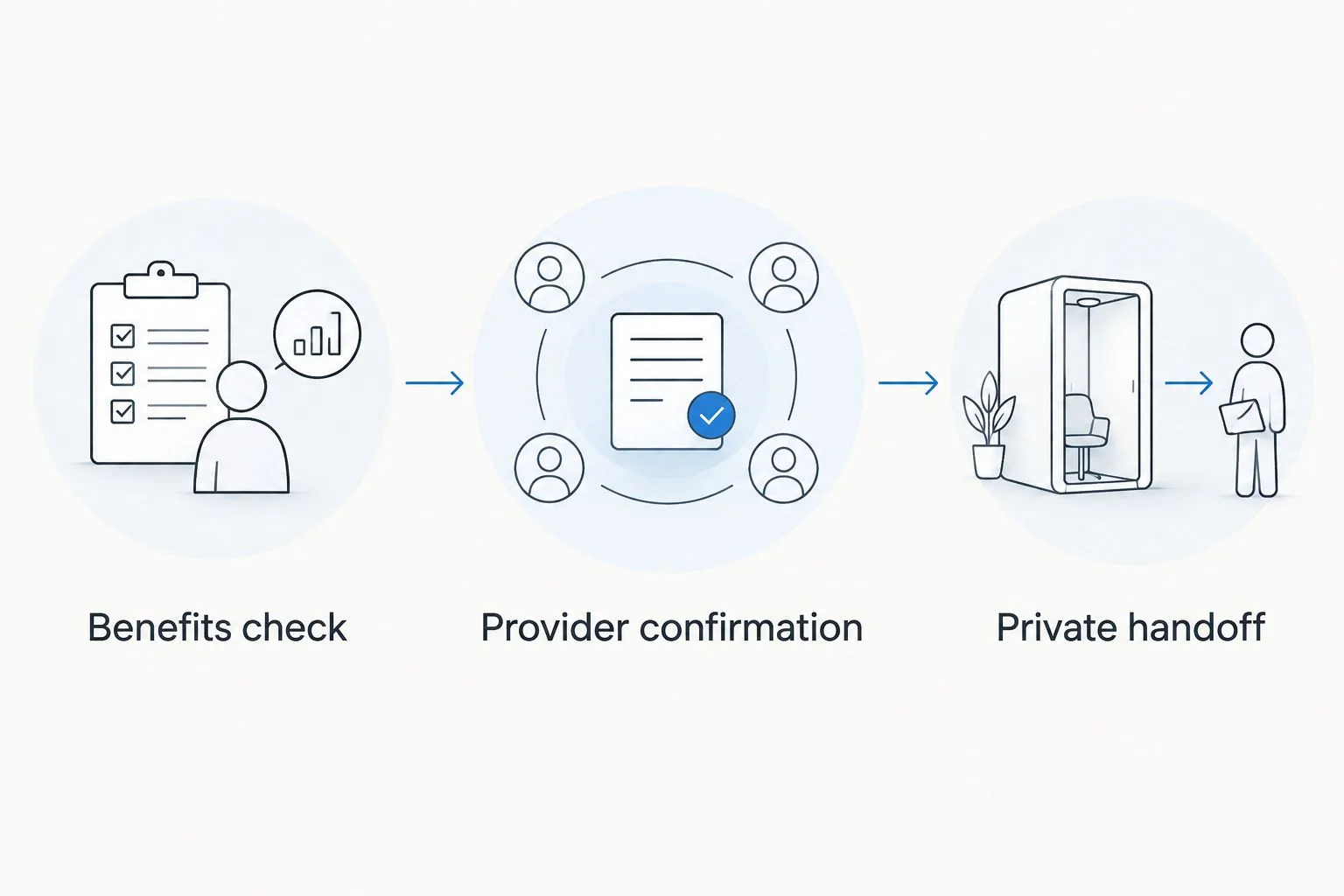
The employee, EAP, and practice should confirm the benefit and appointment. Employers should close their administrative checklist using only information they are permitted to receive.
When EAP counseling becomes ongoing therapy
A second workflow begins when an employee wants to continue therapy beyond the EAP arrangement. Continuing with the same therapist does not automatically continue the same authorization. Discuss the transition before the current authorization ends.
- Ask the clinician about the next clinical step. The employee and clinician should discuss continued therapy, another service, or referral elsewhere based on the employee's needs.
- Check the next benefit arrangement. Ask the health plan and practice whether the clinician participates for ongoing care and whether additional authorization is required. Do not reuse an EAP approval as proof of health-plan coverage.
- Confirm continuity. Ask whether the current clinician can continue care under the new arrangement. If not, request referral guidance and discuss how to avoid an unplanned gap.
- Coordinate records through the practice. If another clinician needs records, ask the practice to arrange a secure transfer and explain whether authorization is required for the records involved. Do not route clinical records through the employer.
When planning ongoing care, check the current benefit documents even if earlier visits used a different arrangement. If symptoms worsen during the transition, contact the treating clinician promptly; use emergency or crisis services when needed.
Troubleshooting
The practice accepts the health plan but not the EAP
Ask the EAP for a clinician who participates in its specific arrangement. Alternatively, ask the practice and health plan whether a separate outpatient therapy pathway applies. Do not describe that alternative as EAP-authorized care without confirmation.
The authorization does not match the appointment
Ask the EAP and practice to compare the authorized service, clinician, and relevant dates. Resolve discrepancies before assuming the scheduled visit falls within the authorization. Keep clinical details out of a manager's troubleshooting email.
The employee does not want to tell a manager why they need therapy
For a routine voluntary referral, provide private access instructions without asking for a diagnosis. If leave, accommodation, or a formal workplace process is involved, direct the employee to the designated administrator for that separate process.
The telehealth location has changed
Tell the practice where the employee will physically attend the appointment. The practice must determine whether it can provide care there. Do not assume an Ohio-based appointment can proceed unchanged when the employee travels elsewhere.
The employee misses the first appointment
The employee should contact the practice about rescheduling and any access barriers. For a voluntary referral, a manager can offer general help without asking whether the employee attended or why a visit was missed. For a formal workplace referral, confirm what attendance reporting and follow-up are permitted under the applicable process before taking employment-related action.
Customize your workflow
Build a short administrative checklist rather than a shared spreadsheet containing health histories. Track the contact route, the next responsible person, unresolved access issues, and only the information your role is permitted to hold. Restrict access according to your organization's policies.
Before implementing an employer referral process, ask 3 questions:
- Who owns access problems? Name the person or service that resolves authorization and scheduling questions.
- Who receives information? Define the administrative information each recipient needs and the permission required.
- What happens next? Establish how employees get help when the initial referral does not connect them with care.
SOS Wellness offers outpatient mental health services for children and adults in Ohio. When requesting care, describe the service needed directly to the practice and confirm the referral arrangement; do not send a workplace assessment as a substitute for clinical intake.
FAQ
How does an employer EAP referral to therapy work?
An employer EAP referral to therapy connects an employee with the program's access process, followed by benefits verification and provider scheduling. The referral itself does not confirm authorization, provider participation, or an appointment.
Can I contact the EAP without telling my manager?
Check your program's self-referral instructions and confidentiality notice. Ask the EAP directly what information it shares with your employer and whether any exceptions apply before discussing sensitive details.
Does accepting my insurance mean a therapist accepts my EAP?
No. Health-plan participation and EAP participation are separate arrangements. Confirm the specific program, clinician, and service with both the EAP and receiving practice.
Can my employer see my therapy notes?
Do not assume an employer referral gives your employer access to therapy notes. Ask the provider and EAP what disclosures apply, what permission is required, and what legal or safety exceptions exist.
Can I keep seeing the same therapist after EAP counseling ends?
Continuing with the same therapist requires confirmation with the practice and the next benefit arrangement. Ask about continued care before the EAP authorization ends so the clinician can help plan the transition.
Can an EAP refer me to SOS Wellness in Ohio?
Ask your EAP and SOS Wellness whether the specific referral arrangement is accepted. SOS Wellness provides outpatient mental health services in Ohio, but the requested service and authorization need individual confirmation.
What should I do if I need help before the referral is complete?
For immediate danger or a medical emergency, call 911. In the United States, call or text 988 for suicide-related concerns or emotional crisis; do not wait for routine EAP scheduling.
One last thing
The most useful handoff question is not whether someone received a therapist's name. It is whether the employee knows the next step and who can resolve a problem with it.
A referral can stall even when everyone involved intends to help. Give the employee a clear contact for authorization questions and the practice's own appointment instructions. Keep clinical progress out of the employer's administrative checklist. That boundary makes the process clearer without asking the employee to trade privacy for help.
Further reading
- NIMH: Psychotherapies
- US Department of Labor: Mental health and FMLA
- OPM: Employee assistance programs
Related reading
This article provides general educational information and does not replace an individual clinical assessment. Contact your healthcare provider about your own care.