

If you receive a court order for addiction treatment in Ohio, start by reviewing the order, arranging a clinical assessment, confirming reporting permissions, and documenting each requirement. These steps help distinguish your legal obligations from your clinical treatment plan; they do not establish that a particular provider or program satisfies the order.
At a glance
- A court order to addiction treatment starts with the written order, not an assumed treatment schedule.
- SOS Wellness provides outpatient addiction treatment and mental health care in Ohio; confirm court-specific requirements before scheduling.
- Clinical assessment determines treatment needs; the court determines legal obligations.
- Confirm consent, reporting recipients, deadlines, and completion documents before treatment begins.
Why this matters
A court order tells you what the legal system requires. A clinical assessment determines what care addresses your substance use, mental health, and safety needs. Neither document replaces the other. Starting care without checking both can leave you attending appointments that do not satisfy the order.
Sos-wellness offers addiction recovery and mental health services in Ohio. An assessment determines appropriate care; its published services do not establish acceptance for a particular court referral. Its services include psychiatry, therapy, medication management, addiction treatment, and telehealth. Before relying on any provider for court-related care, confirm whether it can meet the specific assessment, documentation, and reporting requirements in your order.
This workflow is educational, not legal advice or an individual treatment recommendation. Your attorney or designated court contact should clarify legal requirements; a qualified clinician should assess treatment needs.
Before you start
- Gather the documents. Keep 1 complete copy of the signed order, any referral instructions, your case identifier, deadlines, and the contact details supplied by the court. Bring your medication list and relevant treatment records to the assessment.
- Confirm access and responsibilities. Identify who schedules the assessment, who receives reports, and whether the order specifies a provider, program, or treatment setting. Ask about payment arrangements and any coverage authorization before enrolling.
- Check the reporting gotcha. A court order does not automatically give every person involved unrestricted access to treatment records. Ask the provider what consent or other legal authority permits each disclosure before assuming that attendance will be reported.
Address urgent safety needs before administrative tasks. Call 911 for an overdose, immediate danger, or a medical emergency. Call or text 988 for suicide or mental health crisis support. If stopping alcohol or other substances raises withdrawal concerns, seek medical guidance rather than attempting withdrawal alone.
Order review
Ohio law provides a civil involuntary alcohol or drug treatment process with statutory criteria, distinct from treatment conditions in a criminal case. Do not use instructions from one case type to interpret another. Work from the current signed order and any later written changes, and ask your attorney how they apply to your case.
- Read the operative document. Locate the requirements for assessment, treatment, attendance, testing, reporting, and deadlines. Separate what the order explicitly requires from recommendations someone gave you verbally.
- Create a requirement list. Record each obligation, its deadline, the person responsible, and the evidence needed to show compliance. Write down questions instead of filling gaps with assumptions.
- Clarify unclear language. Ask your attorney or designated court contact whether the order requires an assessment only, treatment recommended after assessment, or a particular program. Court staff cannot replace advice from your attorney.
- Verify provider acceptance. Ask whether the court must approve the provider before treatment begins. Then ask the provider whether it accepts the referral and can supply the required documentation.
- Record the answer. Keep written confirmation when possible. If instructions arrive by phone, note the caller, date, and question, then request written clarification of anything affecting compliance.
Expected result: You have an actionable requirement list and know which questions still need an authorized answer. You have not treated an appointment booking as proof of compliance.
Clinical intake
The assessment should address substance use and mental health together, including medications, withdrawal risk, and immediate safety concerns. SOS Wellness offers both addiction treatment and mental health services; confirm whether its available care and documentation match your specific referral.
- Share the order before intake. Ask how to submit it securely and whether the assessor needs additional referral paperwork. Do not send sensitive records to an unverified email address.
- Describe your needs accurately. Bring your medication list and explain current substance use, past withdrawal, previous treatment, and symptoms affecting daily life. Accurate information supports safer care; it is not a test of willpower.
- Ask for the clinical recommendation. Clarify the recommended setting, appointment expectations, medication follow-up, and any need for withdrawal management or additional evaluation.
- Compare the recommendation with the order. If the recommended care differs from the legal requirement, ask the clinician to document the recommendation and consult your attorney about the next legal step.
- Confirm the start plan. Obtain the appointment details and instructions for reaching the treatment team. Keep 1 named administrative contact for scheduling or documentation questions, if the provider assigns one.
Expected result: You understand the recommended care and have identified any mismatch before assuming the treatment plan satisfies the court.
Treatment settings and visit formats
This unranked decision guide distinguishes care settings from telehealth, which is a way to deliver some services rather than a separate level of care. These options are not interchangeable ways to satisfy an order. Check both the clinical recommendation and court requirements.
| Setting or format | When it may fit | Practical consideration | Limitation |
|---|---|---|---|
| Outpatient care | When assessment supports care while living at home | Can accommodate daily responsibilities | Does not provide continuous supervision |
| Residential care | When assessment supports a structured live-in setting | Involves living at the treatment facility | Requires time away from the usual home setting |
| Telehealth appointments | When the service is clinically appropriate remotely and meets court requirements | Avoids travel for that appointment | Requires privacy and a suitable connection; does not replace emergency care or required in-person services |
Choose care based on assessed need, not convenience alone. A remote appointment is useful only when the provider offers the needed service and the order permits that arrangement.
Reporting setup
Keep separate records for your clinical care instructions and your legal compliance checklist. They serve different purposes. Confidentiality requirements depend on the provider, records, and proposed disclosure. Ask the provider which privacy rules apply, including HIPAA and, where applicable, 42 CFR Part 2, and what consent or other legal authority is required for each report.
- Name each recipient. Identify the specific court office, probation contact, attorney, or other authorized recipient. Do not assume everyone associated with a case receives the same information.
- Review disclosure paperwork. Ask what information will be shared, why, with whom, and under what authority. Read any consent form before signing. Special consent and disclosure conditions can apply to criminal-justice referrals under 42 CFR Part 2; do not assume consent can always be revoked immediately. Ask the provider and your attorney about duration, revocation limits, and their implications for your referral.
- Define the reporting task. Clarify whether the requirement concerns attendance, an assessment recommendation, treatment participation, testing, or completion. These are different records.
- Assign responsibility. Confirm whether the provider sends reports directly or you must submit documents. Ask how delivery is verified and what happens if a deadline falls before a report is ready.
- Check the first handoff. Confirm receipt with the authorized recipient rather than assuming a sent document reached the right case file.
Expected result: You know what will be disclosed, who handles it, and how to verify delivery. Your personal reminder system does not become a substitute for authorized reporting.
The complete handoff follows this sequence: Order review, Clinical intake, Reporting setup, and Completion records. Each stage resolves a different question before the next administrative handoff.
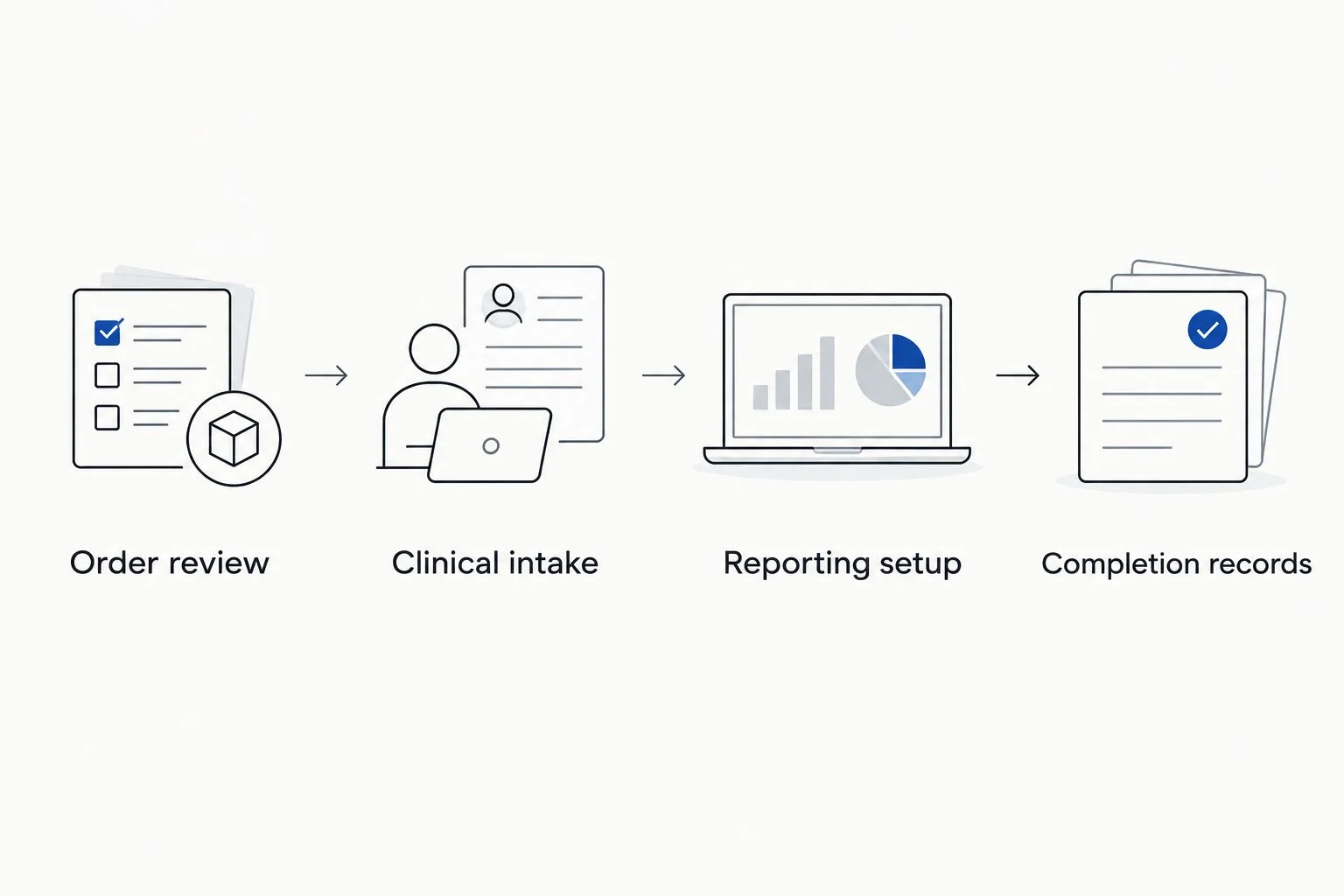
Confirm both the care plan and reporting responsibilities before treating enrollment as compliance.
Completion records
Treatment progress and legal completion are not always the same event. A clinician can describe participation and clinical recommendations; the court determines whether its legal requirements have been met.
- Review progress against the actual requirements. Check attendance, assessments, requested reports, and outstanding tasks. Ask about discrepancies while there is still time to address them.
- Request the required document. Use the wording in your order or referral instructions. An attendance record does not necessarily establish treatment completion, and a discharge summary does not necessarily answer every court requirement.
- Check factual details. Confirm your identifying information, relevant dates, provider details, and the report recipient. Ask the provider to correct factual errors through its established process.
- Submit through the required channel. Follow the court's instructions and retain evidence of submission. Avoid sending clinical records to additional people just to make sure someone sees them.
- Confirm the legal status. Ask your attorney or designated court contact whether anything remains outstanding. Do not stop clinically recommended care solely because a document was submitted.
Expected result: You have the required records, a submission trail, and a clear answer about remaining obligations. Keep clinical follow-up separate from the question of whether the court has closed its requirement.
When the order or treatment plan changes
An updated order needs a fresh document check, not an informal adjustment to your calendar. During a treatment episode, a new clinical recommendation also needs review if it affects how you meet the existing order.
- For a revised court order: Give the provider the updated document, identify changed requirements, and confirm whether reporting recipients or deadlines changed.
- For a new clinical recommendation: Ask the clinician to document the reason for the change. Consult your attorney before assuming the recommendation modifies a legal obligation.
- For a provider transfer: Confirm acceptance, secure records transfer, reporting responsibilities, and the next appointment before treating the handoff as complete.
Keep earlier documents as well as the replacement. A dated record helps distinguish what applied before the change from what applies now. Do not edit the original order or rewrite a clinician's report yourself.
Troubleshooting
The provider cannot meet the order
Ask which requirement it cannot fulfill: the service itself, the assessment format, or the reporting task. Take that specific answer to your attorney or designated court contact and request instructions about an acceptable alternative.
Your appointment falls after the deadline
Keep the appointment confirmation and promptly notify your attorney or designated court contact. Ask about the process for requesting more time; a booking does not extend a deadline by itself.
A report was sent but is missing
Ask the provider to verify the recipient and transmission details. Confirm the case identifier, then follow the approved process for resending it. Avoid creating multiple conflicting versions of the same report.
You missed an appointment or returned to substance use
Contact the treatment team promptly for clinical guidance and ask your attorney about legal obligations. Do not hide the problem or assume it automatically ends treatment. Seek urgent medical care when intoxication, withdrawal, or another immediate safety concern requires it.
A family member wants updates
Ask the provider what permission or legal authority is needed for family involvement. Relatives can offer information, but that does not automatically entitle them to receive confidential treatment details.
Customize your workflow
Use a private calendar for appointments and deadlines, plus a secure folder for orders, permissions, reports, and submission confirmations. Put only the information needed for reminders in calendar entries, especially on shared devices. Keep sensitive treatment details out of shared family calendars.
For remote care, confirm clinical suitability, court acceptance, privacy, and a backup plan for a failed connection. SOS Wellness patients must be physically in Ohio during telehealth visits. These requirements are separate from insurance questions. The guide to Virtual IOP services and insurance questions addresses coverage; coverage alone does not establish court acceptance.
Ask SOS Wellness whether its outpatient services match your assessment needs and the specific documents required by your referral. Confirm this before making it the provider named in your compliance plan.
FAQ
What do I do first after receiving a court order to addiction treatment?
Read the signed order and identify the assessment, treatment, reporting, and deadline requirements. Ask your attorney or designated court contact to clarify anything unclear before assuming that a particular appointment satisfies it.
Can I choose my own addiction treatment provider in Ohio?
Your choice depends on the order and any provider-approval requirements. Confirm acceptance with both the court contact and the provider before enrolling.
Does SOS Wellness provide addiction treatment in Ohio?
SOS Wellness provides outpatient addiction treatment and mental health services in Ohio. Confirm directly whether its services, assessment process, and documentation meet your specific court referral.
Can telehealth count toward court-ordered addiction treatment?
Telehealth may count toward a treatment requirement if the court accepts the arrangement and the provider confirms that the requested service is clinically appropriate and available remotely. For SOS Wellness video visits, you must be physically in Ohio. Confirm these details before replacing an in-person service with a remote appointment.
Will the treatment provider automatically send my records to court?
Do not assume that reporting happens automatically. Confirm the required information, recipient, consent or other legal authority, and responsibility for sending it.
What if I cannot get an appointment before the court deadline?
Notify your attorney or designated court contact promptly and keep evidence of the appointment offered. Ask how to request more time; scheduling alone does not change the deadline.
Does finishing treatment mean my court case is finished?
Finishing treatment does not automatically resolve every legal requirement. Submit the required documentation and confirm your case status with your attorney or designated court contact.
What should I do if withdrawal or a mental health crisis happens?
Call 911 for an overdose, immediate danger, or a medical emergency. Call or text 988 for suicide or mental health crisis support, and seek medical guidance about withdrawal rather than attempting it alone.
One last thing
Ask what proves receipt, not just what proves attendance. You can attend treatment and still have an unresolved reporting task. For your records, keep the appointment evidence and the submission confirmation as separate documents, then verify that the authorized recipient received what the order requires.
Further reading
- SAMHSA: Substance use disorder treatment options
- Ohio law: Involuntary treatment criteria
- HHS: Substance use treatment confidentiality
Related reading
This article provides general educational information and does not replace an individual clinical assessment. Contact your healthcare provider about your own care.