

Start with your prescribing clinician when considering pharmacogenetic testing in Ohio. This unranked decision guide discusses a commercial psychiatric test, a clinical laboratory, and a health system—not interchangeable services. Ask your clinician which testing pathway, if any, addresses your medication question, and confirm current services and referral requirements before proceeding.
At a glance
- Pharmacogenetic tests inform selected medication decisions; they do not identify a guaranteed effective treatment.
- GeneSight reports selected psychiatric drug–gene findings for clinician review.
- Mayo Clinic Laboratories offers pharmacogenetic laboratory testing; confirm the appropriate test and ordering requirements.
- Cleveland Clinic offers pharmacogenomic services; confirm the relevant service and referral pathway.
- SOS Wellness offers Ohio psychiatric care, medication management and pharmacogenetic testing; confirm the exact test, interpretation arrangements and costs.
Why this matters
If you have experienced medication side effects or disappointing results, another test can sound like a clear next step. Pharmacogenetic testing is useful when a result can change a specific prescribing decision. It is not a substitute for diagnosis, follow-up, or listening to how you feel.
SOS Wellness provides psychiatry, medication management and pharmacogenetic testing services in Ohio. A clinician can discuss whether testing is appropriate, its limitations, availability and potential cost. This guide is published by SOS Wellness, which offers services discussed here; it is not an independent provider ranking.
This guide distinguishes a commercial psychiatric test, a clinical laboratory, and an Ohio health system. Those are different services. Comparing them as interchangeable testing providers would hide the decision that matters: who will interpret your result and act on it?
How to evaluate pharmacogenetic testing option
Choose a testing pathway using these criteria before comparing names:
- Medication relevance: The test addresses a drug you take or are seriously considering, rather than collecting unrelated genetic information.
- Actionable guidance: The result connects to an established drug–gene recommendation, such as guidance from the Clinical Pharmacogenetics Implementation Consortium, or CPIC.
- Clinical interpretation: A qualified clinician reviews the result alongside your diagnosis, other medicines, medical history, and treatment response.
- Appropriate scope: A focused test answers a focused question; a broader panel needs a reason beyond having more genes.
- Follow-up responsibility: You know who will explain the report, make any prescription changes, and monitor their effects.
- Clear consent: You understand what is being tested, how the sample and information are handled, and what the result cannot establish.
A polished report does not satisfy these criteria by itself. Before testing, ask your prescriber to finish this sentence: If the result shows a clinically important finding, the treatment decision would be different in this way.
Pharmacogenetic testing options at a glance
These examples include a commercial test, a laboratory and a health system. Their services may overlap; access depends on the particular test, clinical service and ordering or referral requirements.
| Option | Service | Questions to ask |
|---|---|---|
| GeneSight | Reports selected psychiatric drug–gene findings | Does the test address my medication question, and who will interpret it? |
| Mayo Clinic Laboratories | Offers pharmacogenetic laboratory testing | Which test is relevant, and what ordering requirements apply? |
| Cleveland Clinic | Offers pharmacogenomic services | Which service addresses my question, and is a referral required? |
No option wins simply because it includes more genes. A useful result answers your clinical question and reaches someone responsible for your care.
GeneSight: an option for psychiatric medication discussions
GeneSight reports selected psychiatric drug–gene findings for clinician interpretation. It does not diagnose depression, anxiety, ADHD or another mental health condition, predict which medication will work best, or identify every interaction or allergy.
Potential fit: People considering psychiatric medication testing with a prescriber who can explain how the report would affect treatment.
GeneSight is a relevant discussion point when psychiatric prescribing is the actual question. However, a medication appearing in a more favorable report category is not a promise that it will work, and a flagged medication is not automatically unsuitable.
GeneSight pros
- Its psychiatric focus matches a mental health medication discussion.
- A report can support a structured conversation about relevant drug–gene findings.
- Results can be considered alongside previous side effects and medication response.
GeneSight cons
- The report cannot establish which medication will definitely relieve your symptoms.
- Commercial report categories are not interchangeable with every independent drug–gene guideline.
- Genetic findings do not capture all medication interactions, health conditions, or reasons a treatment fails.
Ask the clinician which findings are supported by established prescribing guidance and which require more cautious interpretation. Also ask whether the test would change the next medication decision or merely add information without changing the plan.
Before considering GeneSight, ask your prescriber whether its findings could inform a specific medication decision and whether its scope fits that question. Testing is not automatically appropriate for every patient.
Mayo Clinic Laboratories: an option for a defined drug–gene question
Mayo Clinic Laboratories provides clinical pharmacogenetic laboratory testing. This route is relevant when your clinician has identified a particular medication or gene-related prescribing question and needs an appropriate laboratory test. The laboratory result still needs clinical interpretation.
Potential fit: People whose clinician identifies a medication question that an available laboratory test could help answer. Confirm the test scope and ordering requirements.
For example, established pharmacogenetic guidance addresses CYP2C19 and clopidogrel, a medicine used to reduce blood clotting. The usefulness of that information depends on the clinical indication and treatment choices; the presence of guidance does not mean every patient needs testing.
Mayo Clinic Laboratories pros
- Clinical laboratory testing can address specific pharmacogenetic questions.
- A clinician can select testing around the intended prescribing decision.
- The laboratory route separates the testing task from choosing a treatment provider.
Mayo Clinic Laboratories cons
- A laboratory result does not provide ongoing medication management by itself.
- Choosing the wrong test scope can leave the original clinical question unanswered.
- Your treating clinician must determine how the result applies to your circumstances.
Before proceeding, ask which exact test the clinician intends to order and why. Confirm who receives the result, whether it enters your medical record, and who explains its implications. Do not assume that using a particular laboratory transfers your care to that institution.
Before proceeding, confirm that the ordering clinician defines the drug–gene question. Mayo Clinic Laboratories is a laboratory option, not a replacement for a prescribing relationship in Ohio.
Cleveland Clinic: pharmacogenomic services
Cleveland Clinic is an Ohio-based health system offering pharmacogenomic services. Ask which service can address your medication question and confirm referral, intake and access requirements before arranging care.
Potential fit: People considering pharmacogenomic services as part of a medication assessment, subject to the relevant service’s intake requirements.
Complexity can include medicines prescribed by different clinicians or uncertainty about whether a genetic result actually explains a problem. The purpose of specialist review is to clarify the decision, not to assume that genetics accounts for every side effect.
Cleveland Clinic pros
- It offers an Ohio-based setting for discussing pharmacogenomics with clinical specialists.
- A health-system route can place testing within a broader medical evaluation.
- Specialist review can help distinguish genetic findings from other prescribing considerations.
Cleveland Clinic cons
- Contacting the health system does not establish that a specific clinic is the right referral destination.
- An evaluation does not necessarily lead to genetic testing.
- You still need clarity about who handles ongoing prescriptions and follow-up.
Ask whether your question belongs with psychiatry, another medical specialty, or a pharmacogenomics service. Bring existing genetic reports rather than assuming a new test is necessary. A specialist needs the medication history as well as the DNA findings.
Before proceeding, confirm the appropriate service, referral requirements and who will interpret any results. A broad panel still needs a clear clinical purpose.
What pharmacogenetic tests can—and cannot—tell you
Pharmacogenetic tests examine inherited genetic variants relevant to selected drug–gene relationships. These findings may inform treatment, but they need interpretation alongside your medication list, clinical history and response.
Some findings may inform metabolism, dosing or the risk of specific adverse reactions when supported by established drug–gene guidance. Not all psychiatric medicines have actionable genetic guidance. Testing does not diagnose a mental health condition or guarantee the best medicine, dose or outcome, and it cannot explain every reason a medication does or does not help.
Genetic findings
A genetic finding can support a prescribing recommendation when the drug–gene relationship has established guidance. Its meaning depends on the medicine and clinical situation.
Medication interactions
Other medicines can alter drug metabolism. A clinician must account for these interactions rather than reading the genetic result in isolation.
Health history
Kidney function, liver function, age, diagnosis, and previous treatment response remain relevant. A genetic report does not erase those considerations.
Follow-up
Your experience after starting or adjusting treatment remains essential. Testing cannot replace monitoring symptoms, side effects, and functioning.
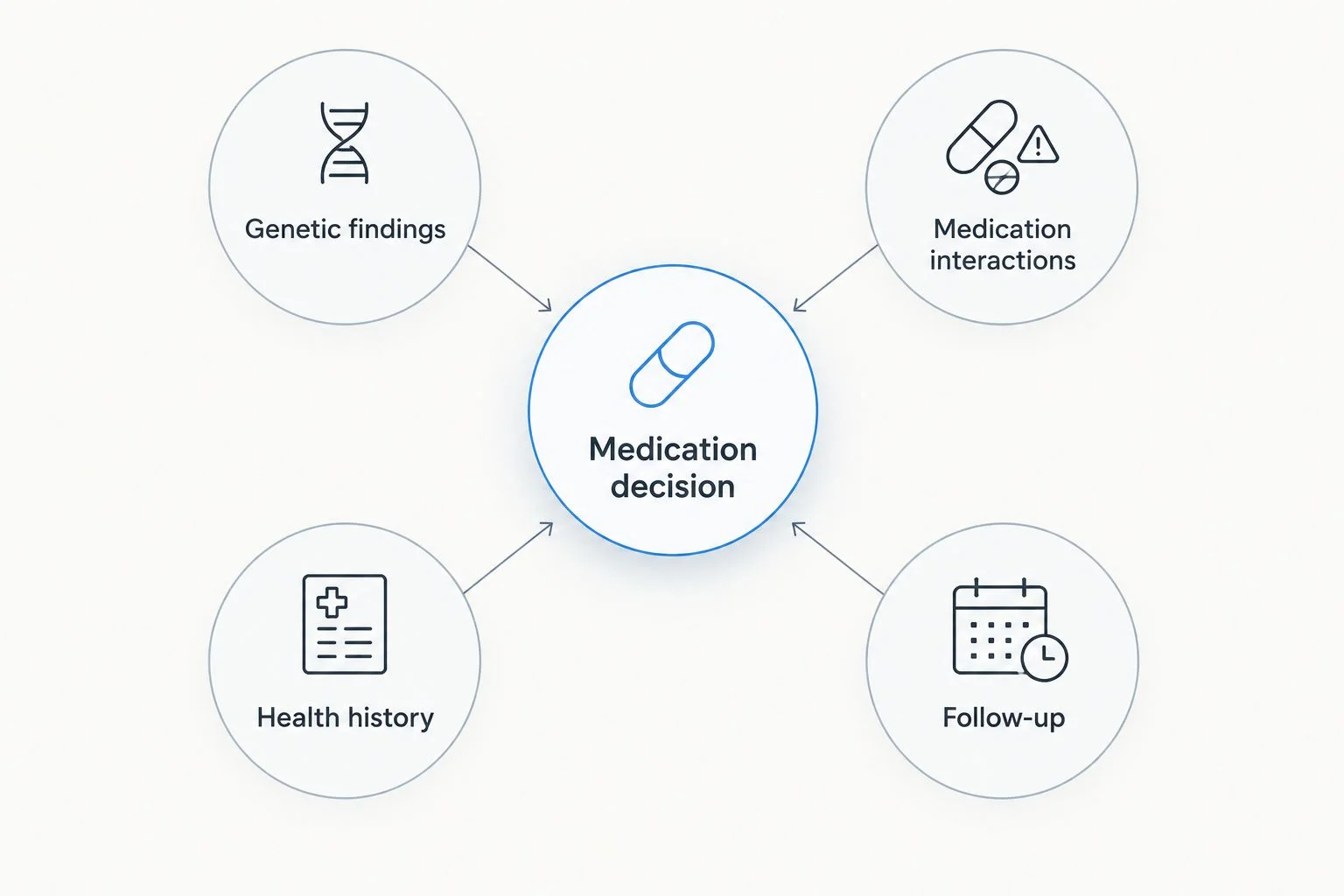
A genetic result is one part of a medication decision, not the entire decision.
Do not stop, start, or change a prescribed medicine based on a report alone. The safe next step remains a conversation with the clinician responsible for that prescription.
How to choose your next step in Ohio
Start with the medication question
Write down what you want to understand: a troublesome side effect, repeated difficulty tolerating treatment, or a decision between appropriate medicines. Include medication names and what happened when you took them. This is more useful than requesting the largest panel.
Ask what would change
Have your clinician describe the treatment decision before ordering testing. If different possible results would lead to the same plan, ask what benefit testing would add.
Confirm interpretation
Identify the person who will explain the result and whether they will use established prescribing guidance. Ask how the report will be shared with other clinicians involved in your care.
Plan follow-up
Agree on what happens after the result arrives. That includes discussing the findings, deciding whether a change is appropriate, and monitoring any treatment adjustment.
For Ohio readers seeking mental health treatment, SOS Wellness offers psychiatry, medication management and pharmacogenetic testing. Ask which test is available, whether it addresses your medication question, who will interpret the results and what coverage or costs apply.
Discuss your medication care
Explore Ohio psychiatric care and medication management, then ask whether testing fits your treatment plan.
How to use this decision guide
The options illustrate different roles: psychiatric report discussion, laboratory testing and specialist assessment. Their order does not indicate superiority, and this guide does not establish comparative accuracy, treatment outcomes or service quality.
Use medication relevance, actionable guidance, clinical interpretation, consent and follow-up responsibility to assess a testing pathway with your clinician. Confirm the exact service and access requirements with each organization.
Which pharmacogenetic testing option should you choose?
Discuss your medication question with your prescribing clinician before selecting a test or service. Compare relevant drug–gene coverage, actionable guidance, interpretation, access and costs. The options described here are examples, not ranked or mutually exclusive pathways.
If your immediate need is psychiatric care rather than a genetic report, SOS Wellness is an Ohio care option. Keep the distinction clear: choosing treatment support and choosing a laboratory are separate decisions.
Bring any existing pharmacogenetic report to the appointment. Your inherited genetic findings generally remain stable, but their interpretation and the medicines you take can change. Ask whether reviewing an existing result is more appropriate than repeating testing.
FAQ
How do I assess whether a pharmacogenetic test fits my psychiatric medication question?
Ask your prescriber whether the test covers a relevant drug–gene relationship and whether a finding could change treatment. GeneSight is one psychiatric-testing option, but it does not predict which medication will work best. Interpretation, follow-up and costs also matter.
Can a pharmacogenetic test tell me which antidepressant will work?
No pharmacogenetic test can guarantee which antidepressant will work for you. Certain findings inform selected prescribing decisions, while diagnosis, previous response, interactions, and follow-up remain essential.
Is GeneSight better than testing through Mayo Clinic Laboratories?
This guide does not establish that either is better. GeneSight reports selected psychiatric drug–gene findings, while Mayo Clinic Laboratories offers pharmacogenetic laboratory testing. Compare the specific tests’ scope and relevance with your clinician rather than assuming the organizations serve entirely different needs.
Does SOS Wellness offer pharmacogenetic testing in Ohio?
Yes. SOS Wellness publishes pharmacogenetic testing among its services. Ask the team which test is available, whether it fits your treatment question, who will interpret the results and what costs or coverage requirements apply. Offering testing does not establish that it is appropriate or covered for every patient.
Should I stop a medication if my genetic report flags it?
Do not stop or change a prescribed medication based on a genetic report alone. Ask your prescriber to interpret the finding alongside your response, other medicines, and medical history.
Do I need to repeat a pharmacogenetic test?
Repeating testing is not automatically necessary because inherited genetic findings generally remain stable. Your clinician should review the original test scope and whether updated interpretation or additional testing answers a new question.
Can children have pharmacogenetic testing?
Children can have pharmacogenetic testing when a qualified clinician identifies an appropriate clinical reason. Testing does not diagnose ADHD, anxiety, or another childhood mental health condition, and pediatric prescribing needs its own assessment.
What should I do if medication problems become a crisis?
Call 911 for an immediate medical emergency or immediate danger. In the United States, call or text 988 for suicide or mental health crisis support, available 24 hours a day; do not wait for genetic testing.
One last thing
A useful test changes a decision; a detailed report does not necessarily change care. Before you provide a sample, ask who will explain the result and what treatment decision it could affect. That question is more valuable than comparing report colors or counting genes.
Further reading
- MedlinePlus: Pharmacogenetic tests
- Cleveland Clinic: Psychiatry and psychology
- GeneSight: Clinician questions and test limitations
- Mayo Clinic Laboratories: Pharmacogenomics questions
- Cleveland Clinic: Pharmacogenomics
Related reading
This article provides general educational information and does not replace an individual clinical assessment. Contact your healthcare provider about your own care.