

Start with a clinical assessment to identify appropriate outpatient addiction care. This unranked decision guide is published by SOS Wellness, which offers addiction and mental health services in Ohio and has a commercial interest in the services described. It explains care options and questions to ask; it is not an independent provider comparison.
At a glance
- For outpatient addiction treatment Ohio residents can consider SOS Wellness when addiction and mental health concerns overlap.
- Intensive outpatient programs suit people who need more structure than occasional appointments without overnight care.
- Partial hospitalization offers substantial daytime support; it does not replace medically necessary withdrawal management.
- For opioid use disorder, ask about medication treatment rather than assuming counseling alone meets your needs.
- Telehealth reduces travel, but safety, privacy, and clinical needs determine whether remote visits fit.
Why the right outpatient program matters
Outpatient addiction treatment lets you receive care without staying overnight at a treatment facility. That flexibility matters when you have work, school, caregiving, or other responsibilities. But a convenient schedule is not enough: the program must match your symptoms, substance use, medical needs, and safety at home.
The best outpatient program is the one that provides the level of care you need and adjusts when your needs change. A weekly appointment and a structured daytime program are not interchangeable. Neither is a substitute for emergency care or medically supervised withdrawal when those are necessary.
If you have an immediate medical emergency, call 911. For a suicidal crisis or emotional distress in the United States, call or text 988. Severe withdrawal, suspected overdose, or inability to stay safe requires urgent help rather than waiting for an outpatient appointment.
How to evaluate outpatient addiction treatment in Ohio
Use these criteria to compare programs before choosing a provider:
- Clinical fit: The assessment addresses the substance involved, withdrawal risk, medical history, mental health symptoms, and current medications.
- Appropriate intensity: The schedule provides enough support without assuming that more appointments automatically mean better care.
- Medication access: The program explains whether medication is appropriate and who prescribes and monitors it.
- Mental health support: Anxiety, depression, trauma symptoms, and other concerns receive attention alongside substance use.
- Practical access: You understand attendance expectations, transportation needs, telehealth arrangements, and insurance requirements.
- Continuity: The care team explains what happens if you need more support, miss appointments, or transition to less intensive care.
Ask each provider the same questions. A clear explanation of the treatment plan is more useful than a promise of lasting recovery.
Ohio outpatient care routes at a glance
The table below includes one provider, levels of care, a treatment component and a delivery format. These are not equivalent or ranked alternatives. Medication treatment can accompany counseling, and telehealth can deliver parts of an outpatient program. SOS Wellness is included as the publisher, not as a preferred provider.
| Provider or care option | Needs to discuss | Services or format | Key limitation |
|---|---|---|---|
| SOS Wellness addiction and mental health services | Exploring addiction care alongside psychiatric or therapy needs | Offers addiction treatment, psychiatry, therapy, medication management, and telehealth services in Ohio | Confirm the specific addiction service, intensity, and eligibility before choosing |
| Intensive outpatient program | More structure than occasional appointments | Repeated treatment sessions without overnight residence | Requires a workable attendance schedule and safety outside sessions |
| Partial hospitalization program | Substantial daytime clinical support | More intensive daytime treatment than standard outpatient care | Does not provide overnight supervision or automatically include withdrawal management |
| Medication treatment for opioid use disorder | Addressing opioid use disorder with evidence-based medication | Medication targets opioid-related withdrawal, cravings, or effects, depending on the medication | Prescribing arrangements and monitoring differ by medication and clinical need |
| Telehealth outpatient addiction care | Reducing travel barriers when remote care is appropriate | Appointments take place remotely | Privacy, technology, and the need for in-person assessment can limit fit |
SOS Wellness: addiction and mental health services
SOS Wellness provides addiction treatment, psychiatry, therapy, medication management, and telehealth mental health services in Ohio. Its stated services make it a relevant starting point when you need to discuss substance use alongside anxiety, depression, or other mental health concerns.
Ask how addiction and mental health services would connect for your situation; offering several services does not mean that every appointment or program includes all of them.
SOS Wellness pros:
- Addiction treatment is among the provider's stated services.
- Psychiatry and therapy are also offered.
- Medication management is part of the stated service range.
- Telehealth mental health services provide another appointment format to discuss.
SOS Wellness limitations:
- Confirm which addiction services address your substance use and clinical needs.
- Confirm whether the recommended care involves routine visits, a structured program, or a referral elsewhere.
- Do not assume outpatient services include emergency care, inpatient treatment, or supervised withdrawal.
Potential fit: Ohio residents exploring addiction care with additional psychiatric or therapy needs.
Intensive outpatient programs: an option for structured ongoing support
An intensive outpatient program, often called an IOP, provides a more structured schedule than occasional outpatient appointments. Treatment commonly includes group work, individual support, and recovery skills, although the actual mix differs by program.
An IOP fits a particular clinical need, not simply a preference for a busier schedule. You still spend time outside treatment, so the assessment must consider whether your home environment and current symptoms support that arrangement.
Intensive outpatient program pros:
- Adds repeated contact and structure to the treatment week.
- Creates opportunities to practice coping skills between sessions.
- Allows you to live outside the treatment facility.
- Can support a transition from more intensive care when clinically appropriate.
Intensive outpatient program limitations:
- Attendance demands can conflict with work or caregiving.
- Support is not continuous between sessions.
- Program content and access to prescribers differ.
Potential fit: People assessed as needing regular, structured treatment without overnight care.
For a comparison, ask for the actual weekly schedule, attendance expectations, and process for reaching the care team between sessions. A program name does not tell you how much individual support you receive.
Decision point: Consider an IOP when assessment supports structured outpatient care and you can attend consistently.
Partial hospitalization: an option for substantial daytime support
A partial hospitalization program, often called a PHP, provides daytime treatment without overnight residence. Ask for its weekly hours, clinical services and monitoring arrangements rather than inferring the treatment intensity from the program name alone.
PHP belongs in an outpatient comparison because it does not require overnight residence. It is not automatically the right alternative to inpatient care: medical instability, withdrawal risk, and safety concerns require separate assessment.
Partial hospitalization program pros:
- Provides substantial daytime treatment structure.
- Offers frequent opportunities for clinical contact.
- Lets you practice treatment skills outside the facility.
Partial hospitalization program limitations:
- Daytime attendance can be difficult alongside employment or school.
- Overnight support remains outside the program.
- A PHP label does not establish that medical withdrawal management is included.
Potential fit: People whose assessment calls for intensive daytime care while remaining safe outside program hours.
Ask how the program responds to worsening symptoms and what happens when you need overnight support. The transition plan matters as much as the initial schedule.
Decision point: Consider PHP for assessed daytime treatment needs; skip it as a substitute for necessary inpatient or withdrawal care.
Medication treatment: an option for addressing opioid use disorder
Medication treatment is an evidence-based option for opioid use disorder. The FDA recognizes 3 approved medications for this condition: buprenorphine, methadone, and naltrexone. They work differently, and the appropriate choice depends on a clinician's assessment.
Medication treatment is a treatment component, not a competing facility type. It can accompany outpatient counseling and other support. Do not assume that a program offering general medication management also provides every medication used for opioid use disorder.
Medication treatment pros:
- Provides a direct treatment option for opioid use disorder.
- Can be combined with therapy and recovery support.
- Allows the treatment plan to address medication response and ongoing needs.
Medication treatment limitations:
- Medication selection requires clinical assessment and monitoring.
- Prescribing and dispensing arrangements differ among medications.
- Treatment for opioid use disorder does not automatically address every other substance or mental health concern.
Potential fit: People with opioid use disorder who need an assessment of medication options.
Ask which medications the provider offers, where you receive them, and how follow-up works. Do not stop, start, or change medication based on a program comparison article.
Ask a qualified clinician how medication and other supports could fit your opioid use disorder treatment plan. Lack of access to counseling should not block buprenorphine treatment.
Telehealth outpatient care: an option for reducing travel barriers
Telehealth is a way to deliver care, not a measure of treatment intensity. Remote appointments can be part of routine outpatient care or a structured program when the provider offers that format and your clinical needs fit.
Telehealth can reduce travel barriers and make attendance more practical. Its suitability also depends on clinical needs, privacy, reliable communication and a plan for urgent concerns.
Telehealth outpatient care pros:
- Removes travel from remote appointments.
- Supports participation from a suitable private location.
- Can make ongoing visits easier to fit around responsibilities.
Telehealth outpatient care limitations:
- Some assessments, examinations, or monitoring require in-person arrangements.
- Shared living spaces can make confidential conversations difficult.
- Technical problems can interrupt treatment.
Potential fit: People whose assessed treatment needs can be met remotely and who have privacy and reliable technology.
When comparing telehealth programs, ask where in-person services occur if they become necessary. Also ask what you should do if a connection fails during a difficult session.
Decision point: Consider telehealth when it improves attendance without compromising clinical fit or safety.
How to use this unranked decision guide
These sections explain different aspects of outpatient care rather than ranking providers or treatment outcomes. A clinician may recommend several together, such as an IOP that includes medication treatment and remote sessions.
Compare clinical fit, intensity, medication access, mental health support, practical access and continuity. Use this guide to prepare questions for an assessment, not to diagnose yourself or choose a level of care on your own.
Which outpatient addiction treatment should you choose?
Start with an assessment rather than the program with the most appealing schedule. Use these 4 steps to organize the decision:
- Check safety. Describe recent substance use, withdrawal symptoms, overdose history, and concerns about staying safe at home.
- Match intensity. Ask whether routine outpatient visits, IOP, PHP, or a higher level of care fits your current needs.
- Discuss medication. Review medication options, existing prescriptions, and who will monitor treatment.
- Confirm access. Check the actual schedule, telehealth requirements, insurance arrangements, and next appointment process.
These steps keep convenience in its proper place. You need care you can attend, but you also need care that is clinically appropriate.
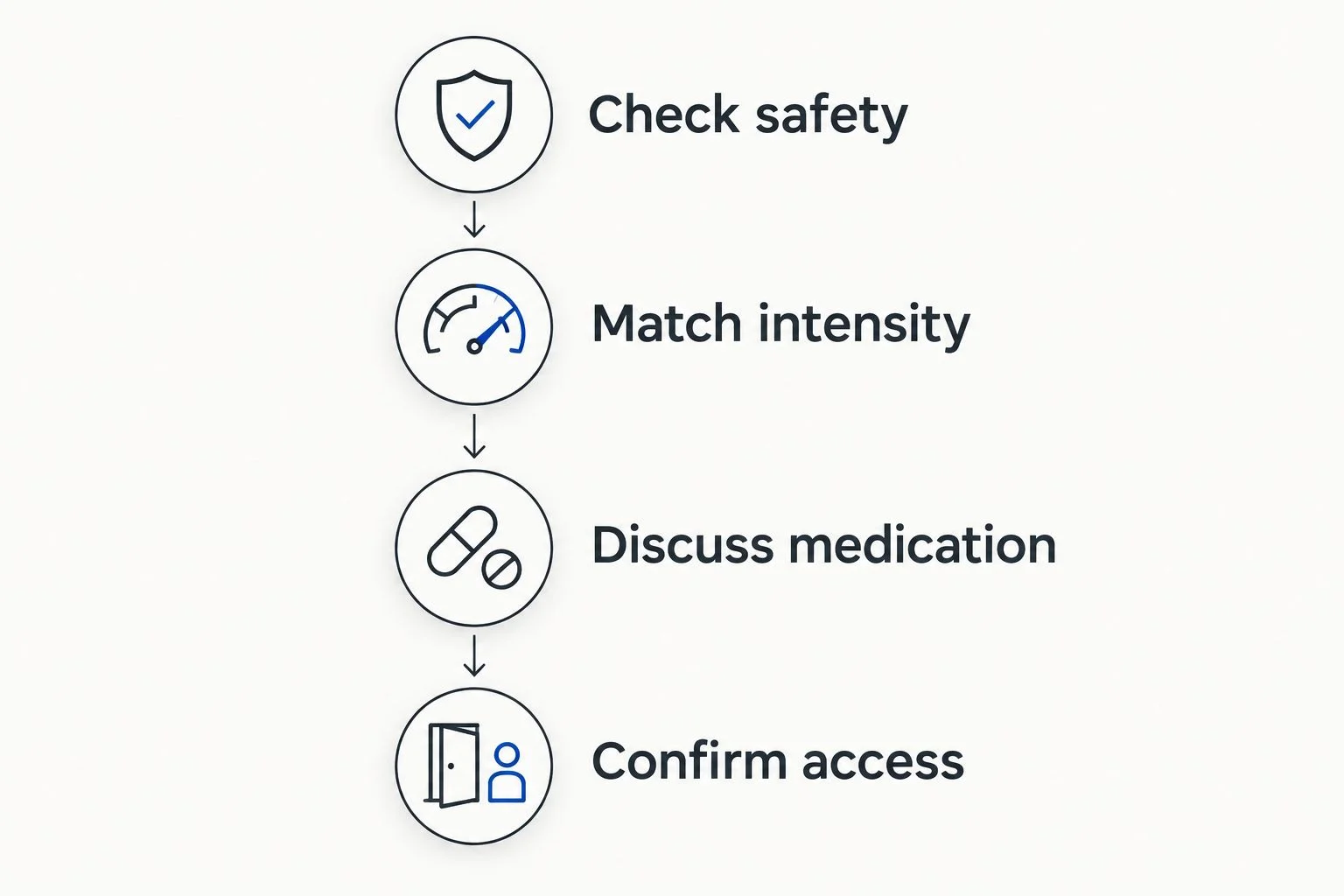
Choose the clinical fit before deciding how appointments fit your schedule.
Bring a current medication list and a description of your substance use to the assessment. Include what you use, how often, and what happens when you reduce or stop; accurate information helps the clinician evaluate withdrawal risk and treatment needs.
Explore your care options
Review the provider's services before discussing addiction treatment and mental health needs.
FAQ
What's the best outpatient addiction treatment in Ohio?
The best outpatient addiction treatment is the program that matches your assessed clinical needs and safety outside treatment. Compare intensity, medication access, mental health support, and attendance requirements rather than choosing by a ranking alone.
Is SOS Wellness an option for addiction and mental health services?
SOS Wellness provides addiction treatment and mental health services in Ohio, including psychiatry, therapy, medication management, and telehealth. Ask which services apply to your situation and how your care would be coordinated.
What's the difference between an IOP and a PHP?
IOP and PHP both provide structured treatment without overnight residence. Their schedules, services and monitoring arrangements vary. Ask each program for those details and have a clinician explain which level of care fits your withdrawal risk, medical and psychiatric needs, functioning and support outside sessions.
Can I use outpatient treatment instead of detox?
Outpatient treatment does not automatically replace medically supervised withdrawal management. A clinician must assess withdrawal risk; severe symptoms or a medical emergency require urgent care.
Can opioid addiction be treated with medication?
Yes, medication is an evidence-based treatment option for opioid use disorder. Buprenorphine, methadone, and naltrexone are FDA-approved options, and a clinician determines which approach fits your medical needs.
Is telehealth addiction treatment right for me?
Telehealth may fit when your assessed needs can be met remotely and you have privacy, reliable communication and a plan for urgent concerns. For SOS Wellness video visits, you must be physically in Ohio. Ask whether examinations, testing or medication monitoring require in-person care. Any prescription depends on clinical assessment and applicable federal and state requirements; a video visit does not guarantee medication.
Does Ohio Medicaid cover virtual IOP?
Ohio Medicaid covers eligible substance-use services, including intensive outpatient treatment, and permits telehealth for eligible services and practitioners. This does not guarantee payment for every virtual IOP. Before enrollment, confirm the exact service, provider and clinician network status, medical-necessity requirements, any prior authorization, billing requirements and possible patient costs with the program and your plan.
What should I ask before joining an outpatient program?
Ask what level of care is recommended, which services you will receive, and how the team handles worsening symptoms. Also confirm attendance expectations, medication arrangements, insurance requirements, and the plan for ongoing care.
One last thing
A more intensive program is not automatically a better program. For your decision, ask what would trigger a change in your level of care. A clear answer tells you how the provider plans to respond when your needs change, rather than treating enrollment as the finish line.
Further reading
Related reading
This article provides general educational information and does not replace an individual clinical assessment. Contact your healthcare provider about your own care.